THE ONLY DAUGHTER – The story of Dushala

~Tanushree Wadodkar
I have always loved reading about mythology. But not in the way you might think. I don’t read about Shri Ram or Shri Krishna. No. I like to read about the ones that are not talked about. The background characters. The overlooked ones. Which is why I have always loved books like Sita’s Sister or Karna’s Wife. And recently, I came across another such book – Dushala.
In a story shaped by power, politics, and conflict, one name stands apart. The Mahabharata is remembered for its heroes and villains, for its good and evil, for its dharma and adharma. And yet, not every life in this epic was lived with a weapon in hand. Some lives were lived in silence, in waiting, and in loss.
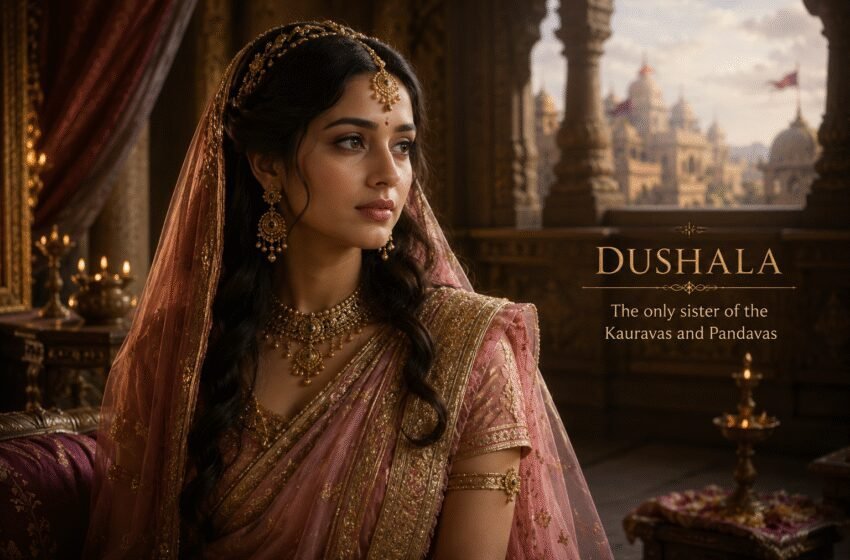
Among these forgotten figures stands Dushala, the only daughter of Dhritarashtra and Gandhari, and the sister to a hundred brothers. Her story is not of conquests or fights. It is one of witnessing, of belonging to a world she did not quite fit in, and of enduring a war where both sides were her own.
The Only Sister
Dushala was born into one of the most powerful families of that time. She was surrounded by brothers who would one day become central to one of the greatest wars in mythology. While the world remembered names like Duryodhan, Dushala somewhat faded into the noise.
As the only sister, she would have been loved, perhaps even protected. But she was also a silent observer in a world that revolved around male ambition and political rivalry. The palace of Hastinapur was not merely a home. It was a place where rivalries were sharpened, and destinies were shaped. In a family preparing, knowingly or not, for war, her place was certain but, at times, forgotten.
Marriage
Like many marriages of that time, Dushala’s marriage to Jayadratha was also more of a royal alliance. It was a decision that linked kingdoms and strengthened political ties. For Dushala, it meant leaving behind the only home she had ever known, despite having no say in it. Dushala’s identity became tied to her role as a queen in Sindhu, and as a wife to a husband whose actions would later draw him into the very conflict that forms the base of her story.
Jayadratha’s actions only add more complexities to her already entangled life. His attempt to abduct Draupadi places him firmly within the moral tensions of the epic. For Dushala, this must have been a complicated reality. How could she be loyal and devoted to a husband who tries to violate her sister-in-law? She must have felt trapped in the middle. On one side was her duty to her husband, and on the other side her brothers, the Pandavas. When he attempted to kidnap Draupadi, the Pandavas were ready to kill him. But, they did not want their dear sister to live as a widow, so they shaved his head to humiliate him.
The Kurukshetra War
The part that pains me the most about her story is the impossible position she stood in during the Mahabharata War. Both sides of the war were her own. The Pandavas were just as much as her family as the Kauravas.
When the war began, it brought with it a scale of destruction and pain and loss that no one could fully contain. Every victory came with loss, and every loss struck close to home. Every news of death did not come merely as a report on the war, but as another blow to her life.
One by one, her brothers fell. The very men who had shaped her childhood, who had filled the halls of Hastinapura with noise and presence, were gone. Even Duryodhan and Dushasana, her eldest brothers, were defeated. Their death wasn’t just the end of their political ambitions, but also the end of the family she had grown up with.
Her husband, Jayadratha, had sided with the Kauravas during the war. He was killed by Arjuna as a result of Abhimanyu’s (his son) tragic death. In a span of just a few days, she lost both the family she was born into and the family she married into.
For others, the war would be seen in terms of victory and defeat. For Dushala, it was all about loss. The people who had defined her life were no longer there.
The Aftermath
The aftermath of the war was especially brutal for Dushala, who had lost her husband as well as her brothers. The Pandavas won, and Yudhisthir was crowned King of Hastinapur. Dushala returned to Sindhu (her husband’s kingdom) as a widow.
During the Pandavas’ Ashvamedha Yagya, Arjuna came to the Sindhu Kingdom. Dushala’s son, Suratha, who was ruling Sindhu, died of shock or fear upon hearing of the Pandavas’ arrival in his kingdom. And just like that, Dushala also lost her son.
Desperate and heartbroken, she approaches Arjuna with her infant grandson in her arms. She pleads for the safety of her kingdom and her lineage. Arjuna, who loved his sister, accepted her plea. He empathised with the tragedy of her life and crowned her grandson as the ruler of Sindhu. This allowed her to rule as a guardian until he grew up.
What stood out to me the most about Dushala is her silence. Unlike Draupadi, whose voice challenges and questions the injustice done to her, or Kunti, whose decisions influence the course of events, Dushala remains largely silent. Her thoughts, feelings, and struggles are not recorded in much detail. Her story reflects how certain lives are recorded in such epics. Some are given space to speak and express. Others are remembered only in relation to those around them.
Battles are shaped by kings, warriors, and princes. But their consequences extend far beyond the battlefield. Women like Dushala have to live through the aftermath of the destruction. They have to carry the pain of loss, and still try to move forward in a world that is forever changed.
Dushala has always held a special place in my heart. She reminds me that epics are not just about those who act, but also about the ones who endure. She did not fight the war that defined and changed her life. She survived it, and in that survival lies a quiet, often overlooked strength that cannot be fully described in words.