THE PRINCE WHO REJECTED LUXURIES – The history of Gautam Buddha and Buddhism

~Tanushree Wadodkar
Among the many philosophical and spiritual religions that emerged in ancient India, Buddhism is one of the most influential. It began as a journey of one man seeking answers and became a religion that spread to several parts of the world. Buddhism focused on personal conduct, compassion, self-awareness, and the search for enlightenment, rather than elaborate rituals and social hierarchies.
At the centre of Buddhism stands Gautama Buddha, a figure remembered not as a God but as a teacher who sought to understand the nature of human suffering. Born as a prince, Buddha left behind all worldly pleasures and went out to search for the true meaning of life.
Over time, Buddhism spread from India to neighbouring countries and became one of the world’s major religions. It spread to countries like China, Japan, Sri Lanka, and many more. Universities (Like Nalanda), monasteries, stupas, and scriptures have helped preserve Buddhism.
Siddhartha Gautama
Gautam Buddha was born as Siddhartha Gautama around the 6th century BCE in Lumbini (Nepal). He belonged to the Shakya clan, and his father, Suddhodana, was a ruler of that region. According to Buddhist tradition, at the time of Buddha’s birth, astrologers predicted he would either become a great king or a spiritual teacher.
His father, wanting his son to be a king, shielded him from the outside world. Siddhartha spent much of his early life inside the palace, surrounded by luxury and protected from the harsher realities that existed beyond the palace walls. At the age of 16, he married Yashodhara and had a son named Rahul.
During his journey outside the palace, Buddha saw four sights that changed his perspective of the world and became the turning point in his life. He encountered an old man, a sick man, a funeral procession, and finally a wandering ascetic who seemed to be at peace.
For the first time in his life, he understood that suffering was unavoidable and universal. At the age of twenty-nine, he left behind royal life, his family, and worldly comforts in search of truth and understanding.
The Search for Enlightenment
After leaving the palace, Siddhartha spent years travelling and learning from spiritual teachers. He eventually rejected the idea of severe penance and developed the concept of the “Middle Path”, the path between complete indulgence and severe asceticism.
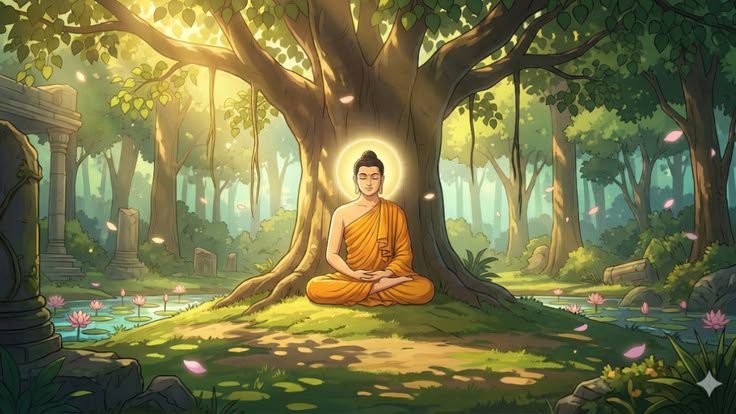
According to Buddhist tradition, Siddhartha then sat beneath the Bodhi tree at Bodh Gaya and entered deep meditation. He resolved not to leave until he attained the truth he had been seeking. After a prolonged period of 49 days, he attained enlightenment and became the Buddha, meaning “the awakened one.”
Teachings of Buddha
After attaining enlightenment, Buddha travelled to teach others. His first sermon was at Sarnath. The Buddha’s teachings focused on understanding suffering and finding a path beyond it. The teachings of Buddha focused on ethical living, self-discipline, and awareness.
The Four Noble Truths
The Four Noble Truths form the foundation of Buddhist thought.
- Life involves suffering (Dukkha)
- Cause of suffering (Samudaya)
- End of suffering (Nirodha)
- Way to end suffering (Magga: the eight-fold path)
The eight-fold marg
The Eightfold Path serves as a guide for ethical and spiritual living. It encourages balance in thought, behaviour, and awareness.
The eight principles are:
- Right View
- Right Thought
- Right Speech
- Right Conduct
- Right Livelihood
- Right Effort
- Right Mindfulness
- Right Meditation
Through the four noble truths and the eight-fold path, the idea of moderation became central to Buddhism. Buddha rejected both extreme luxury and severe asceticism, opting for a middle path.
Spread of Buddhism
After attaining enlightenment, Buddha travelled across India to teach and gained followers from different social backgrounds. His first sermon was at Sarnath. Buddha delivered his message in Prakrit, which was spoken by the common people. This made Buddhism accessible to everyone. The simplicity of the doctrine and Buddha’s own personality also contributed to its popularity. The Buddhist community began organising itself in monasteries and monastic communities. Merchants, farmers, kings, and even women were allowed to be a part of it. Once in the Sangha, everyone was equal, and the social classifications of the varna system no longer existed.
Buddhism gradually spread beyond India into many parts of Asia. Trade routes, travelling monks, royal patronage, and missionary activity all contributed to its expansion. Ashoka played an important role in the spread of Buddhism. Ashoka embraced Buddhism and promoted its teachings throughout his empire. He built stupas and monasteries and sent Buddhist missionaries to regions outside India, including Sri Lanka.
Universities, like Nalanda, became centres of learning that attracted scholars from various countries. They also helped spread the teachings of Buddha across neighbouring countries.
Although Buddhism declined in India after the first millennium CE, it continued to flourish in other parts of the world.
The Death of Buddha
Gautama Buddha died at the age of 80 in Kushinagara. His death is referred to as Mahaparinirvana in Buddhist traditions, which means freedom from the cycle of birth and rebirth.
After his death, his followers preserved his teachings through oral tradition. His relics were distributed and placed within stupas, which later became important centers of Buddhist worship and pilgrimage.
The Buddhist Councils
After the death of Buddha, four Buddhist councils were organised across different years to discuss and preserve Buddha’s teachings.
The first Buddhist Council was held in Rajgir (after Buddha’s death: 483 BCE), the second in Vaishali (383BCE), the third in Patliputra (250 BCE), and the fourth in Kundalavana (7C CE).
Over time, disagreements contributed to the development of different Buddhist traditions, including Theravada and Mahayana Buddhism. Other Buddhist schools like Hinayana, Vajrayana, and Zen also developed.
Buddhism, today, is a major religion in countries like Myanmar, Bhutan, Sri Lanka, and Thailand. However, it began simply as a man’s search for the truth of life and suffering. The teachings of Buddha encouraged people to look within themselves, rather than rely on extensive rituals. He believed in simplicity, and ethical and spiritual living.
Over centuries, Buddhism has continued to shape societies and culture through education, art, architecture, and philosophy.