The Lost Colony of Roanoke: The Mystery of America’s Vanished Settlers

-Devashree Kulkarni
History is full of stories some are completely known while few are mystery till date. One of such mystery of American history is the story of the Lost Colony of Roanoke. In 1587, approximately 115 English settlers arrived on Roanoke Island, present-day North Carolina, hoping to establish a permanent colony in the New World.
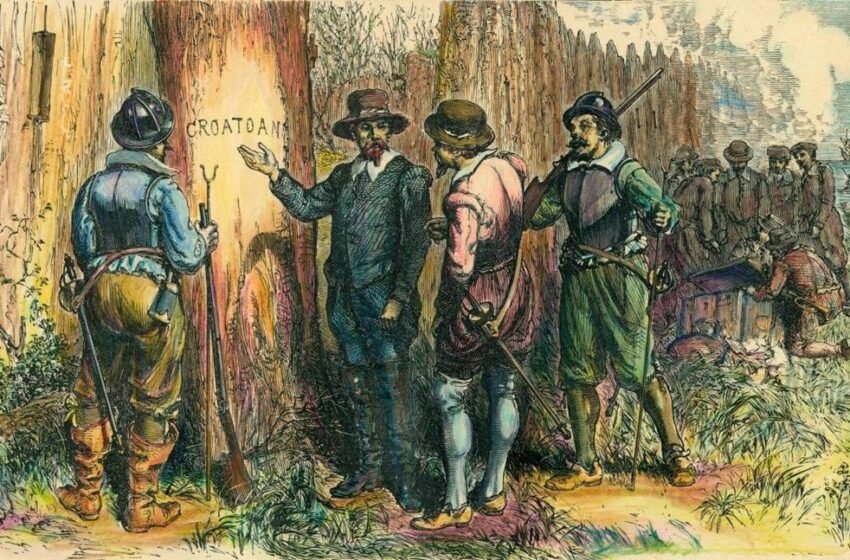
They arrived at the island with their families, essentials and dreams of a better future. But, within just a few years, the entire settlement disappeared without a trace, no bodies were found and the only clue left behind was the word ‘CROATOAN’ carved into a wooden post. Even today almost after four centuries later, Roanoke settlers remains unknown, continuing to fascinate historians and mystery enthusiasts around the world.
England’s Race to Colonize the New World:
To understand this mystery it is important to look back at those times when this all happened. European countries were competing to expand their power throughout the world and establishing colonies. As spain was already succeeded in establishing colonies in America and expanding its power.
England wanted to establish its own settlements in North America to challenge the dominance of Spain. Sir Walter Raleigh led efforts to create a permanent colony. His multiple attempt failed due to harsh environment and limited resources. Later Roanoke Island was selected for the settlement.
The Arrival of the Settlers:
In 1587, around 115 English settlers arrived on Roanoke Island under the leadership of Governor John White, this group included women and children with the intension of permanent settlement. The colonists hoped for new life there.
But they faced difficulties as life on Roanoke was never easy, food supplies were limited, the environment was unfamiliar and relations with some local Indigenous groups were tense. As conditions worsened, the settlers asked John White to return to England for supplies. Although he was reluctant to leave his daughter Eleanor Dare and granddaughter Virginia Dare the first English child born in North America behind but he agreed expecting to return within a few months.
A Return Delayed by War:
Unfortunately White was unable to leave England as it was facing the growing threat of invasion from Spain. Due to this crisis, he was unable to secure a ship capable of returning back to Roanoke. What should have been a short journey turned into a delay lasting nearly three years.
For White, the wait was agonizing. He knew the settlers depended on supplies from England. Every passing month increased the risk that the colony might face starvation, disease or conflict.
Finally, in 1590, he secured passage back to Roanoke and set sail across the Atlantic.
He had no idea what awaited him.
The Shocking Discovery:
White arrived at Roanoke Island in August 1590. He was expecting to experience struggling people for survival but there was just silence on the island.
The colony was deserted.
The houses stood empty. There were no signs of life. No voices echoed through the settlement. No welcoming party greeted the returning governor. Instead, many structures appeared to have been carefully dismantled, suggesting that the settlers had left deliberately.
Then White discovered a clue.
Carved into a wooden post was the word “CROATOAN.”
Nearby, the letters “CRO” had been carved into a tree.
Before departing for England, White and the colonists had agreed on a system of messages. If the settlers were forced to relocate, they would leave behind information indicating their destination. If they left under danger or attack, they would carve a Maltese cross as a distress signal.
No cross was present.
This suggested that the settlers had not been under immediate threat when they departed.
But where had they gone?
The Croatoan Theory:
A Native American group, Croatoan people who lived on an island south of Roanoke now known as Hatteras Island. They generally maintained friendly relations with the English settlers. Historians believe the colonists may have relocated to Croatoan territory for safety.
Excavations on Hatteras Island have uncovered English artifacts dating to the late sixteenth century which included pottery fragments, tools and other objects associated with the settlers.
Historians suggest that the colonists gradually integrated into Indigenous communities through trade, cooperation and intermarriage. This theory could be possible but there is no strong evidence to prove it.
Other supporting theories:
One popular theory suggests that the settlers moved inland in search of better farmland and resources. The English artifacts were discovered in inland areas of North Carolina support the possibility that at least some colonists relocated. Another theory suggests that disease, starvation and harsh environmental conditions gradually weakened the settlement forcing survivors to disperse and join other communities for survival.
Some historians also believe the colony may have been attacked by hostile groups whiolw the another speculation was Spanish forces secretly destroyed it as they look at these colonies as threat. Still there’s no single theory has been able to fully solve this mystery.
Modern Investigations:
Archaeologists have spent decades examining Roanoke Island and surrounding regions. The research for unknown mystery. Researchers analyzed the artifacts, maps and excavation sites carefully to get any hint for this research.
One clue appeared from a map created by John White which was hidden under the patch. It was a symbol indicating a possible fortification site inland from Roanoke. Many researchers predicted it as an alternate place for settlers for the safety purpose.
Investigation in that particular region have uncovered European artifacts that may date to the Roanoke period. Still there was no conclusive proof for settlers fate.
Why the Mystery Endures:
The great mystery of the Lost Colony of Roanoke continues to captivate public because it is based on real historical events with an unknown ending. As per the records it was confirmed that settlers arrived on Roanoke Island and that Governor John White returned three years later to find the colony abandoned leaving behind only the word ‘CROATOAN’ as a clue. The settlers truth remained unknown where they disappear. Even after more than four centuries later, the disappearance of colonists remains one of the greatest unsolved mysteries in American history which is still atopic for research, debate and fascination.