DADABHAI NAOROJI – THE GRAND OLD MAN OF INDIA

-Tanushree Wadodkar
The story of India’s struggle for independence is often associated with mass movements, protests, satyagraha, and revolution. Naturally, we tend to think of names like Mahatma Gandhi, Bhagat Singh, Mangal Pandey, and Jawaharlal Nehru. However, long before these movements took shape, some individuals were working towards exposing the realities of British rule, not through revolt or protests, but through reasoned argument, research, and political advocacy. Among these individuals was Dadabhai Naoroji.
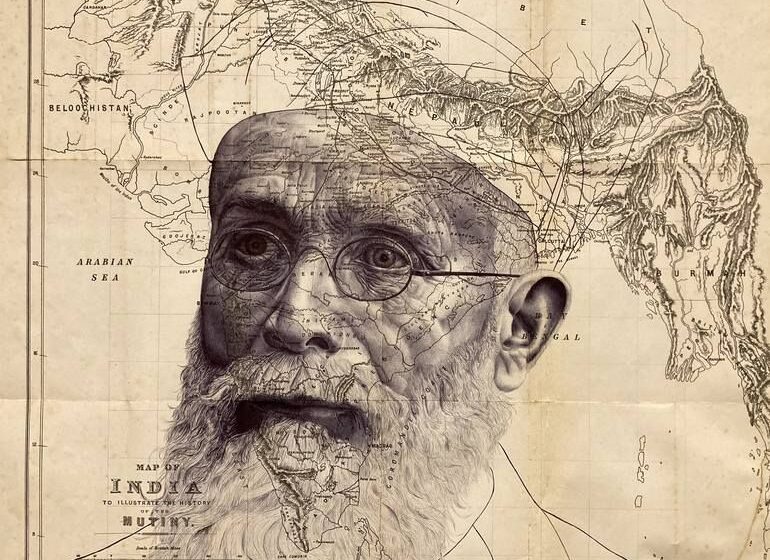
Known as the “Grand old man of India”, Dadabhai Naoroji was one of the earliest people to transform Indian nationalism into an organised movement. He was a scholar, teacher, businessman, social reformer, and political leader. At a time when most Indians believed that British rule would transform India and bring prosperity to the country, Naoroji exposed a different truth. He argued that India was becoming poorer because its wealth was being systematically transferred to Britain. The economic policies were also designed to benefit the colonial interests.
His ideas and studies laid the intellectual foundations for the national movements. He challenged the colonial exploitative policies through his speeches and studies, and changed the perspective of Indians towards British rule. Moreover, he also inspired an entire generation of freedom fighters who would later carry the movement forward.
Early Life
Dadabhai Naoroji was born on 4 September 1825 in Bombay (Mumbai)in a Parsi family. His father died when he was still young, and much of his upbringing was shaped by his mother, Manekbai, who ensured that her son received a good education.
Dadabhai was an exceptional student and even attended the Elphinstone Institution, which was one of the most prestigious educational institutions in India. His academic record and achievements earned him widespread recognition, and he soon became one of the first Indians to be appointed a professor at Elphinstone College. And this happened during a period when senior academic positions were largely reserved for Europeans. Naoroji’s appointment as a professor reflected not only his capabilities but also the emergence of an educated middle class.
Social Reformer
Before becoming a prominent political figure, Naoroji was actively involved in social reform. He believed that progress required improvements not only in governance but also within society itself.
In 1849, he established (along with other students) the first network of six free schools for girls in Bombay at the age of 24. As a professor at the Elphinstone Institution, he advocated for women’s education. He taught special classes set up to spread literacy and education among women.
As a member of the Parsi Community, he co-founded the Rahnumai Mazdayasan Sabha in 1851 to modernise and reform the Zoroastrian religious and social practices. He launched the Gujarati-language newspaper Rast Goftar (Truth Teller) to educate people and advocate for social reform.
Political Career
As British control over India expanded, Naoroji became increasingly interested in political issues. He initially pursued constitutional methods instead of mass protests.
As one of the founding fathers of the Indian National Congress and its three-time president, he advocated for swaraj.
In 1866, he founded the East India Association in London. The organisation aimed to educate British citizens and lawmakers about conditions in India. It served as a critical predecessor organisation to the Indian National Congress.
He served as a minister to the Maharaja of Baroda in 1874, where he attempted to improve the governance and conditions within the state.
Naoroji was a key founding member of the INC in 1885. He served as INC’s President three times: 1886 (Calcutta), 1893 (Lahore), and 1906 (Calcutta). At the 1906 session in Calcutta, Naoroji openly advocated “Swaraj,” or self-government, as the goal of the Indian people.
Naoroji achieved another historic milestone in 1892 when he was elected to the British House of Commons. Representing the Liberal Party, he became the first Indian to serve as a Member of Parliament in Britain. During his time at the Parliament, he spoke about the economic exploitation of India and the need for Indian participation in governance.
The Drain Theory
One of the most significant contributions of Dadabhai Naoroji was the “Drain Theory” developed in 1867. He first introduced the concept in his paper, England’s Debt to India, and elaborated on it in his book, Poverty and Un-British Rule in India, in 1901.
It argued that the colonial rule was systematically siphoning India’s wealth and resources into England without any adequate economic return, causing severe poverty and preventing the country’s industrial development. Naoroji also identified several channels through which this transfer occurred.
- British officials working in India received high salaries and pensions that were often spent in Britain.
- Administrative expenses, military expenditures, and payments related to colonial governance frequently benefited British interests rather than India’s development.
- Profits earned by British companies operating in India were also transferred abroad.
The wealth was generated in India using Indian resources and workforce, but was not used for India’s development. He described this process as an “un-British” form of rule because it contradicted the principles of fairness and justice that Britain claimed to uphold.
Dadabhai Naoroji passed away on 30 June 1917 at the age of ninety-one, leaving a lasting impact on the economic and political spheres of the national movement. Through scholarship, public service, and political activism, he challenged the assumptions that justified colonial rule and gave Indians a new understanding of their country’s condition.
His Drain Theory exposed the economic realities of the colonial rule in India. His leadership within the Indian National Congress helped shape the direction of Indian nationalism. His election to the British Parliament demonstrated that Indian voices could not be excluded from political debate, especially when it concerned their own country. Whether as a teacher, social reformer, Congress leader, or member of the British Parliament, he remained focused on the same goal: securing justice and better governance for the people of India. He helped create the foundations upon which future generations of nationalists would build. For all these reasons, he is now remembered as “The Grand Old Man of India”.