THE LAST KURU PRINCESS – The story of Uttara

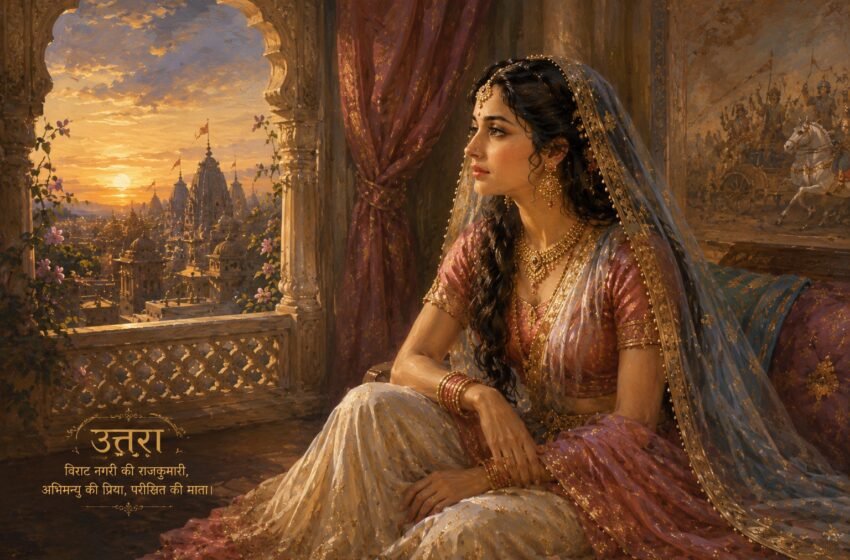
-Tanushree Wadodkar
In a vast epic like the Mahabharata, not all characters get the attention they deserve. They may not have won battles or have heroic poems written about them. But they still manage to leave a lasting impression on the readers. One of such characters, for me, was Uttara.
I came across her through Abhimanyu, the young warrior who had one of the most tragic deaths in the Mahabharata. Naturally, I was drawn to Abhimanyu’s bravery and his heartbreaking end. But then, I learned about Uttara, a young princess whose married life was engulfed by loss almost from the very beginning.
Amongst all those who suffered, her loss and pain touched me. Maybe because she went through so much in such a short span of time. She was a princess of Matsya, a beloved daughter, a young bride, a widow before she had truly begun married life, and eventually the mother of the child who would carry forward the Kuru lineage.
The Matsya Princess
Uttara was born into the royal family of the Matsya kingdom to King Virata and Queen Sudeshna.
The kingdom of Matsya becomes crucial in the Mahabharata, as this is where the Pandavas took refuge in their last year of exile. According to the rules of the exile, the Pandavas had to spend twelve years in the forest, followed by one year living in disguise. If they were discovered during that final year, the entire period of exile would have to begin again. To avoid being detected and recognised, the Pandavas entered Virata’s kingdom in different disguises.
Yudhisthir lived as Kanka, a court advisor. Bhima worked as a cook named Ballava in the palace kitchen. Nakul and Sahadev took care of the royal stable and cattle. Draupadi worked as one of Queen Sudeshna’s servants as Sairandhri. Arjun, due to a curse that had required him to spend a period of time as a eunuch, adopted the identity of Brihannala and became Uttara’s dance and music teacher. At that time, Uttara was a young princess interested in music, dance, and the arts. She had no idea that her teacher was one of the greatest warriors the world had ever known.
Uttara and Brihannala
The part of Uttara’s life I found most fascinating (and cute!) was her relationship with Brihannala. For almost a year, Arjun taught her music and dance while maintaining his disguise. He taught her with the same affection and guidance as he did with his own sons, Abhimanyu and Shrutkarma. And Uttara too deeply respected and trusted her teacher.
The disguise eventually ended when the Kauravas attacked Matsya and attempted to steal the kingdom’s cattle. Uttar, the young Matsya prince (Uttara’s brother), declared that he would defeat them. But when he saw the Kaurava army, fear overshadowed his confidence. It was Brihannala who accompanied him to the battlefield. There, Arjun revealed his true identity and raised his weapons once again. He defeated the Kaurava forces and protected the kingdom.
This revelation, that the people who had lived in their palace for the past year were none other than the Pandavas themselves, came as a shock to King Virata and his family.
Marriage to Abhimanyu
After the Pandavas revealed themselves, King Virata proposed a marriage between Arjun and Uttara. He was worried about how society would react to the fact that he had spent a year in Uttara’s chambers. However, Arjun refused the marriage proposal.
He told King Virata that he had been her teacher and therefore regarded her as a daughter. He held the same affection for her in his heart as he did for his children. Instead, he suggested a marriage between his son, Abhimanyu, and Uttara.
Abhimanyu was the son of Arjun and Subhadra, and the nephew of Krishna. He was admired throughout the Aryavarta for his bravery, skill, and noble character. Raised under the love and guidance of Krishna himself, Abhimanyu was beloved by all.
For Uttara, this marriage must have seemed like the beginning of a promising future. She was marrying one of the most accomplished young princes of her generation and was looking forward to this new chapter in her life.
The dark shadows of war
The long-standing conflict between the Pandavas and Kauravas eventually led to the Kurukshetra War. Armies gathered, alliances formed, and the subcontinent braced itself for the greatest war of its generation.
Abhimanyu entered the battlefield as one of the Pandava army’s brightest hopes. Although he was very young, he displayed remarkable courage and skill. On the thirteenth day of the war, he entered the Chakravyuha, a complex military formation. Abhimanyu knew how to enter the formation but did not know how to exit it. Nevertheless, he chose to fight.
What followed is still regarded as one of the most devastating moments of the war. Surrounded by the army and warriors from all sides, Abhimanyu fought with great determination. Eventually, he was killed on the battlefield.
When the news reached the Pandava camp, it devastated everyone. Yet, amidst all the grief, one person is often forgotten: Uttara.
She was carrying Abhimanyu’s child, the future of the Kuru Dynasty.
And she was also suddenly now a widow.
The Unbord Heir
Even after losing her husband, Uttara’s grief did not end. After the Kurus had been defeated, Ashwatthama, seeking revenge, released a powerful celestial weapon aimed at the unborn child growing within Uttara’s womb. This attack threatened the very future of the Kuru dynasty. Terrified for her child’s life, Uttara turned to Krishna for help. According to traditional accounts, Krishna intervened and saved the unborn child from destruction. The infant survived and was later born as Parikshit.
Parikshit eventually succeeded Yudhisthir to become king after the Pandavas retired from worldly life. Through him, the royal line continued.
When I see Uttara, I see love, loss, endurance, and pain. She should have had a long married life. She should have raised her son alongside her husband. Instead, she watched him die so soon after her marriage.
The Mahabharata is full of extraordinary heroes, but Uttara’s story reminds us that survival itself can be an act of courage.