Ancient Indian Education System

Long before the modern classrooms, universities and printed textbooks became common, India had already built one of the world’s oldest and most sophisticated traditions of education. In ancient times knowledge and education was not any tool to secure the job it was pursued with the aim to be able to choose a right path and get the truth, discipline, wisdom and liberation.
Ancient Indian education was deeply woven into the fabric of civilization. Kings supported scholars, temples served as centers of learning, and students traveled great distances to study subjects ranging from philosophy and medicine to astronomy, mathematics, warfare, and art. Shaped by Vedic traditions, Buddhist and Jain teachings and regional cultures, the system evolved over centuries, yet one belief remained constant knowledge was sacred and learning was considered divine.
The Vedic Period:
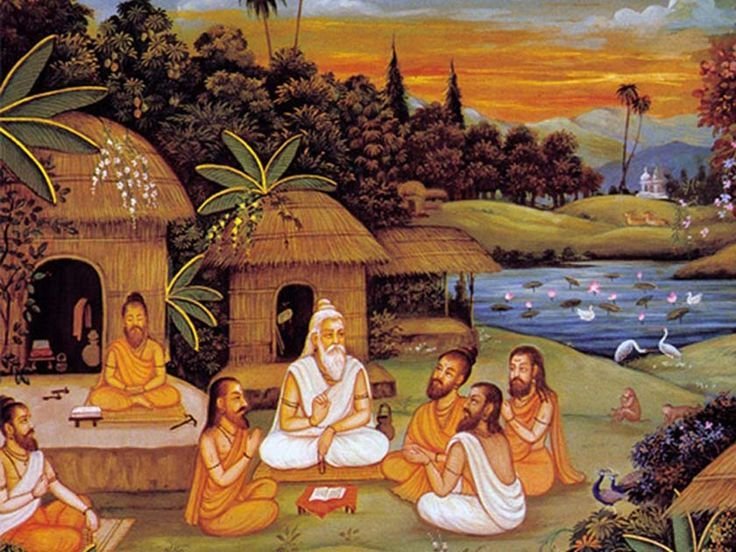
In Vedic age, organized education in India started taking shape, roughly between 1500 BCE and 500 BCE. The Vedas were memorizes through recitation rather than writing. As manuscript was difficult to write teacher/guru used to repeat it and learning was easy this way. This oral traditional method of learning is widely popular since ancient times. Even today scholars are amazed by the precision with which Vedic hymns survived across thousands of years. Education during this period generally took place in Gurukuls.
The Gurukul System:
The Gurukul was the foundation of ancient Indian education. The word Gurulul was derived from Sanskrit terms where Guru meaning teacher and Kula meaning family or home. Students lived at Guru’s house which is basically situated in forest or peaceful area. Education was not limited to academic learning alone it was about shaping a child’s entire lifestyle formed part of the educational process. Young child was sent to the gurukul as a Shishya where he woke up early, perform duties, cleaning the ashram and surrounding area. Under the guidance of guru he studies discipline, humility, self-control and respect which are the important intellectual abilities. Thus, guru-shishya relation was more than teaching and valued even in today’s world. Education was usually completed through a ceremony known as Samavartana, marking the student’s transition into adult life.
Knowledge Beyond Religion:
Although religious texts formed a major component of early education, ancient Indian learning extended far beyond spirituality.Indian scholars made major contributions in several scientific and intellectual fields.
Mathematics:
Ancient India produced some of the world’s greatest mathematical thinkers. The concept of zero as a number developed in India and transformed global mathematics forever.
Scholars such as Aryabhata, born in 476 CE, made groundbreaking advances in algebra, arithmetic, geometry and astronomy. In his famous work Aryabhatiya, he proposed that the Earth rotates on its axis and explained eclipses scientifically rather than mythologically.
Later mathematicians such as Brahmagupta further developed rules involving zero and negative numbers.
These ideas eventually traveled through Arab scholars into Europe, influencing global scientific development.
Medicine and Surgery:
Ancient Indian education also produced extraordinary advancements in medicine.
The Ayurvedic tradition developed systematic approaches to health, diet, surgery and disease treatment. Two legendary scholars stand at the center of this tradition:
• Charaka
• Sushruta
The Charaka Samhita focused on internal medicine, diagnosis, and ethics of medical practice. The Sushruta Samhita described surgical techniques, instruments, anatomy and procedures including reconstructive surgery.
Historians often refer to Sushruta as one of the earliest surgeons in world history.
Medical students underwent rigorous practical training. They studied plants, anatomy, patient observation and surgical methods in detail.
Centers of Higher Learning:
As Indian civilization evolved, education expanded beyond small Gurukuls into major institutions attracting thousands of students.
Among the greatest of these were ancient universities.
Takshashila:
Takshashila also known as Taxila is considered one of the world’s earliest centers of higher learning. It attracted students across the world. The institution became famous for Medicine, Politics, Military Science, Philosophy, Grammar.
Chanakya was most celebrated scholar of Takshashila later he wrote Arthashastra.
Nalanda University:
Nalanda University represented the peak of ancient Indian academic excellence. Nalanda became one of the greatest residential universities in the ancient world. Thousands of students studied there and hundres of teachers taught them various subjects, the libraries were huge and includes countless manuscript. The subjects like Buddhist Philosophy, mathematics, medicine, sanskrit literature, Astronomy were included.
Students from differenyt countries joined Nalanda university to seek knowledge in these many subjects.
Vikramashila University:
Vikramashila University became another major Buddhist university known especially for advanced studies trained to in philosophy and tantra.
Role of Debate and Discussions:
Students were trained and encouraged to debate about various topics that exists in the society. To question, argue and analyse the situation carefully was a part of the ancient education system. It helps students to start logical thinking and ethical behaviour along side learning conciousness, logic, ethics, language, spiritual liberation.
Legacy in modern world:
Ancient Indian Education paved the way for modern day education system. Even today, few of these teaching techniques used in schools for students to learn quickly. The Gurukul system, Nalanda and Takshashila also scholars like Aryabhata, Chanakya India emerged as a hub for Knowledge, wisdom and progressive education including major subjects like Mathematics, Medicine, Philosophy, Language learning, Astronomy. The ancient Indian education continues inspiring the modern ideas of learning.