KOODIYATTAM – The world’s oldest living theatre tradition

~Tanushree Wadodkar
There are some traditions that we grow up hearing about, and others that we discover later, almost by chance. I always knew about the numerous traditions of our country in fragments. It was only when I came across Koodiyattam that I began to understand how deep and layered these traditions truly are. I had heard of many forms of performance before, but Koodiyattam felt different the moment I came across it. The idea that a form of theatre has survived for over a thousand years felt almost unreal. In a world where everything changes so quickly, the continuity of something so intricate and disciplined stands out. Koodiyattam is a tradition that has carried language, expression, and storytelling across centuries. It is a performance that still connects the past to the present.
Origins
Koodiyattam is a 2000-year-old classical dance-theatre tradition from Kerala. It originated as a dramatised temple ritual based on ancient Sanskrit theatre.
It stems from Koothu, an ancient art form mentioned in the Sangama Literature. It later developed into “combined acting”, i.e, Koodiyattam. The word Kutiyattam is derived from the prefix “koodi” in Malayalam, which stands for “combined” or “together,” and “attam,” which means “acting.”
The ancient Kerala king and playwright, Kulasekhara Varma Cheraman Perumal, is often credited with refining the art form and creating the first acting manual: Attaprakaram. This text details the nuances of performance, choreography, and the use of gestures and costumes. Koodiyattam was traditionally performed in halls called Koothambalams within the temple premises. The art form was formalised between the 9th and 15th centuries.
Performance styles
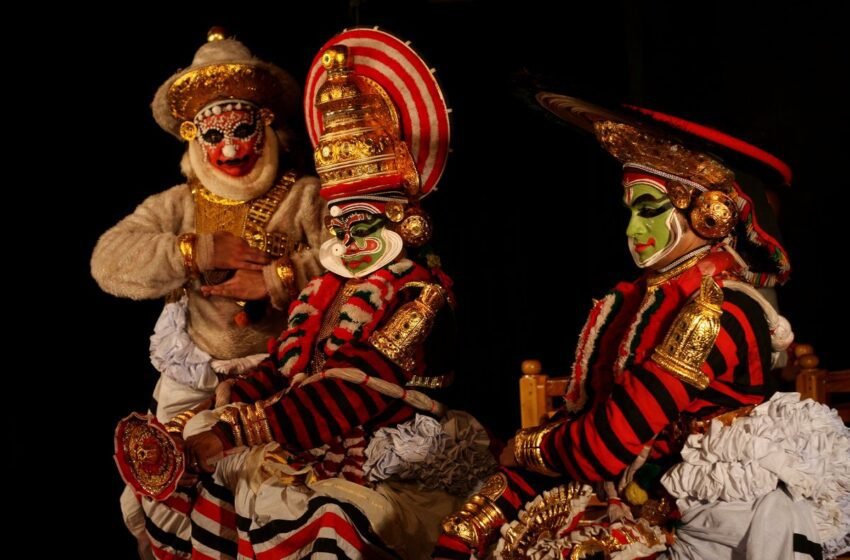
Koodiyattam, meaning “acting together” in Malayalam, is characterised by elaborate costumes, dramatic makeup, facial expressions, and mudras (hand gestures). The performance includes chanting, music, and instruments like Mizhavu, Idakka, Sankhu, and Kurumkuzhal. Each performance can last several days, with a single act taking 41 days in its original form. In this format, storytelling is not rushed. Events unfold slowly, allowing space for interpretation and reflection.
The traditional format divides the performance into three main parts:
- Purappadu: It is the opening segment in which the actor performs a verse accompanied by a dance. It sets the tone of the performance and introduces the main character/s.
- Nirvahanam: This segment portrays the internal emotions of the characters through facial expressions and body language.
- Koodiyattam: The final part, where all characters come together and interact through dialogues and dramatic storytelling.
Traditionally, the men from the Chakkiyars caste play the main role, while female roles are performed by women from the Nambiar caste. The Vidhushaka, who is a comic character, explains the narrative in simple Malayalam, as the performances are usually in Sanskrit.
Koodiyattam also involves highly elaborate makeup and costumes. The costumes are typically a combination of black, white, and red, and the makeup is designed to enhance the expressions of the performers.
The heroic characters are distinguished from others by their green face paint, while the Vidhushaka has a different makeup to show his humorous nature.
The performance includes four forms of expression: angika (gesture), vachika (speech), aharya (costume and makeup), and satvika (emotional authenticity). The eye movement techniques, known as netrabhinaya, are extremely refined and beautiful.
Preservation and Continuity
In the 20th century, the decrease in temple patronage and social restrictions threatened the art’s existence. In this period, many masters, such as Mani Madhava Chakyar and Ammannur Madhava Chakyar, kept the tradition going through public performances and educational initiatives. It was their efforts that brought Koodiyattam to cultural stages and reached a broader audience. The establishment of Kerala Kalamandalam, Margi in Thiruvananthapuram, and Nepathya at Moozhikkulam further institutionalised training in the art form.
In 2001, UNESCO declared Koodiyattam a “Masterpiece of the Oral and Intangible Heritage of Humanity”. Today, workshops are conducted in Europe, Japan, and the United States to introduce theatre artists to a holistic method of actor training. Modern masters like Guru Mani Madhava Chakyar helped popularise Koodiyattam beyond temple spaces.
Koodiyattam remains a living cultural treasure, bringing together ritual and drama, and continues to attract scholars, cultural enthusiasts, and heritage photographers seeking to experience one of the world’s most ancient theatrical traditions.
Challenges and preservation
Despite global recognition and conservation efforts, Koodiyattam continues to face challenges. The intense and time-consuming training required often discourages students. Reduced funding and limited availability of temple venues have decreased the frequency of the performances. Moreover, the slow pace of the drama can feel unrelatable to modern audiences. People are used to faster visual media and do not easily connect with performances like Koodiyattam.
Despite all this, efforts are being taken to preserve and revive the art form. Online workshops, digital archives, digital folklore documentation, and virtual performances are helping the tradition reach more people, especially researchers. Institutions such as Nepathya and Kalamandalam are experimenting with high-definition recordings, bilingual subtitling, and contextual lectures for global viewers.
The question now is, “Can today’s audience relate and connect to a centuries-old temple tradition?”
For me, encountering Koodiyattam changed the way I think about traditions. It showed me that survival does not always come from change. Sometimes, it comes from staying the same, with intention and discipline. In a world that values speed and accessibility, Koodiyattam stands apart. It asks for patience, and that is perhaps why it continues to exist. Not because it changed with time, but because it chose not to.
What stands out is not just its age, but the way it has been carried forward. Generations of performers have treated it as more than a craft. It is something learned slowly, practised patiently, and understood over time. That process gives it depth. It cannot be rushed, and it cannot be simplified without losing something essential.
Preserving art forms like this one needs to be a collective effort. It cannot depend only on the performers who dedicate their lives to it. It also requires awareness, respect, and participation from the larger community. At the same time, preservation should not turn into distance. These art forms need to remain accessible and not confined to a few spaces.