Bastar Dussehra: Inside the World’s Longest Festival

In a quiet corner of southern Chhattisgarh, far from the fanfare of Ravana effigies and fireworks that mark Dussehra across most of India, a different kind of celebration unfolds. It doesn’t last ten days. It lasts seventy-five. And it has almost nothing to do with Rama’s victory over Ravana at all.
This is Bastar Dussehra, centered in the town of Jagdalpur, and it stands as one of the most extraordinary living cultural traditions on earth.
A Festival Older Than Most Nations
Bastar Dussehra traces its roots back roughly six centuries, to the reign of the Kakatiya king Purushottam Dev. According to local tradition, the king was a devoted follower of Lord Jagannath and journeyed to Puri to take part in the Rath Yatra there. His devotion earned him the title “Rath-Pati,” along with a sixteen-wheeled chariot gifted in his honor. That chariot became the seed of a tradition that has continued, largely unbroken, ever since.
Unlike Dussehra celebrations elsewhere that mark the triumph of good over evil through the burning of Ravana’s effigy, Bastar’s version is dedicated to Goddess Danteshwari, the family deity of Bastar’s former royal line and one of the region’s fifty-two shaktipeeths. In many Bastar communities, Ravana isn’t treated as a villain at all. Some Gond groups trace their ancestry to him, viewing themselves as descendants of his lineage, which gives the festival an entirely different spiritual character than the Dussehra most Indians grow up with.
Seventy-Five Days, Countless Rituals
The festival typically begins around the new moon of Hareli Amavasya in the Hindu month of Shravan, roughly July or August, and runs through Ashwin in September or October. Within that stretch sits a sequence of rituals so intricate that scholars have questioned whether “Bastar Dussehra” can even be called a single festival, given how many gods, communities, and ceremonies are woven into it.
It opens with Paat Jatra, a ritual in which the surrounding forests and timber are worshipped before any wood is touched. From there, the festival moves through a series of remarkable, often startling ceremonies:
- Kachan Jatra, where a young unmarried girl from the Pankha community is believed to become possessed by Kachan Devi, the goddess of fertility. Seated on a swing built from thorns, she must grant permission before the festival can formally proceed.
- The Jogi’s vigil, in which a young man sits in penance for nine days, buried shoulder-deep in a pit, holding what many believe is the spiritual center of the entire celebration.
- Nisha Jatra, a tantric night ceremony involving sacrificial offerings gathered from villages across the region.
- Mawli Parghaw, the procession welcoming Devi Mavli, believed to have watched over Bastar even before Danteshwari’s arrival.
- The palanquin journey of Goddess Danteshwari, carried from her main temple in Dantewada to Jagdalpur.
Each ritual carries its own history, its own community of custodians, and its own place in a calendar that most outsiders never get to see.
The Chariot at the Heart of It All
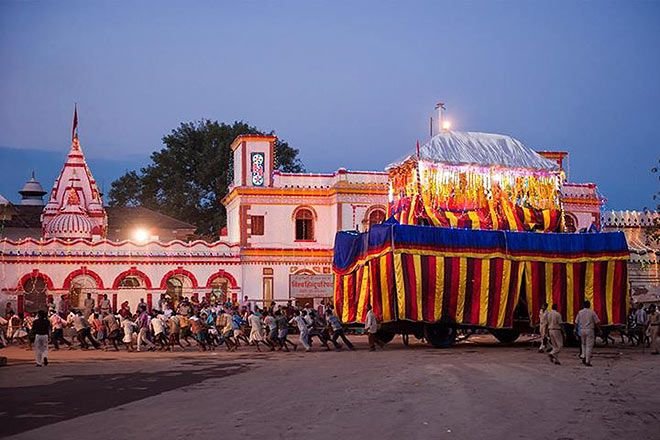
If there’s a single image that captures Bastar Dussehra, it’s the chariot. Built entirely without nails, using Sal wood for the body and Tinsa wood for the wheels, the massive two-tiered structure is constructed by local artisans following methods passed down for generations. Before construction even begins, a sacred piece of wood known as Thurrule Kotla is worshipped and offered sacrifices, a reminder that in Bastar, the forest itself is treated as sacred, not just a resource.
Once complete, the chariot is pulled through the streets of Jagdalpur by hundreds of people, sometimes as many as four hundred, in processions known as Bhitar Raini and Bahar Raini. These final days of the festival draw enormous crowds and mark the emotional peak of the celebration, a convergence of devotion, craftsmanship, and collective effort that few festivals anywhere can match.
A Living Mosaic, Not a Museum Piece
What makes Bastar Dussehra remarkable isn’t just its length or its scale. It’s that the festival has managed to stay alive and relevant across centuries of political change. The former royal family still plays a ceremonial role, with the current Maharaja continuing rituals that symbolically remind him his authority flows from his people, not over them. At the same time, elected officials and modern governance structures have folded themselves into a festival that predates them by hundreds of years.
Dozens of Indigenous communities, including the Gond, Maria, Muria, Bhatra, Dhurwa, and Halba, all participate, each contributing their own customs, deities, and roles. Rather than diluting the festival, this layering of traditions is what gives Bastar Dussehra its depth. It isn’t one story. It’s many stories, told at once, across the same seventy-five days, in the same stretch of forest and city streets.
Why It Matters Beyond Bastar
In a country where Dussehra is often reduced to a single day of effigies and fireworks, Bastar offers something rarer: a festival that has resisted homogenization. It holds onto tribal cosmology, oral history, and forest-based ritual practice in an era when so many indigenous traditions worldwide are fading or being flattened into tourist spectacle.
That tension, between preservation and change, between ancient ritual and modern tourism, is precisely what makes Bastar Dussehra worth documenting now. It is not a relic. It is a living, breathing tradition, still shaping the identity of the communities who carry it forward every single year.