The House That Ate a City: Inside Bamberg’s Witch Prison

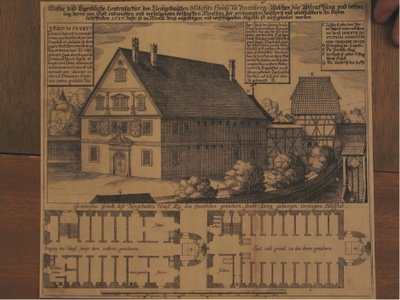
In 1627, in the German city of Bamberg, a bishop built a prison with only one purpose: to break people until they confessed to something that wasn’t real.
It had cells. It had torture chambers. Its walls were painted with Bible verses, meant to ward off the spells its own prisoners were accused of casting. Locals called it the Drudenhaus, or sometimes just the Malefizhaus: the witch house. Over five years, it would swallow hundreds of the city’s own citizens, including its mayor, and it would do it with the full backing of the Church.
This isn’t a story about superstition in some distant, foggy past. It’s a story about what happens when a government builds infrastructure for paranoia, and how quickly a “purge” can turn on the very people running it.
A Bishop With a Frost Problem
Bamberg was a small, self-governing Catholic territory inside the Holy Roman Empire, sitting uncomfortably close to the Protestant-Catholic fault line. Its ruler, Prince-Bishop Johann Georg Fuchs von Dornheim, took power in 1623 determined to turn his state into a model of Counter-Reformation piety. He wanted total obedience. He got paranoia instead.
The spark, as it so often was in witch panics, was the weather. A brutal, unseasonal frost destroyed crops across the region, and a frightened population demanded someone be blamed. A local woman named Katharina Merckhlerin was arrested and, under pressure, confessed to summoning the frost through witchcraft. That single confession opened a door that would not close for years.
Von Dornheim didn’t just permit a hunt. He industrialized one. He set up a dedicated Witch Commission with its own prosecutors, encouraged citizens to inform on their neighbors, and stripped the accused of nearly every legal protection they had. Charges weren’t made public. Defendants couldn’t cross-examine witnesses. And torture, which imperial law technically restricted, was applied without limit.
By 1627, the prisons were so full that von Dornheim commissioned something new: a purpose-built facility just for suspected witches.
Built for Breaking People
The Drudenhaus held around twenty to forty prisoners at a time, locked in twenty-six individual cells plus a couple of larger group holding rooms. A Latin inscription over the entrance, borrowed from Virgil, warned visitors to learn justice and not scorn the gods. Inside, the Bible verses painted on the walls were meant to protect staff from the very witchcraft the prisoners were accused of, as if evil might seep out of the stonework.
The building’s real purpose was extraction. It ran on isolation and pain, a combination designed to produce confessions on demand, guilty or not. Interrogators used thumbscrews that crushed fingers until blood ran from under the nails. They used the strappado, binding a prisoner’s hands behind their back and hoisting them by a rope until their shoulders dislocated. They forced people into ice baths, then into baths of scalding water mixed with caustic lime. One method, grimly nicknamed the “Bamberg thirst,” involved force-feeding prisoners heavily salted herring and then denying them any water at all. Another had victims kneel for hours on sharpened spikes while they were whipped.
The math of it was brutally simple, and everyone inside the building knew it: the torture would not stop until you confessed. It didn’t matter whether you were guilty. It didn’t matter who you were.
The Mayor’s Last Letter
That last point mattered enormously, because Bamberg’s witch hunt didn’t stay confined to the poor and marginal, which is where these panics usually did their damage. It came for the city’s own leadership. Court officials, clergy, and multiple sitting mayors were swept up in the accusations, often implicated by the coerced confessions of previous victims. Suspicion became a chain reaction: torture one person into naming names, and you had your next dozen suspects.
Among those caught was Johannes Junius, Bamberg’s own burgomaster, arrested in June 1628 after another official named him under torture. Junius held out for days, denying everything even as the interrogators went to work on him. Official court records claimed, absurdly, that he confessed freely and was never tortured at all. His own words tell a different story.
While awaiting execution, Junius managed to smuggle a letter out of the prison to his daughter Veronica, written in secret and hidden from the guards. In it, he described enduring the thumbscrews until his hands bled, and being warned by his own executioner that resistance was pointless: the torture would simply continue, session after session, until he said what they wanted to hear. Eventually he broke, and invented a confession out of nothing, because the alternative was more of the same pain with no end in sight. He begged his daughter to keep the letter hidden, terrified that its very existence could get the sympathetic jailer who smuggled it out killed.
Johannes Junius was burned at the stake in August 1628. His letter survived him by centuries, quietly proving that the Bamberg court’s official records, which insisted its torture always produced honest confessions, were lies from start to finish.
A Machine That Finally Ran Out of Fuel
Estimates of the total death toll from the Bamberg trials vary, but scholars place it somewhere between 300 and over 900 people executed across the broader campaign, out of roughly 900 to 950 total prosecutions. Confiscated property from wealthier victims like Junius poured hundreds of thousands of florins into the prince-bishopric’s coffers, which meant the machine had a financial incentive to keep running exactly as long as it did.
It eventually stopped for reasons that had little to do with mercy. The Holy Roman Emperor, Ferdinand II, tried to intervene on behalf of some victims and was openly defied by von Dornheim, but mounting political pressure eventually forced formal mandates against the persecutions. What really ended it was the Thirty Years’ War: as Swedish troops advanced on Bamberg in 1632, von Dornheim fled the city, and the Drudenhaus was torn down not long after.
What the Walls Left Behind
The Bamberg witch house wasn’t an isolated horror; smaller versions of the same design were built in nearby towns like Zeil, Hallstadt, and Kronach. But Bamberg’s was the largest and the most notorious, a piece of dedicated civic infrastructure built for the sole purpose of manufacturing guilt.
What makes it linger, more than the torture instruments or the death count, is how ordinary the victims were. Not outsiders. Not the marginalized figures witch panics usually consumed first. Tailors, shoemakers, a chancellor, a mayor’s own family, the mayor himself. Anyone could be next, and the machine didn’t care who you’d been the week before your name came up under torture.
Johannes Junius understood that better than most. In his last letter he wrote something close to a warning for anyone who might one day doubt how such a thing could happen: inside that building, he said, no one escaped, not even an earl. The Drudenhaus is long gone. What it proved about how easily institutions can be turned into engines of cruelty against their own people is not.