The Room That Outlived the Empire – Indian Museum in Kolkata

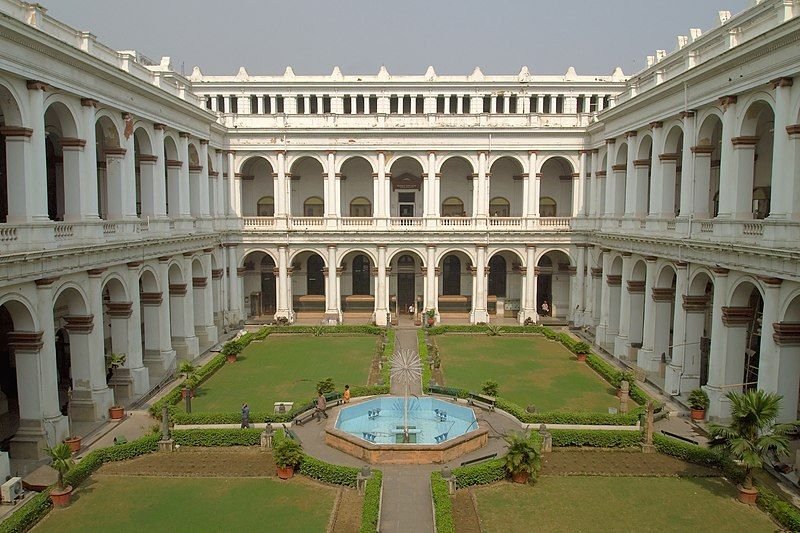
Walk into the Indian Museum in Kolkata expecting sculpture, coin cabinets and fossils, and for the first five galleries you get exactly that. Bharhut railings from the second century BCE. An Egyptian mummy donated to the Asiatic Society in 1834. More than fifty thousand coins. Then you reach the anthropology section, and for close to a century, one part of that section held something considerably stranger: a display of human bodies, and casts of human bodies, arranged as objects of scientific study.
That part of the anthropology section had a name, apparently used by the museum’s own staff: the Room of the Nudes. Historians of museums have written a great deal about how European and American collections shaped anthropology as a discipline. The Indian Museum, despite predating most of them and holding one of the largest anthropological collections in Asia, has barely been examined the same way.
An institution built for cabinets
The Indian Museum began in 1814 as a project of the Asiatic Society of Bengal, with the Danish botanist Nathaniel Wallich as its founding curator. For its first decades it was a fairly conventional cabinet of curiosities: minerals, plants, antiquities, the kind of material a learned society in Calcutta might accumulate through donation and purchase.
The Indian Museum Act of 1866 formalized the collection into what was then called the Imperial Museum of Calcutta, and a purpose-built home on Chowringhee Road, designed by W.L. Granville, opened to the public in stages through 1878 and 1879. By the time it was complete, the museum held six sections: art, archaeology, anthropology, geology, zoology and economic botany.
Anthropology, as a museum section, needed a different kind of object than the others. A coin gallery could simply display coins. An anthropology gallery, organized around the era’s central question of how human populations differed from one another, needed bodies, or at least representations of them: skeletal material, plaster casts of skulls, life casts of faces and figures, and the anthropometric photographs being produced in parallel by survey work like Herbert Risley’s Ethnographic Survey of Bengal. The museum’s anthropology holdings grew directly out of the same colonial project that was measuring nasal indices and cephalic ratios across the subcontinent. The specimens collected in the field needed somewhere to be exhibited, and the Indian Museum became that place.
The technique itself, life-casting, was not unique to Calcutta. Museums built along similar imperial lines, including the South African Museum in Cape Town, developed comparable collections of plaster casts taken directly from living subjects around the same period, part of a wider late nineteenth-century museum practice that treated the human body as raw material for scientific display. What made the Calcutta collection distinct was its scale and its administrative position. It sat inside the largest multidisciplinary museum in Asia, a few galleries away from Bharhut sculpture and Mughal painting, so that a visitor moving through the building in sequence would pass from religious art to numismatics to, eventually, a room built around the classification of living people.
The collection was not simply stored. It was arranged, captioned and displayed to make an argument, one built around the racial and caste theories circulating among colonial administrators at the time. Museums like this have sometimes been called the “institutional homeland” of anthropology, the place where the discipline actually took shape, through the daily work of arranging objects into sequences that were meant to look like evidence. That description has usually been applied to museums in London, Paris and Washington. It applies just as well to a museum on Chowringhee Road in Calcutta, one that outlasted the empire that built it.
A discipline that outlived its founders
In 1916, the museum’s anthropological and zoological material was split off into a new body, the Zoological Survey of India, which took the zoology side with it. Anthropology stayed with the parent institution until 1945, when it too was spun into an independent organization: the Anthropological Survey of India, founded in Varanasi with Biraja Sankar Guha as its first director and Verrier Elwin as deputy director. In 1948, the Survey relocated to Calcutta and took up residence inside the Indian Museum itself, the same building that had housed its founding collection for decades.
This is where the story stops following a simple script. It would be easy to tell it as a clean transition: colonial science, then independence, then the closing of the account. That is not what happened. The Anthropological Survey of India, now run by Indian scholars, inherited the physical collection that had been assembled to prove theories those same scholars would spend the following decades dismantling. The room did not disappear when the ideology that built it lost its authority. It changed hands.
Later research on Indian museology, including work on what has been called “the slow death of the diorama,” describes how this handover actually looked in practice. Long after independence, the Indian Museum commissioned sixteen full-size dioramas, built in plaster of Paris between 1963 and 1965, depicting the peoples of India, largely tribal communities, engaged in what the exhibits called their traditional occupations. The visual language was strikingly close to the colonial ethnographic tradition it was meant to succeed: essentialized human types, posed and captioned, standing in for entire communities. Between 1996 and 2004 the plaster figures were converted to fiberglass. The gallery finally closed in 2014. Postcards of the dioramas are still sold in the museum shop.
A different kind of museum, built to argue back
Not every postcolonial response took the shape of quiet continuation. In 1979, a new institution, the Indira Gandhi Rashtriya Manav Sangrahalaya, was established in Bhopal with an explicitly different mandate: to educate the public about the richness and diversity of Indian culture, and to promote national integration rather than racial hierarchy. Scholarship on this period frames it carefully. Indian anthropologists did not reject the idea of the museum itself as a tool for understanding human diversity. What they rejected was the specific colonial method that had shaped collections like the one in Kolkata, built around ranking and classification rather than description.
That distinction matters, because it means the story of the Room of the Nudes cannot be reduced to villains and heirs. The people who inherited the Indian Museum’s anthropological collection after 1947 were not simply continuing a project. They were working inside a building, and often with actual physical objects, that had been assembled for purposes many of them explicitly opposed. Some of that material stayed on display for decades under new administration. Some of it was eventually reframed, relocated or quietly retired, as with the dioramas closed in 2014.
What the room asked of its visitors
Exactly which objects the room contained, in what configuration, and for how long, is the kind of institutional detail that would need the museum’s own accession records to establish with real confidence, and that fuller picture is not yet public. What can be said is that the room existed as a named, apparently well-understood space within the Indian Museum’s anthropology section, built to display the human body itself as scientific evidence.
That is a different proposition than a portrait gallery or an ethnographic photograph collection, however troubling those can be in their own right. A photograph documents an individual, even when it is captioned as though it documents a type. A cast or a specimen goes further: it takes something from the body directly and turns it into a museum object, cataloged alongside minerals and coins, available for measurement by any researcher who walks in with calipers.
A room that is still, in some sense, open
The building that housed it is still standing on what is now Jawaharlal Nehru Road, still the oldest museum in Asia, still organized around the same six sections it has kept since 1878. The Anthropological Survey of India, born to interrogate the assumptions that built the original collection, is still headquartered inside that same museum, sharing walls with the objects its founding directors set out to reexamine.
Somewhere in that building’s storage, separate from the fiberglass dioramas retired in 2014 and the coin cabinets that never needed reinterpretation, sits whatever remains of the original collection: casts, specimens, catalogue cards, and photographs whose subjects were never asked what they thought the room was for. The science that justified assembling them has been abandoned by every serious anthropologist working today. The objects themselves are still there, still catalogued, in a museum that has spent eighty years figuring out what to do with a room it did not build but somehow still owns.