From Mahajanapadas to Modern States: How India Was Politically Unified

-Devashree Kulkarni
Imagine the land we today called India does not exist as a single political entity around 2600 years ago. There was no national flag, no central government and no unified administration. Only the subcontinent was a mosaic of kingdoms, republics, tribes and competing powers and even with political division people were connected through trade, cultural and religious ideas and traditions. The India’s political unification story is not about one ruler or one empire. It’s a journey of many years which connects with millions of stories including the ambition, conquest, administration, cultural integration, colonial rule, nationalist awakening and then finally the creation of the modern Republic of India.
The World of the Mahajanapadas:
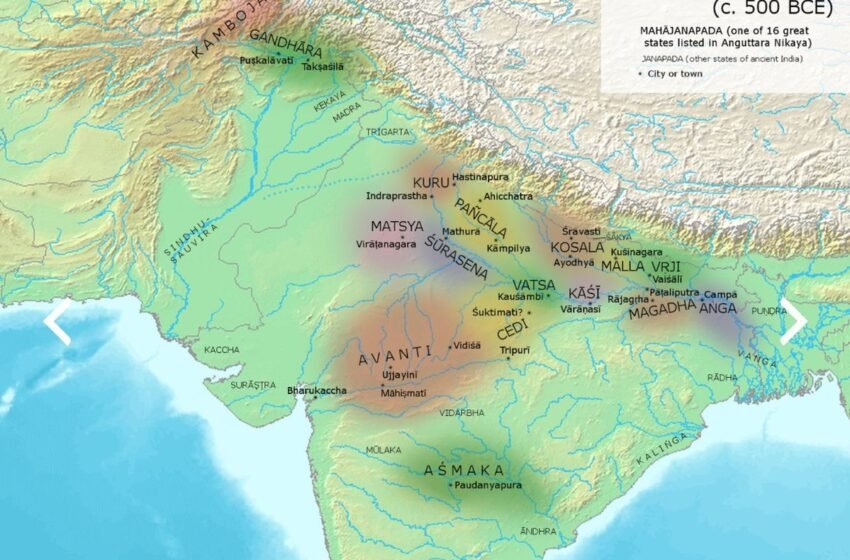
Northern India in sixth century BCE was divided into sixteen major states known as the Mahajanapadas. These included powerful kingdoms such as Magadha, Kosala, Avanti, Vatsa, and Kashi. Some were ruled by kings and some by the assembly.
Life during this era was different, the cities grew, trader used to travel long distance, scholars were found debating in royal courts also it witnessed the rise of Buddhism and Jainism which challenged social and religious structures. But still politically the regions remained divided. War for territory and influence among the rival states was frequent.
One of the strongest kingdom among the Mahajanapadas was Magadha. Its strategic location, fertile land, rich iron deposits and ambitious rulers allowed it to dominate its neighbors. The foundations of political unification were being laid.
Chandragupta Maurya and the First Great Unification:
Political instability spread around many regions in India after Alexander’s invasion. Chandragupta Maurya who was guided by Chanakya founded Mauryan Empire around 322 BCE.
He established and maintained a strong central administration with an organized tax system, military and provincial governance. Maurya Empire tried the best to establish political unity.
Ashoka: Unification Beyond Conquest:
Under the Ashoka reign, Mauryan Empire reached its peak. Ashoka was a grandson of Chandragupta Maurya, he was a powerful conqueror but Kalinga War’s terrible bloodshed changed. He spread these values and connected various communities under common morals. Even though Mauryan empire declined after Ashoka’s death, he left behind the vision for political unity.
The Gupta Age and Imperial Revival:
The Gupta Empire rose in fourth century in northern India and is often called the Golden Age of Indian civilization. The Gupta rulers brought stability and encouraged trade, science, literature and art. The temple architecture flourished and Sanskrit literature became widely popular among people. This helped in administration and cultural unity across northern India.
Regional Powers and New Political Landscapes:
Between the seventh and twelfth centuries India experienced some major changes in power. The Cholas completely dominated southern India and established maritime empire extending into Southeast Asia. The parts of western and northern India were ruled by the Rajputs.
With the political diversity, economic and cultural interactions continued. Trade connected ports on both coasts and it connected the regions socially.
The Delhi Sultanate and Administrative Expansion:
Delhi Sultanate in thirteenth century, came in power in northern India and brought many regions under centralized rule. The rulers developed administration, revenue systems and communication networks.
They also introduced new architectural styles and military methods. Also persian became the major language of administration. The Sultanate laid the foundation for future large empires even it was not controlling all parts of India.
The Mughal Empire and Subcontinental Integration:
The Mughal Empire rise in sixteenth century, founded by Babur and it expanded under rulers such as Akbar, Jahangir, Shah Jahan and Aurangzeb. Among these rulers Akbar played a vital role in political integration. His policies encouraged cooperation among different regional elites and communities. Mughal administration included standardized record keeping, extensive road networks to increase trade, expansion of cities. Also with developed revenue system and provincial governance.
Even the empire weakened later, it left behind administrative institutions that influenced later governments and helped to develop policies for an empire.
Colonial Rule and Administrative Unification:
The British East India Company in eighteenth century expanded its control over India through wars, treaties and alliances. India came under direct British rule after The Revolt 1857. Colonial reule exploited resources but it also created administrative unity through railways, telegraphs, common legal system and modern bureaucracy
But they also generated the conditions for resistance.
The Rise of Indian Nationalism:
The education and communication improved in India, people started recognizing themselves as a part of one Nation. The political change bought by Indian National Congress founded in 1885, became the independence movement. Millions of Indians were united through movements like Non-Cooperation, Civil Disobedience and Quit India during that period. Freedom from British rule was common goal of all the people belonging to different communities, religion and regions and wanted to make nationalism a powerful force for unity.
Independence and the Challenge of Integration:
India became independent in 1947. The challenge of uniting princely states was led by Sardar Vallabhbhai Patel and V. P. Menon through negotiation and diplomacy they integrated these states into the Indian Union. This union prevented India from breaking into smaller nations and again dividing into political powers.
The Birth of Modern India:
On 26 January 1950, India became a sovereign democratic republic with the adoption of its Constitution. Mahajanapadas to the modern republic this journey contributed to Indian political unification. Many rulers, kingdoms and people were included in shaping a nation. People also showed their contribution during freedom struggle with the freedom fighters and leaders. This unity results in strengthening both political institutions and a shared sense of national identity.