FOURTEEN YEARS OF WAITING – The story of Urmila

-Tanushree Wadodkar
I remember the first time I watched Ramayana on TV. I remember sitting with my family and watching the stories I had grown up hearing. I also remember how one particular character stayed with me for years: Urmila. Her silent endurance, her support for her husband, and her sacrifice felt overlooked amidst the larger picture. While we remember how Sita followed Ram into exile, we forget that Urmila stayed back so that Lakshman could fulfil his duty. Her role may appear smaller than the others’, but if you look closely, you will see a woman who gave up just as much as the others.
Urmila’s sacrifice was different in the way that it existed in silence. She spent years separated from her husband, carrying a burden only a few would understand. Although her presence in the Ramayana is limited, it is shaped by duty, loyalty, and waiting.
The Princess of Mithila
Urmila was born in Mithila to King Janak and Queen Sunaina. She was Sita’s younger sister. Ancient texts and later retellings describe Urmila as intelligent, gentle, and compassionate. As a princess of Mithila, she received an education in the Vedas and religious texts befitting her status. She was raised in an environment where wisdom and virtue were valued. Although Sita occupies a central role in stories about Mithila, Urmila was an important part of the royal family. She adored her elder sister, and they shared a deep bond. She was her sister, her friend, her teacher, and her closest confidant.
Marriage to Lakshmana
When Ram won Sita’s hand in marriage by breaking the divine bow, his brothers’ marriages were also fixed. Lakshman was to be wed to Urmila, Bharat to Mandavi, and Shatrughna to Shrutkirti.
The weddings united the royal families of Ayodhya and Mithila in celebration. For Urmila, it marked the beginning of a new chapter. She was married to the younger brother of Lord Rama, Lakshman. Lakshman was known for his courage, loyalty, and fierce sense of duty. His life revolved around his elder brother, whom he admired deeply. He believed his life’s purpose was to serve his elder brother. She was married to a man who was already committed to his dharma.
From the very beginning, Urmila understood Lakshman’s devotion towards his brother and completely supported him. She believed it was her duty to help her husband in his purpose.
The Exile
The turning point in their lives came when Queen Kaikeyi claimed the two boons that King Dasharatha had once promised her. She demanded that her son Bharat be crowned king and that Ram be sent into exile for fourteen years. She was influenced by her maid, Manthara, who led her to believe she would lose her position in the royal family after Ram became king. Her demands shook the entire household. The preparations for Ram’s coronation were stopped.
Sita immediately declared that she would accompany her husband into the forest. She refused to remain in the palace while Ram faced hardship alone. Lakshman too made his decision without hesitation. He would follow Ram into exile and dedicate himself to serving and protecting both Ram and Sita. He could not let his elder brother walk into the forest alone. Initially, Urmila wanted to follow Lakshman, but he requested that she stay back to care for his parents. So she stayed. She endured fourteen years of separation and let him go.
What makes Urmila’s story all the more remarkable is that she did not stand in the way of Lakshman’s duty. She understood the bond between the two brothers. She understood the responsibilities he felt toward Ram. And instead of asking him to stay, she gave him the freedom to go with him.
Sleeping all those years
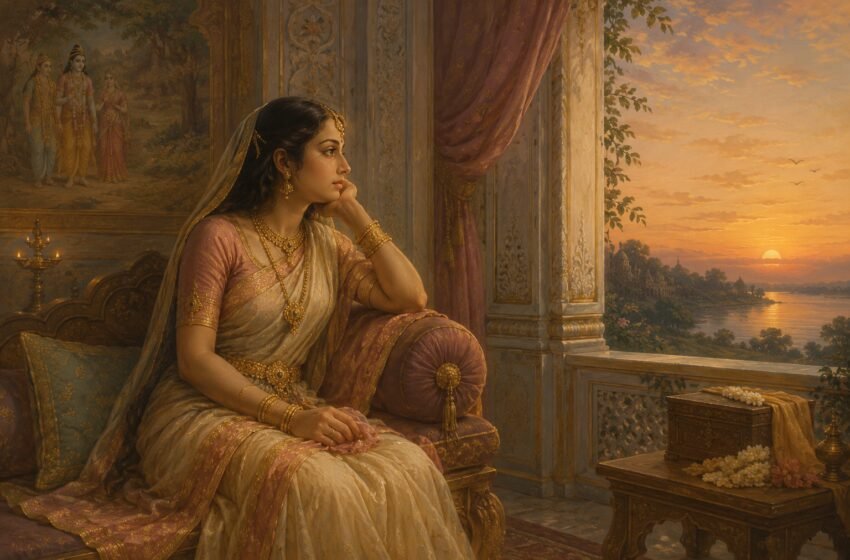
One of the most interesting aspects of her story comes from later retellings and many regional versions of the Ramayana. It is said that Lakshman vowed that he would not sleep for fourteen years so that he could serve and protect Ram-Sita day and night. When the Goddess of Sleep approached him, he requested to be able to stay awake, even at night. She agreed on the condition that someone else take his share of sleep. He wished for his sleep to be transferred to Urmila. As a result, Urmila is said to have slept throughout the years of exile, bearing the burden of sleep on her husband’s behalf.
This is also what enabled him to kill Meghnad/Indrajit (Ravana’s eldest son and a powerful warrior), as he had a boon that he could only be killed by the “one who had conquered sleep”.
(This tale does not appear in the earlier versions of the Ramayana or in the Valmiki Ramayana.)
After Exile
When Ram, Lakshman, and Sita return to Ayodhya after fourteen years, the city erupts in celebration. Lanes were decorated, lamps lit, and people gathered to welcome them. For Urmila, this meant the end of her separation from her husband.
The Ramayana does not provide extensive details about Urmila’s life after Lakshman’s return. Like many women in the epic, she gradually fades into the background as the narrative shifts toward Ram’s coronation and his reign as king. It is said that Lakshman and Urmila had two sons: Angada and Chandraketu.
In today’s age, where mythological stories are being brought to life through movies, serials, and books, characters like Urmila are being noticed more. Modern retellings often place her at the centre of the story. They mention her emotions, her sacrifice, and the events through her point of view. A good example of this is the book, Sita’s Sister by Kavita Kane, which follows the life of Urmila from the young princess of Mithila to Ayodhya’s daughter-in-law. Many modern TV serials also shed light on Urmila’s sacrifice and give her a voice.
Urmila’s story might exist in the margins or footnotes, but her role is not any less important than the others. She stood by her husband, she fulfilled her duties, and became her husband’s strength during those long fourteen years.