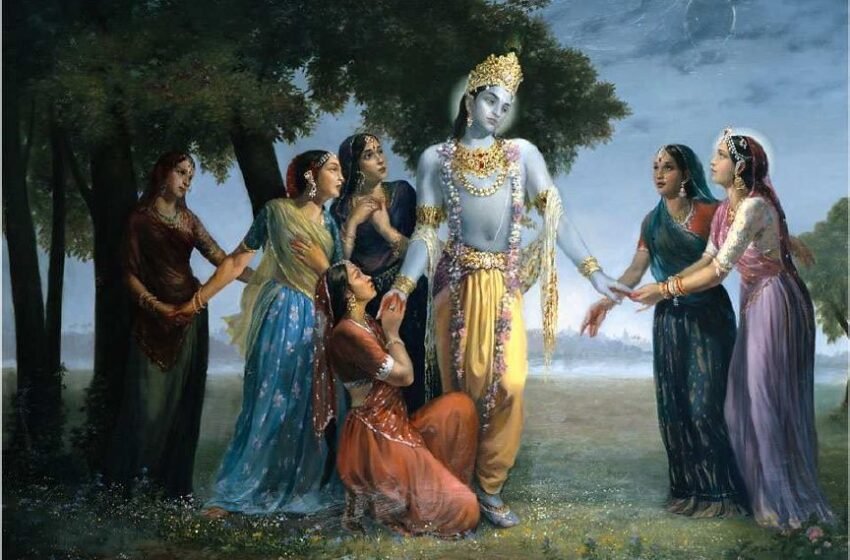
THE QUEENS OF KRISHNA – The 16,108 wives of Lord Krishna

-Tanushree Wadodkar
Lord Krishna occupies a rather unique position in the Hindu traditions. He is seen not just as a God, but also as a friend, a guide, and a companion. He is also a central figure in the great war of the Mahabharata. However, beyond the battlefields, diplomacy, and philosophy lies another aspect of his story. A story connected to the women who shared his life and his home.
The eight principal wives of Krishna are called Ashtabharya. The story behind the other 16,100 wives is incredibly interesting. Their stories reveal courage, devotion, determination, and resilience. They form an important part of Krishna’s life and the broader mythology surrounding him.
Krishna is often placed in the centre of the narrative. But his wives also deserve attention for their love and devotion to him.
Rukmini
Rukmini is remembered as Krishna’s chief queen and is believed to be an incarnation of Goddess Lakshmi. Rukmini had heard about Krishna’s divine energy and his virtues, and had decided to marry him. Her brother, however, wanted Rukmini to marry Prince Shisupal. Rukmini wrote a letter to Krishna declaring her love and asking him to come take her away. Krishna arrived in Vidarbha and carried her away before the wedding ceremony could take place. They got married, and Rukmini became the principal queen of Dwaraka. She represents pure love and devotion, and is remembered for her wisdom and dignity.
Satyabhama
Satyabhama is believed to be the incarnation of Bhumidevi and is described as outspoken, confident, and fiercely independent. She was the daughter of a Yadav nobleman, Satrajit, who owned the divine Syamantaka jewel. Unlike most royal women described in mythology, Satyabhama was unafraid to voice her opinions and strongly stood beside Krishna.
She was the one who accompanied Krishna in the battle against the demon Narakasur and defeated him. Her strong personality has made her memorable in later retellings and folk stories. Beneath her pride, she carried deep love for Krishna and remains one of his most beloved queens.
Jambavati
Jambavati is chronologically the second wife of Lord Krishna. She was the daughter of the bear-king Jambavan (who helped Lord Rama in the Ramayana). When the Syamantaka jewel goes missing, Krishna is falsely accused of theft. To clear his name, he goes to search for the jewel and finds it in Jambavan’s cave. They have a fierce fight which lasts for over 20 days. When Jambavan realises that Krishna is the incarnation of Visnu, he surrenders and returns the jewel. He also offered his daughter Jambavati’s hand in marriage to Krishna.
Kalindi
Kalindi, the personification of the River Yamuna, was the daughter of the Sun God. For a long time, she lived near the river, doing penance and praying to have Vishnu as her husband. Krishna met Kalindi during a hunting trip with Arjuna. Moved by her devotion, Krishma agrees to marry her and accepts her as his wife.
Kalindi’s story is not based on political alliances or royal events. Instead, it revolves around faith and perseverance. She is also believed to be the symbol of purity and simplicity.
Mitravinda
Mitravinda was the daughter of King Jayasena and Rajadhidevi, the sister of Krishna’s father. She was Krishna’s cousin and the princess of Avanti. Her brothers, who ruled Avanti, were loyal allies of Duryodhan and tried to get Mitravinda married to him. However, during her swayamvar, Krishna arrived and carried her away, overcoming those who attempted to stop him, including her brothers.
Despite opposition from her family, she remained determined in her wish to marry Krishna.
Nagnajiti
Nagnajiti, also known as Satya in some versions, was the daughter of King Nagnajit of Kosala. To win her hand in marriage, her father set a challenge for all suitors. Anyone who wished to marry his daughter must first subdue seven dangerous bulls. Many princes attempted the challenge but failed. When Krishna arrived, he tamed all seven bulls effortlessly and won Nagnajiti’s hand in marriage.
This story highlights the popular concept of organising challenges to determine the best suitor for the princess (similar to the fish eye condition for Draupadi’s marriage).
Bhadra
Devi Bhadra was the princess of the Kekaya Kingdom and the daughter of Krishna’s paternal aunt Srutkirti. She was married to Krishna when her brothers offered her hand in marriage. Unlike some of the more dramatic marriage stories associated with Krishna, Bhadra’s union with him is described as relatively peaceful.
Lakshamana
Lakshmana was the princess of Madra. According to the texts, her father organised a swayamvar for her. There are two versions of this story. One says that Krishna abducted her from the Swayamvar and married her. The other says that he wins her hand by hitting the target and completing the condition of the swayamvar.
Traditional accounts portray Lakshmana as graceful, intelligent, and devoted. Though she receives less attention in popular retellings, she forms an essential part of the Ashtabharya.
The Other 16,100 Women
Apart from the eight principal wives, Krishna also married 16,100 other women who were held captive by the demon Narakasur.
Krishna rescues them after Satyabhama defeats Narakasur. Since they cannot return to their families and fear that society will not accept them, they beg Krishna to take them in. Krishna accepted them into his household, restoring their dignity and security.
This story emphasises Krishna’s protection and compassion, as well as Satyabhama’s bravery.
The story of Krishna’s wives is far more than just a list of royal alliances. Each woman who became a part of his life represented devotion, love, courage, patience, and resilience. Some devoted years to prayer before meeting him, wishing he would come to rescue them. Others entered his life through events shaped by destiny or politics.
Rukmini’s devotion, Satyabhama’s fierceness, or Kalindi’s penance, all tell the story that extends beyond the central narrative. The queens of Krishna remind us that mythology is not built solely around kings and heroes. It is also shaped by the women who stood by them, loved them, and supported them.