Chola Copper Plates Returned to India: A Homecoming Across a Century

-Devashree Kulkarni
A memorable moment of 2025, Chola Copper plates finally came back home.The centuries old Chola copper plates inscribed records from one of South India’s greatest empires were formally returned to India after being traced overseas for decades. More than just metal sheets etched with ancient writing, these plates carried the voice of a lost era: the administration, culture, faith and intellectual sophistication of the mighty Chola Empire. Their return was not merely about recovering an artifact. It was about restoring history itself.
Fact of Cholas:
To understand why these copper plates matter a lot once need to know the grandeur of the Cholas. Emerging strongly around the 9th century CE, the Cholas transformed southern India into a powerful maritime empire. Under rulers such as Rajaraja Chola I and Rajendra Chola I, The empire is expanded to Tamil Nadu, Sri Lanka (present day), parts of Southeast Asia and the Indian Ocean trade routes.
The Cholas were conquerors, administrators, temple builders, naval strategists, patrons of art and protectors of Tamil literature. Monumental structures like the Brihadisvara Temple still stand as proof of their architectural brilliance. But unlike monuments carved in stone, many details of Chola governance survived through copper plate inscriptions.
Why Copper plates:
All the royal records used to engraved in copper plates earlier. Later they started documenting on papers. This plates were used as a legal documents and kings issued them to record grants of land, tax exemptions, temple donations, administrative orders or major political achievements.
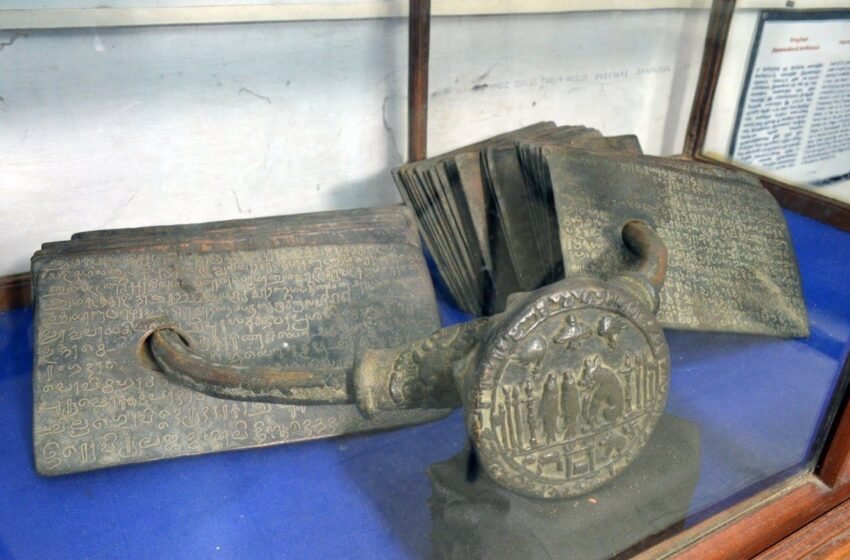
These plates were placed together with a copper ring and sealed with royal emblem. These engraved became historic evidence as copper and also served as a treasure for historians as it contains engraved information like name, address, dates and details of administration of that era. The script written primarily in Tamil and sanskrit also using Grantha script.
Significance of Chola plates:
Among the most significant Chola inscriptions are the Leiden Plates, the Thiruvalangadu Plates, the Anbil Plates, and the Larger Leiden Grant. These records reveal extraordinary details about the Chola state and the cosmopolitan nature of Chola society and its maritime links with Southeast Asia.
Another set celebrated Rajendra Chola I’s victorious naval expeditions across the Bay of Bengal. Such inscriptions proved that medieval India maintained extensive overseas connections long before European colonial powers entered Asian waters.
How the Plates Left India:
Like countless Indian artifacts during the colonial era, many copper plates gradually found their way into foreign collections through questionable circumstances. Some were taken by colonial officials, some were sold illegally by intermediaries, while others disappeared from temples, mutts, or private holdings during periods of political instability.
European collectors and museums in the 18th and 19th centuries showed enormous interest in Indian antiquities. Ancient manuscripts, sculptures, bronzes and inscriptions were frequently transported abroad in the name of “preservation” or “scholarship.”
In many cases, the original communities from whom these objects were taken had little power to resist. Over time, several Chola-period inscriptions became scattered across museums and private collections in Europe and elsewhere. Though scholars studied them, India increasingly began to view such removals as losses of cultural identity rather than acts of preservation.
Repatriation and Rediscovery:
In the 21st century, India intensified efforts to bring back stolen or illegally exported antiquities. The government, archaeologists, diplomats, art historians and international agencies began collaborating to identify objects that had left the country unlawfully.
The movement gained momentum especially after several high-profile investigations exposed international smuggling networks dealing in South Asian antiquities. Temples in Tamil Nadu had been particular targets because of their rich bronze sculptures and historical artifacts.
Authorities started tracing provenance records, auction catalogues, museum archives and collector histories. Through these efforts, several artifacts linked to the Chola period were identified abroad. The copper plates became part of this broader cultural recovery mission.
The Return to India:
The return of the Chola copper plates represented years of diplomatic coordination and scholarly verification also experts confirms the authenticity, historical origin and ownership trail of the inscriptions before repatriation could occur.
As per Indian officials that the plates were not for museum but to preserve as a sacred historical records which led to the cultural memory of Tamil civilization. Their return was celebrated widely as it helps in reconstructing the history. The come back gives access to Indian scholars, institutions and future generations.
Ceremonies marking the repatriation highlighted the importance of preserving heritage against trafficking and illegal export and also emphasized on how the cultural artifacts belong to its original place where they are created.
Beyond a Symbol:
Some may have a question like ‘Why does the old copper plates matter in modern times?’
The answer be it reflects on the identity, memory and historical continuity.
Artifacts are not isolated objects. They carry the intellectual and emotional imprint of a civilization. When such objects are removed permanently, communities lose direct access to parts of their own story. For Tamil Nadu, the Chola legacy is not distant history it shapes their language, temples traditions, art and culture.
The copper plates are evidence of how advanced medieval Indian administration truly was. They challenge many different colonial stereotypes that portrayed pre modern India as politically disorganized or historically undocumented. They prove that Indian kingdoms maintained complex bureaucratic systems comparable to major contemporary civilizations elsewhere in the world.
The Maritime power of Chola empire:
The copper plates help historians reconstruct many networks in remarkable detail and they breakdown the trading pattern and naval strength under Chola empire and that’s fascinating aspects how Chola inscriptions is the empire’s maritime ambition.
Under Rajendra Chola I in the 11th century, the Chola navy launched expeditions across Southeast Asia, targeting regions associated with the Srivijaya Empire. The inscriptions celebrate victories for conquest and protecting trade routes and asserting influence across the Indian Ocean. The trade was operated by tamil merchants internationally connecting India with China, Southeast Asia and the Arab world.
Preserving the Historic treasure:
The home come back of copper plates also raises important questions about conservation and accessibility. The cultural context is studied and translated through these plates by the historians. Archaeological Survey of India play a major role in documentation and recovery efforts. Also, historians stress that public awareness is equally important as local people are unaware of historic objects. The return of the Chola plates therefore serves as both celebration and warning: heritage must be actively protected.