Bhojshala Vagdevi Temple: The Echoes of Knowledge, Faith and History

-Devashree Kulkarni
Bhojshala Vagdevi temple is located in Dhar, Madhya Pradesh, this city is about 65 km from Indore, The temple known for its history, scholarship, devotion and centuries of transformation. Bhojshala was believed to be a renowned center of Sanskrit learning and a temple dedicated to Goddess Saraswati and attracting scholars and poets under the patronage of King Bhoja.
King Bhoja was celebrated 11th-century ruler of the Paramara dynasty. He developed Dhar as one of India’s intellectual and capital culture of that time. The main focus was on literature, philosophy, architecture, and education. The story of Bhojshala is not limited to be a monument it represents the knowledge and wisdom path through centuries.
The Age of King Bhoja:
King Bhoja ruled the Paramara kingdom of Malwa during the 11th century CE, approximately between 1010 and 1055 CE. Though remembered as a warrior king, Bhoja’s greatest legacy was his extraordinary patronage of knowledge, literature, philosophy, medicine, astronomy, grammar, architecture, and art. His ideal kingship stories flared in surrounding cities. Historical records and literary traditions credit him with authoring or patronizing numerous scholarly works, including texts on poetry, architecture, yoga, medicine and statecraft.
Among the institutions linked with his reign was Bhojshala believed to have functioned as a great center of Sanskrit learning and worship dedicated to Goddess Vagdevi, the another form of Saraswati.
What Does Bhojshala Mean?
The Bhojshala means the school of bhoja According to historical traditions, it served both as a temple and as a center of education. The site is closely associated with Vagdevi, the goddess of speech, wisdom, music and learning. Ancient centers dedicated to her were often places where students studied grammar, scriptures, philosophy and literature.
The connection between education and spirituality was experienced in that period. Temples were not merely places of worship but also worked as libraries, schools, artistic centers and meeting spaces for scholars.Everyone used to visit the temple to get blessings and seek knowledge.
The Architecture of Bhojshala:
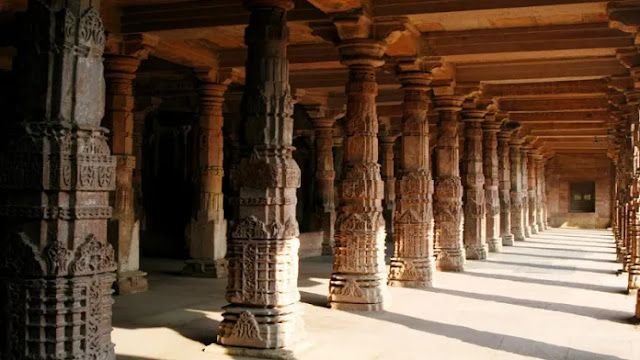
The pillars, arches, carvings, and inscriptions display elements associated with medieval Paramara architecture. The artistic richness is more visible through intricate floral designs, geometric motifs and sculptural fragments. Inscriptions in sanskrit, grammatical diagrams and educational inscriptions gives a strong evidence of the place associated with education.
One of the most important discoveries of Bhojshala was a beautifully carved image believed to represent Vagdevi or Saraswati. The artistic detailing and elegance of the sculpture made it more famous.
During the colonial period, this idol was removed from India and eventually reached United Kingdom, where it is currently placed in the British Museum. The loss of the idol remains emotionally significant for many who view it as an important symbol of India’s intellectual heritage.
The Fall of the Paramaras:
The Paramara kingdom declined after king Bhoja’s death. In 14th century Delhi Sultanate ruled the region. Historical accounts associate the construction of the Kamal Maula Mosque at the site with this period. Like many medieval sites in the Indian subcontinent, the structure became layered with multiple histories rather than remaining frozen in a single era.
The Kamal Maula Connection:
The mosque associated with the site is linked to the Sufi saint Kamal al-Din, often referred to as Kamal Maula. Over centuries, the structure became important to sections of the Muslim community as well.
Thus, Bhojshala evolved into a place carrying overlapping religious memories.
This dual association later became the center of intense historical and political debate.Historians, archaeologists, religious groups and political organizations have all offered differing interpretations and many questions were raised regarding this topic.
Colonial Archaeology and Documentation:
During British colonial rule in the 19th century, the archaeologists started documenting the Bhojshala system. They studied inscriptions, sculptures and architectural fragments found at the site.
Several reports described the structure as containing remnants of temple architecture alongside later Islamic additions. The famous Saraswati idol was also documented during this period before being taken abroad.
Still many medieval Indian structures had experienced centuries of adaptation, destruction, reconstruction and reuse, making their histories far more complex than simple labels allowed. Nevertheless, British records played a major role in shaping later public debates about Bhojshala.
The Saraswati Idol:
Perhaps no object symbolizes Bhojshala more strongly than the idol of Vagdevi.The sculpture depicted the goddess seated gracefully, representing wisdom and artistic excellence. Art historians praised it as one of the finest examples of medieval Indian sculpture from central India.
After its removal during colonial times, the idol eventually became part of museum collections overseas.For many Indians, especially cultural activists and historians, the idol represents a lost piece of heritage similar to other artifacts removed during the colonial era.
Demand for its return emerge in public discussions about cultural repatriation as this topic is out for global conversation many stories came forward about whether artifacts taken during colonial periods should be returned to their place of origin.
Bhojshala in Modern India:
In independent India, Bhojshala became one of the country’s most sensitive heritage sites because of competing religious claims.
Administrative arrangements were introduced over time regarding access and worship practices. Different communities were allocated specific days for prayer and worship at the site. During festivals or politically sensitive periods the security around the Bhojshala increased due to tensions surrounding the monument.
Court cases, archaeological surveys and public debates have continued for decades. Yet beyond controversy, many scholars urge people to view Bhojshala as a shared historical space that reflects the layered nature of Indian civilization itself.
India’s past was rarely linear. Temples became mosques, mosques became administrative buildings, palaces became ruins, and sacred spaces evolved with changing political powers. Bhojshala is one such monument where multiple centuries speak simultaneously.
The Intellectual Legacy of Bhoja:
Beyond all debates it is important to celebrate the cultural sight which is associated with education.
King Bhoja was known as a scholar-king in history. Traditional accounts credit him with establishing educational institutions and supporting scholars from across regions.
Texts associated with Bhoja discuss:
- Grammar
- Sanskrit poetics
- Medicine
- Astronomy
- Architecture
- Philosophy
- Yoga
His court symbolized the ideal of a ruler who valued intellect as much as military power.
The memory of Bhojshala therefore survives not only as a disputed monument but also as a symbol of India’s long scholarly tradition.
Why Bhojshala Matters Today:
Bhojshala is important because it forces modern society to confront difficult but necessary questions:
- How should layered heritage sites be understood?
- Can history belong exclusively to one community?
- How should archaeology, faith and politics interact?
Bhojshala offers a valuable view on architecture, Sanskrit education and the Paramara empire. It carries spiritual significance for many and for archaeologists it preserves fragments of artistic brilliance.
The Silent stone place:
Today, the visitors get the view of weathered pillars, ancient inscriptions and ruins that have survived centuries of history and transformation. It was once visited for learning, devotion. The site still reflects the legacy of King Bhoja and respect for knowledge and wisdom. Keeping the modern day debates aside the Bhojshala remains a symbol of India’s rich intellectual and cultural heritage.