Girls Out of Line: Sukeban and the Politics of Defiant Femininity

-Oishee Bose
For many observers in the mid-twentieth century, Japan presented a convincing image of social discipline: regimented schools, deferential workplaces, and a tightly policed public morality that valued conformity, hierarchy, and a narrowly circumscribed feminine ideal. That very culture of visible order and predictability makes the sukeban phenomenon all the more contradicting. From the late 1960s into the 1970s, pockets of Japan’s schoolyards and urban neighbourhoods became the stage for a subculture of young women who deliberately refused the roles written for them. Rather than a slow, institutional campaign for rights, their rebellion was embodied, immediate, and theatrical, written on seifuku, rheumatic in group ritual, and loud in the street. The sukeban are worth revisiting not because they fit a tidy narrative of feminist progress, but because they force us to reckon with a messy, local, and often violent practice of female agency that unsettled a society which imagined itself orderly.
Origins and social context: exclusion, class, and the logic of formation
Sukeban groups did not appear out of an abstract desire to shock. Their immediate origin was practical: male delinquent groups (banchō) typically excluded women, and girls who wanted the solidarity, status, or protection associated with gang belonging, formed their own all-female units. These groups crystallised in the late 1960s and became especially visible in the 1970s, as juvenile delinquency and media anxieties about youth behavior rose in tandem. The phenomenon must be read against post-war modernisation, urbanisation, and the constraints of an education system and social order that prescribed a narrow destiny for many young women—marriage, domestic authority, and invisibility in the public sphere.
The sexual revolutions of the 1960s were not a sidebar; they were part of the milieu. Shifting norms about sexuality and public comportment intersected with rigid school discipline to create both new aspirations and new anxieties. For many young women from lower-middle-class or working-class families, the promise of social mobility through formal institutions looked remote. In that context, truancy, petty theft, and group toughness became not only rites of transgression but also techniques for creating social capital and material support. Sukeban groups therefore performed a dual function: practical mutual aid and symbolic rejection of a gendered script that limited female public authority.
Many accounts and oral histories collected later emphasise the interweaving of scarcity and spectacle. Girls who might otherwise have been invisible in the labour market, found the classroom, or family in gang life, as it provided practical resources (shared money, pooled cigarettes, food, and protection) and a public identity that asserted they were no longer to be counted as negligible.
The schoolyard as theatre and battlefield
Sukebans could be located in the schoolyard as much as on the street. Schools were primary sites of control: dress codes, timetables, moral instruction and thus also primary sites of insurgency. Sukeban power often unfolded between classes, in bathrooms, on stairwells, and at school gates. Their presence inside the school reworked schoolspace itself: the classroom and corridor became arenas where feminine docility was contested. The street extended and amplified these struggles but the schoolyard was not incidental; it was foundational.
How they looked and why it mattered: the uniform as manifesto
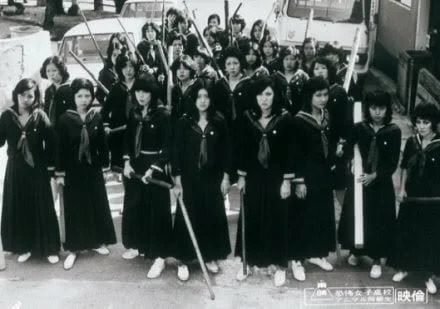
One of the most immediate and legible acts of sukeban rebellion was sartorial. Seifuku, the classic sailor-style Japanese school uniform that signalled conformity was taken apart and reassembled as a tool of defiance. Skirts were lengthened (a deliberate rejection of the contemporary miniskirt trend that some commentators read as sexualised and commodified); sleeves were rolled up; jackets were scrawled with kanji, gang insignia, and personal emblems; hair was permed or dyed in striking shades; and sneakers or loose socks replaced demure footwear. Surgical masks, cigarettes, and visible scrawls on jackets became semiotic signals: “we are not the girls you expect.”
These adjustments were not merely aesthetic choices: they were semiotic interventions that remade the uniform from an emblem of docility into an emblem of collective identity and resistance. Clothing had functional uses as well with layers and folds concealing razors, chains, and makeshift weapons turning everyday attire into both costume and armour. The image of the schoolgirl thus became doubled: both costume and combat gear.
Importantly, the sukeban aesthetic announced a resolved ambiguity: were these girls primarily students, criminals, performers, or political actors? The answer circulated between all these categories; intended ambiguity was itself a political act in a society invested in legible social roles.
Structure, codes, and everyday governance: hierarchies, punishments, and care
Sukeban were not amorphous mobs. They organised themselves with strict hierarchies, rituals and punishments that both enforced internal cohesion and performed seriousness to outsiders. Senpai–kōhai (senior–junior) relations structured daily life; initiation rites and oath-like codes reinforced loyalty; and infractions could be met with harsh sanctions. Cigarette burns as punitive measures for disrespect or theft are widely reported in contemporary and retrospective accounts; other documented punishments included physical humiliation, forced confessions, and group-level shaming rituals. These practices made the group’s moral economy visible and feared.
This internal disciplinary logic produced a paradox: the groups resisted external patriarchal control while sometimes reproducing domination internally. Seniority could easily shade into coercion; protection could be enforced through terror.
Yet outside the ritualised toughness, ordinary practices of care also sustained sukeban life, gestures like sharing money and food, looking after injured members after fights, and negotiating safety on the route home. The same hands that meted out punishment were often the hands that stitched wounds, hid a runaway, or lent travel money. These mundane acts reveal how solidarity and survival were braided into the daily texture of the subculture.
What they did: crime, survival tactics, and public perception
The behavioral register of sukeban ranged from adolescent rebellion to organised street conflict. Common activities included truancy, smoking in school bathrooms, shoplifting (sometimes organised, vandalism, fights with rival groups, graffiti, and occasional substance use. In many cases the activities were adolescent in scale; in public discourse they were framed as a sign of social decay. Police pamphlets, tabloid headlines, and television reports amplified isolated incidents into narratives of moral panic.
Exaggerated membership claims are part of that panic ecology. For instance, contemporary and later accounts repeat figures for large alliances with circulating claims that a so-called “Kantō Women Delinquent Alliance” numbered around 20,000 at its height. However, such numbers are often unverified and should be treated as part of the rumor and moral-panic economy surrounding the phenomenon. The circulation of large, imprecise counts mattered less for empirical accuracy than for the political effects they produced: legitimising crackdowns, schooling reforms, and law-and-order responses.
This amplification had real consequences: it invited intensified policing and school discipline, and fed a media demand for sensationalised film and manga that capitalised on public anxiety while aestheticising sukeban imagery.
Media, myth, and the economy of commodification
The sukeban aesthetic migrated rapidly from street to screen. “Pinky Violence” films, which were low-budget exploitation movies of the 1970s, presented violent, sexualised images of delinquent women and turned sukeban tropes into box-office spectacle. Similarly, shōjo and seinen manga serialised sukeban narratives; Sukeban Deka, in particular, became a massively popular franchise that moved between manga, television, and film and helped transform the sukeban into a durable cultural archetype.
These media forms performed a double economy: they spread sukeban imagery and influence widely, even as they sanitised, sexualised, or depoliticised the material roots of the subculture. What existed as grassroots, risk-laden practice became, for many consumers, a set of striking visual codes divorced from their classed and gendered causes.
The result was ambivalent: greater visibility and cultural afterlife on one hand; erasure of socioeconomic context and commodification on the other. Sukeban wardrobe, posture, and iconography were repackaged, sometimes remembered with political edge, often sold as look, and sometimes simply fetishised.
Theoretical reading: performativity, intersectionality, and the “feminist anti-hero”
Judith Butler Kimberlé Crenshaw’s theories provide valuable lens, which could be used to read sukeban to understand their concept and hold paradoxes.
Judith Butler’s theory of gender performativity shows how gender is produced through repeated acts and social performances. Sukeban visibly re-performed the “schoolgirl” script: they took the uniform and reworked it; they claimed behaviours coded as masculine (public swagger, leadership by coercion, street violence); they repeated acts in public that outwardly contradicted normative femininity. In Butler’s terms, sukeban demonstrate that gender is not a stable essence but an enacted field of possibility; and that reworking the script in visible, repeated ways can destabilise normative gender expectations. The seifuku, reworked and re-worn, becomes a daily theater of gender politics.
Intersectionality, first articulated by Kimberlé Crenshaw and developed by scholars insisting feminism attend to class and lived marginality reminds us not to separate gender from class and institutional marginalisation. Many sukeban were young women constrained by economic precarity and limited institutional routes to recognition; their collective actions must therefore be read as responses not only to patriarchal authority but to classed exclusion. Intersectional analysis shows how race (where relevant in Japanese contexts of immigrant or burakumin marginalisation), class, and institutional neglect shaped who joined and how they acted.
Together, performativity and intersectionality let us see sukeban as feminist anti-heroes: neither saints nor simple villains but agents whose practices challenged gender hierarchies while remaining embedded in messy, sometimes coercive social relations. Importantly, applying these theories does not mean celebrating all sukeban practices. The internal violence and punishments complicate any straightforward heroism. Instead, the feminist claim is empirical and ambivalent: female power often emerges in imperfect, embodied, and risky forms.
Debates and historiography: recovering experience from rumor
Interpretations of sukeban have been contested. Police and sensational media constructed them as a public menace; film and fashion repackaged them as aesthetic spectacle; bloggers and nostalgic accounts sometimes romanticise them as proto-feminist rebels. Serious cultural historians, photographers, and archivists have worked to recover ordinary voices through oral histories, school records, and contemporaneous reportage to reanchor analysis in lived experience rather than myth.
Scholars such as Brian Ashcraft (and cultural projects documenting sukeban history) have attempted to mediate between sensational accounts and lived experience, emphasising the need to decouple verifiable facts from rumour (such as unverified member counts). The historiographical task is therefore to foreground internal life as much as headline incidents and to emphasise structural causes like school discipline, class dynamics, and gendered expectations over purely moralising explanations.
Recovering experience also means keeping messy details: boredom, gossip, small kindnesses, injuries stitched in back rooms, and the slow, rheumatic repetition of group ritual that made the group both durable and dangerous.
Decline and afterlives: repression, assimilation, and cultural persistence
By the 1980s the visible street presence of sukeban diminished. Multiple converging factors explain this decline: intensified policing and school discipline; economic and social shifts that changed youth trajectories; mainstream absorption of sukeban aesthetics (which made rebellion purchasable); and the natural aging-out of cohorts who had once been active in the movement. Decline as public presence, however, did not mean extinction. Sukeban iconography and narrative logic persisted in manga, cinema, fashion editorials, and contemporary cultural projects, most recently in performance collectives and women’s wrestling leagues that explicitly draw on sukeban aesthetics and ethos. In this sense the sukeban legacy is ambivalent: the street practice waned, but the cultural repertoire lived on and was repeatedly reclaimed and reinterpreted.
Why this matters: revising how we imagine resistance
Sukeban complicate tidy stories of social change and push us to rethink what emancipation can look like when institutional channels are closed. Their rebellion was local, improvisational, embodied in everyday acts of dress, speech, and group ritual. They show feminism not only as formal politics or academic theory but as embodied practice: risky, visible acts that reconfigure power in everyday spaces.
If the mid-twentieth-century image of Japan was one of seamless discipline and order, sukeban remind us of the fissures beneath any neat public face. Those fissures, when probed, tell us as much about social constraint as they do about creativity, risk, and the many imperfect ways people fashion dignity for themselves.