POEMS OF SURRENDER – Exploring the faith and devotion of Meera Bai

-Tanushree Wadodkar
मेरे तो गिरिधर गोपाल दूसरो न कोई।
जाके सिर मोर मुकुट मेरो पति सोई।
तात मात भ्रात बंधु आपनो न कोई॥।
छाँड़ि दी कुल की कानि कहा करिहै कोई।
संतन ढिंग बैठि-बैठि लोक लाज खोई॥
चुनरी के किये टूक ओढ़ लीन्ही लोई।
मोती मूँगे उतार बनमाला पोई॥
अँसुवन जल सींचि सींचि प्रेम बेलि बोई।
अब तो बेल फैल गई आणँद फल होई॥
दूध की मथनियाँ बड़े प्रेम से बिलोई।
माखन जब काढ़ि लियो छाछा पिये कोई॥
भगत देख राजी हुई जगत देखि रोई।
दासी “मीरा” लाल गिरिधर तारो अब मोही॥
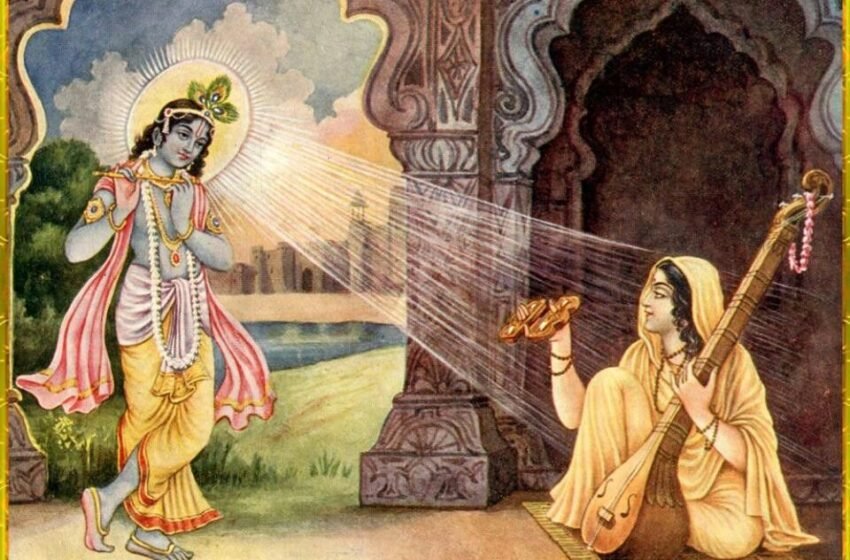
If you recognise these lines, then you already know who this is about. The woman whose life revolved around faith and devotion. The woman who surrendered herself to Krishna. The woman known as his biggest devotee: Meera Bai.
Her devotion to Krishna became the core of her existence. And everything else slowly began to lose importance in comparison to that bond.
Meerabai was a 16th-century Hindu poet and a devotee of Lord Krishna. She is a celebrated Bhakti Saint, particularly in North India.
Early life
Meera Bai was born around 1498 in Kudki, a small village near Merta in present-day Rajasthan. She belonged to a Rajput royal family. Despite being born into privilege, Meera’s childhood was marked by an early and intense devotion to Lord Krishna.
One popular story says that Meera once saw a wedding procession and asked her mother who her husband would be. Her mother, mainly in jest, pointed to an idol of Krishna. Whether it is true or not, the story reflects the emotional foundation of Meera’s devotion.
One legend says that a saint once gave her a small idol of Krishna, and she spent hours with the murti. Even as a child, she spent most of her time praying to Krishna and listening to stories about him. Her connection with Krishna gradually became the centre of her emotional and spiritual life. Krishna became her husband, her companion, and her protector.
Marriage
Meera was married to the crown prince of Mewar and the son of the powerful Rajput ruler Rana Sanga, Bhoj Raj, around 1516. Just like most marriages of that time, this one was also a political alliance between two powerful kingdoms.
As a royal daughter-in-law, Meera was expected to follow the customs of the royal household. Rajput families placed great importance on honour and social conduct, and Meera, like other women of the royal household, was expected to maintain dignity, observe restrictions, and dedicate themselves to family responsibilities.
However, Meera remained deeply consumed in her devotion to Krishna. She spent her time singing bhajans, offering prayers, and attending devotional gatherings. Some accounts say that her husband understood her devotion and defended her in front of his family. Despite his support, her spiritual actions were seen as inappropriate for a woman in her position.
Bhoj Raj lost his life during a battle, and Meera was widowed at a young age. After that, Meera faced even more pressure from members of the royal household, who disapproved of her public devotion and wanted her to behave like a proper Rajput widow.
Conspiracies against her
As Meera’s devotion to Krishna became more open and public, tensions within her household intensified. Her in-laws strongly disapproved of her behaviour. Once, her sister-in-law attempted to tarnish her reputation by telling her husband that Meera was spending the night with another man. This attempt failed as Meera proved that she was only talking to the idol of Krishna.
After her husband’s death, their attempts to harm her only increased. One widely known story says that once the family sent her a cup of poison disguised as a sacred offering. Meera consumed it fearlessly while praying to Krishna, yet survived unharmed as the poison turned to nectar. Another legend says that she was given a basket full of snakes, but when she opened it, there were flowers in it (or, according to some accounts, an idol of Krishna). These stories highlight how Krishna himself protected his biggest devotee.
Her Devotion
Devotion wasn’t just a part of Meera Bai’s life. It was her whole identity. She believed she had a connection with Krishna that was beyond worldly relations. Even in her bhajans and poems, Krishna is not portrayed as a distant God, but rather a companion and lover.
Meera’s devotion was never confined within the walls of a temple. She sang bhajans and danced openly, often in the company of saints and other devotees. Her devotion was pure and deeply personal. She spoke of love, longing, and separation in a language that was easy to understand for everyone.
Meera’s poetry became part of the larger Bhakti tradition that emphasised personal connection with the divine. Her bhajans were not just sung in temples, but also at home and in public gatherings. Some accounts say that her teacher was Raidas, but there is no concrete proof of that.
Her final years
In the later years of her life, it is believed that Meera Bai travelled to places associated with Krishna, like Vrindavan and Dwarka. She spent much of this period immersed in prayer, singing, and spiritual practice.
However, the details regarding her death are unclear. One legend claims that Meera entered a temple dedicated to Krishna in Dwarka and disappeared into the idol itself, symbolising complete union with the divine. Her death is estimated to have occurred around 1546.
Even centuries after her death, Meera Bai continues to hold a special place in Hindu devotional culture. She is remembered not only for her complete devotion to Krishna, but also for the courage with which she followed her spiritual path despite opposition from her own family.
Her bhajans are still sung today, and her poems are taught in schools and literature. Unlike many bhakti saints, Meera Bai’s path was not just about spirituality. It was also about the constant conflict between her faith and social expectations for women.
Especially in today’s world, spirituality and faith can be extremely powerful in achieving peace. And perhaps that is why Meera Bai’s poems still feel personal and relatable.