The glory of Vijayanagara – The story of the mighty South Indian Empire

-Tanushree Wadodkar
The Vijayanagara Empire was one of South India’s most glorious kingdoms and was famous for its art, architecture, and administration.
It was founded by Harihara and Bukka in 1336. It was ruled by four dynasties: Sangama, Saluva, Tuluva, and Aravidu. The capital of the empire was Vijayanagara, which was located on the banks of the Tungabhadra River.
Vijayanagara reached the heights of glory under King Krishnadevaraya, who was known for his military strength, efficient administration, and patronage of art and literature. The kingdom had a strong army, a prosperous economy, flourishing agriculture, and markets filled with a variety of goods. The Vijayanagara Empire is also remembered for its magnificent temples and architecture, such as the Virupaksha and Vittala temples, which reflect the excellence of the Dravidian style.
Administration of the empire
The administration of the Vijayanagara empire was centred around the king, who was advised by a Council of Ministers: Mahapratinidhi. The kingdom was divided into provinces called Rajyas, and these were further divided into districts (Nadu), sub-districts (Sthala), and villages (Grama). Each province was governed by a Mandaleshvara, and the village headman was called the Gauda.
The Nayakara system
The Nayakara system was established during the rule of Krishnadeva Raya. Officials called Nayakas were assigned a piece of land to govern, collect taxes, and maintain troops for the king. They were required to provide military support to the king during wars. They collected taxes from peasants, artisans, and traders in their assigned areas. The Nayakas also sent tributes to the king and personally appeared in the court with gifts to express their loyalty.
The Iqta system of the Delhi Sultanate may have influenced the Nayaka system.
The Ayagar System
The Ayagar system was a hereditary system for village administration. All the village affairs were managed by a group og 12 individuals (Ayagars). They were paid through tax-free land called Manyas.
The revenue and economy
The Vijayanagara empire relied mainly on taxation for revenue.
The main revenue source was the land tax. This was often between one-third and one-sixth, depending on the quality of the soil. Other taxes included property tax, transit tax, and import tax. Professional taxes were levied on weavers, goldsmiths, potters, shepherds, and fishermen. Military contributions during wars were also collected.
The Vijayanagara Empire had a prosperous and flourishing economy. Agriculture thrived in different parts of the country, and the kingdom invested in building infrastructure for irrigation, such as the Kamalapuram tank and the Hiriya Canal. The major crops included rice, spices, sugarcane, coconut, and cotton.
The empire also had trade relationships with Arabia, Persia, South Africa, Burma, China, and the Malay Archipelago. Popular exports included cloth, rice, iron, sugar, and spices, and items such as pearls, copper, and mercury were imported. Horses were imported from Central Asia, and local traders known as ‘Khudrai Chettis’ controlled the trade.
Industries like textiles, mining, metallurgy, and perfumery were organised into guilds.
Military organisation
The military department of the Vijayanagara Empire was called Kandachara and was administered by officials known as Dandanayaka.
The military chiefs (Nayakas), who were granted territories to govern, maintained a fixed number of soldiers, horses, and elephants for the central army.
The Vijayanagara army consisted of well-maintained infantry, cavalry, artillery, and war elephants. The empire was surrounded by thick-walled forts for defence. A separate naval force also existed to protect trading coasts.
The military effectiveness helped the empire dominate South India for over two centuries.
Art and Architecture
Vijayanagara’s art and architecture combined South Indian styles (Chalukya, Hoysala) with Indo-Islamic elements. The empire’s architecture includes religious architecture (temples, statues, ritual halls), court architecture (palaces, audience hall), and civic architecture (pavilions, markets).
Temples: Temples in the Vijayanagara empire, which consisted of features like garbhagriha, mandapa, rangamantapa, and Pradakshinapath, were exemplified by the Gopurams (gateway towers). Another notable feature included the monolithic rock pillars, which were often carved out of a single block of stone.
The Hazara Rama Temple in Hampi has scenes from the Ramayana carved out on the walls. Other temples depicting the Vijayanagara architectural style are the Virupaksha Temple and the Vitthala Temple.
Court architecture in the Vijayanagara Empire was built for power and daily use. The capital at Hampi had large palaces, open halls, and strong fort walls. The palaces were set on high platforms and made of stone bases with brick and wood above. Many parts are lost, but the layout is still clear. The Mahanavami Dibba was a tall platform used for royal events and public shows. Nearby stood the Lotus Mahal, known for its light arches and airy rooms. The Elephant Stables show how even service spaces were planned with care. Fort walls had gates, watchtowers, and long paths to control entry. Water tanks and channels ran through the area. The empire was surrounded by seven layers of fortification, which enclosed the agricultural fields, roads, and cities.
Decline of the Vijayanagara Empire
After the death of Krishnadeva Raya, the empire faced internal instability. The weak rulers were not able to manage the rebellious and powerful Nayakas.
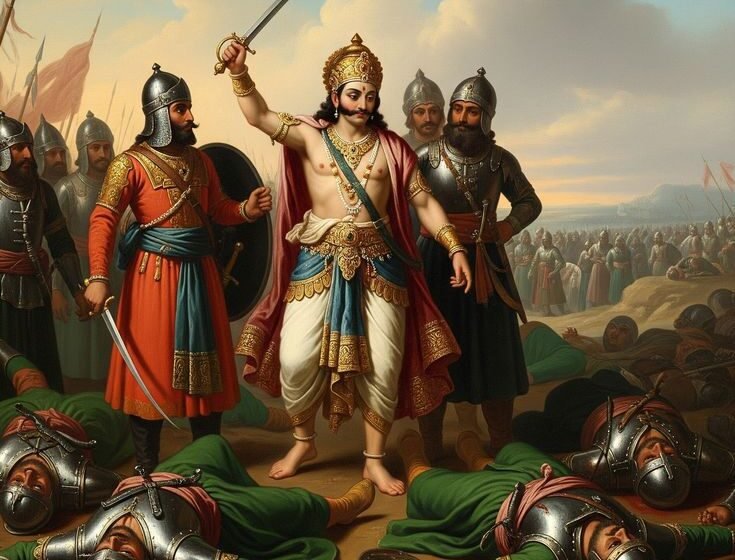
The main reason for the decline of the Vijayanaga empire was the defeat at the battle of Talikota in 1565 against the Deccan sultans. Rama Raya manipulated the sultans and tried to instigate them against each other. When they realised this, they allied. Rama Raya had to face the combined army of Bijapur, Golconda, and Ahmednagar. He was captured and killed during the battle. Following the defeat of Rama Raya, Hampi was sacked, burned, and looted. The city was destroyed and left in ruins.
There were also accusations that the key army generals abandoned the battlefield at a crucial moment. Moreover, the Nayakas began operating independently, diminishing the central authority.
The Vijayanagara Empire remains one of the greatest examples of strength, culture, and organisation in Indian history. From its strong administration and powerful rulers to its rich art, architecture, and military success, the empire showed how a kingdom could achieve both stability and prosperity. Its story shows how strong leadership, planning, and support for the arts can create a lasting legacy.