Maharaja Rameshwar Singh, King of Darbhanga: Mahasidhha in All Mahavidya

-Devashree Kulkarni
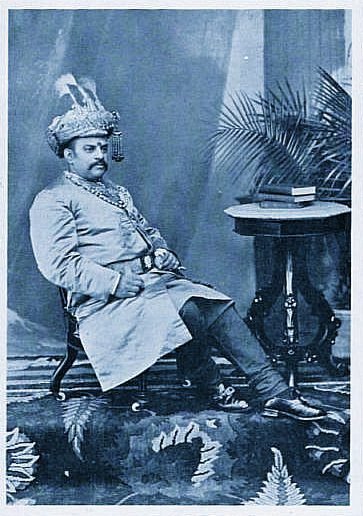
We often think about kings with war, money, power, politics and throne but there were few kings who carried a royal responsibility with the sense of spirituality. One of them was Maharaja Rameshwar Singh. He was the king of Darbhanga and ruled in royalty but he was also an erudite scholar who practiced spirituality and estoric Mahavidyas. His life is unique blend of royal power and deep mystery.
Early life & Education:
Rameshwar Singh was born in 1860 into the powerful Darbhanga Raj family. The Darbhanga kingdom, located in present-day Bihar was known for its economic strength and rich in culture and art.
After his brother’s death, he became a new king of Darbhanga. Unlikely the other rulers of that time he was inclined towards the intellectual growth while taking care of other royal duties. He had an active role in educational reformation and associated with Indian National Congress. Over the time he got connected to something more deeper.
Maharaja Rameshwar was exposed to Indian as well as western education. He was deeply trained in Sanskrit, philosophy and classical texts which initiated his interest in spiritual and tantric studies. He was also exposed to modern education under the British system, which helped him develop an understanding of administration, law and governance. He was a unique blend of ruler and a scholar.
Journey of a Mahasiddha:
Maharaja Rameshwar Singh’s daily life was really unusual. He would get up at 2 a.m. and sit on his bed to read the entire Sri Durga Saptashati to start his day. Then he would take a bath and do Vaidika Sandhyavandana and Sahasra Gayatri Japa. After that he would do Pindadana with rice and then he would do his daily worship of the Parthiva Shivalinga and then go to the temple of Goddess Bhagavati. At the temple, he would do Tantrika Sandhyavandana and Patrasthapana in the way that tantric rituals say to.
Then he would worship Goddess Mahakali by doing Avarana Puja, Japa, Panchanga Patha and Pushpanjali, as well as the Kakaradi Sahasranama. Then came the Kumari, Suvasini and Vatuka Puja and Tarpana and finally the Samayika Puja. He would eat Mahaprasada after finishing these rituals and they do his royal duties. During the Pradosha Kala, he would then take another bath and do Vaidika Sandhyavandana, Gayatri Japa and finish Parthiva Puja. At night, he performed Sangopanga Nisharchana of Devi Bhagavati. During this ritual 108 Brahmins would collectively chant the Durga Saptashati, while 51 Brahmins performed Rudrabhisheka.
As Maharaja Rameshwar Singh ruled over a large kingdom, he became very interested in Hinduism, especially its tantric traditions. Tantra is a complicated spiritual system that focuses on energy, consciousness and transformation. The idea of the ‘Mahavidyas’ ten powerful forms of the Divine Feminine, is at the heart of this tradition. Each one represents a different part of the universe, from creation to destruction and from knowledge to power. These are not just worshipped; they are realized through intense spiritual discipline. This is where his journey gets really interesting. He was regarded as a ‘Mahasiddha’ which means a practitioner who had attained a high level of spiritual mastery through dedicated sadhana centered on the Mahavidyas.
What makes his life even more important is that he didn’t just practice what he knew; he also kept it alive.His palace was a centre for political discussions, spiritual practices, ritual and intellectual conversation regarding tantra and philosophy. He helped the scholars and practitioners which always used to keep this topic as secret. He also studied and promoted sanskrit texts and tantric literature to enhance people knowledge regarding spiritual and philosophical truths. This combination of practice and scholarship shows a rare balance, which makes his legacy not only royal but also very intellectual and spiritual.
Where Tantra Meets Knowledge and Realization:
Rameshwar Singh in 1908 organized a conference for all the scholars in tantra. The guest were Paṇḍita Prakasananda Jha of Vaidyanath Dham, Paṇḍita Shivachandra Bhaṭṭacarya of Kashi, Srividya sadhaka Paṇḍita Subrahmanya Shastri and John Woodroffe (Arthur Avalon), who was associated with the Agama Anusandhana Samiti.
During his seminar, Maharaja explained in detail about relation between Mahavidyas and pranas. He clarified that the five praṇas and five upapraṇas in the human body correlate to the Dasa Mahavidyas, which link the individual to the cosmos, in accordance with traditional tantric teaching. He went into great depth about this relationship:
- Mahakali and Tara in the reproductive region as apana and kurma
- Shodashi and Bhuvaneshwari live in the heart as prana and naga
- Bhairavi and Chinnamasta in the throat as udana and devadatta
- Dhumavati and Bagalamukhi in the navel region as samana and krikara
- Matangi and Kamala in the brain as vyana and dhananjaya.
This interpretation reflects not only his scholarly depth but also his experiential understanding of tantric philosophy.
A Visionary Ruler:
In 1908, he organized a conference of tantra scholars, bringing together learned practitioners and thinkers to discuss, preserve and promote this often misunderstood field. The tantra practices were held as a major secret but he introduced the real side to the world and propagate accurate knowledge with the help of experts in this field.
Beyond his deep spiritual pursuits Maharaja Rameshwar Singh also played an important role as a ruler and philanthropist. He served as a member of the Bengal Legislative Council, actively participating in governance during the colonial period. Also he supported education and responsible for major initiative in formation of the Banaras Hindu University. He fulfilled his administrative responsibility also work towards intellectual and social upliftment of the society.
A Legacy That Lives On:
Maharaja Rameshwar Singh passed away in 1929 but his legacy continued to live on far beyond his lifetime. Well known for his mastery of Mahavidyas through sadhana and called as Mahasiddha this spiritual path transformed his life and the people around him. Through his guidance, patronage of scholars and dedication to preserving tantric knowledge. He inspired many people to explore beyond materialistic life and dive deep into spiritual truths. Today he is remembered as a intellectual king and spiritual figure who keeps the traditional values alive.