IN THE SHADOWS OF RAMA – The story of Lakshmana, Bharat, and Shatrughna

-Tanushree Wadodkar
Ramayana is more than just a mythological epic. It is culture, dharma, and a story that taught us how good always wins over evil. Naturally, the story revolves around Lord Rama, who is considered to be the seventh avatar of Vishnu. Ramayan mentions, in detail, Rama’s childhood, his marriage to Sita, his sacrifices, and his righteousness. But what is less talked about are the people who stood firmly behind him, who were devoted to him, and made sacrifices for him.
His three younger brothers, his pillars of strength: Lakshmana, Bharat, and Shatrughna.
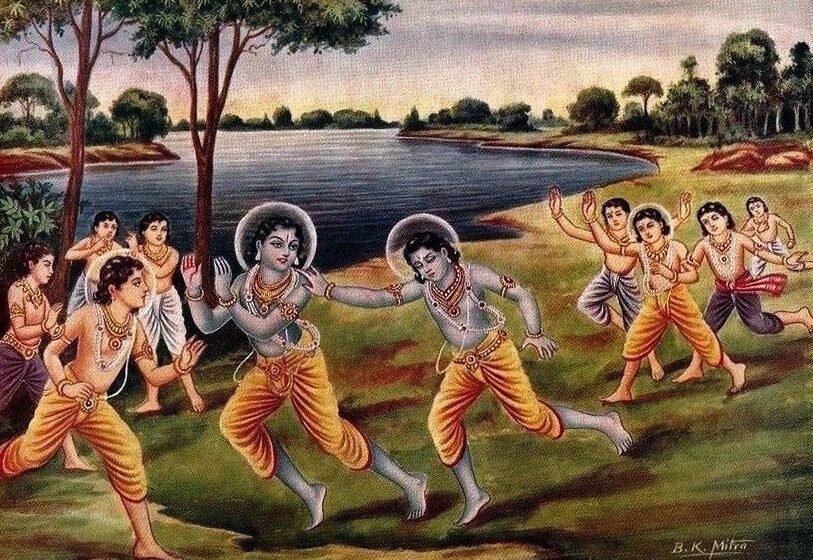
All four brothers grew up together in Ayodhya and later in their Gurukul. Ever since birth, they shared a bond so strong that it felt almost divine. Lakshmana, Bharat, and Shatrughna were extremely devoted and loyal towards their elder brother. Their very childhood laid the foundation of brotherhood as the base of the story.
Lakshmana
Lakshmana was born to Queen Sumitra and was extremely devoted to Rama from childhood. He believed his life’s dharma was to serve and protect his brother. Rama and Lakshmana were inseparable from each other, and Lakshmana even went with Rama to assist Rishi Vishwamitra. Alongside Rama, Lakshmana was wed to Sita’s younger sister, Urmila.
When Rama decides to give up the kingdom and go into exile (due to Dashrath’s promise to Kaikeyi), Lakshmana also accompanies him. He leaves behind the comforts of his home and his beloved wife, Urmaila, to follow his brother. Urmila also stood behind her husband and supported his duty to serve his elder brother. To protect his bhaiya-bhabhi day and night, Lakshmana gives up his sleep for 14 years. Urmila takes his sleep for 14 years, making a sacrifice unlike any other.
When Sita is abducted by Ravana, Lakshmana does everything in his power to help Rama find her. He fights fiercely in the battle against Lanka, even getting fatally injured by Meghnad. After he is saved by the medicine bought by Hanuman, he attacks Meghnad once more and kills him.
After their return to Ayodhya, Lakshmana continues to act as a pillar of support for his brother, who is now the king. According to Valmiki’s Ramayana, Lakshmana and Urmila had two sons, Angada and Chandraketu.
As per the Uttar Kanda of the Ramayana, when Yama came to see Rama, he was promised that any interruption during their meeting would lead to death. Lakshmana was standing guard outside when Sage Durvasa arrived, demanding to see Rama immediately or he would curse the kingdom. Lakshmana had no choice but to interrupt Rama, and thus, he was banished. Accepting this, Lakshmana gave up his life through a Jal Samadhi in the Sarayu River.
As an incarnation of Shesnag, he needed to depart from Earth and leave his human form before Rama.
Bharat
Bharat was the second-oldest son of Dashratha, born to Kaikeyi. He was married to Sita’s cousin, Mandavi. He is remembered as a loyal and deeply righteous person.
When Bharat found out that his mother had sent his brother into exile, he was overcome with grief and anger. He felt no joy in becoming the kind and instead questioned Kaikeyi about her wrongdoings. He refused to accept the throne and openly condemned his mother’s actions.
Accompanied by Shatrughna, the ministers, and the people of Ayodhya, Bharat set out for the forest to bring his brother back. He requested and pleaded with Rama to return as the rightful king, but Rama refused, bound by his father’s promise. Bharat, although saddened, respected Rama’s wishes and asked for his sandals (padukas). Upon returning to Ayodhya, he placed the padukas on the throne and declared that he would not be the king. Instead, he would rule only as Rama’s representative until his return. Moreover, he also left the royal palace and went to stay at Nandigram, and also wore simple clothes. He ruled the kingdom in Rama’s name and ensured that dharma was upheld. For years, he carried the guilt of a crime he did not commit.
When Rama finally returned to Ayodhya after completing his exile, Bharat joyfully restored the kingdom to him without hesitation. Bharat and Mandavi had two sons, Taksha and Pushkal.
Bharat stands as an example of humility and brotherhood. Even when he was handed a whole kingdom, he refused and spent 14 years waiting for his brother to return.
Shatrughna
The youngest son of Dhashratha and Sumitra, Shatrughna, is one who is least talked about. He and his wife, Shurtkirti, were examples of silent strength and unwavering support.
When he came to know about Rama’s exile, he was filled with anger and grief. In some versions of the Ramayana, he even punished Manthara, the maid who had influenced Kaikeyi. Despite all his anger, he stood firmly beside Bharat and supported his decision to leave the royal palace.
Shatrughna’s role in the Ramayana is more subtle but equally important. With Rama and Lakshmana in the forest, and Bharat in Nandigram, the responsibility of taking care of the palace and the mothers fell on Shatrughna. He worked tirelessly to ensure proper administration in the empire and kept everything running smoothly so that Bharat could fulfil his promise to Rama.
Once, after Rama’s return, he was asked by his brother to go and kill the demon Lavanasur, who had been tormenting the sages and priests. He successfully defeated Lavanasur, proving his capabilities as a brave warrior.
Although he may not have been a central figure, his devotion and dutifulness made him an integral part of the Ramayana. Just like Lakshman was dedicated to Rama, Shatrughna was dedicated to Bharat.
In the centre of the story stands Rama, the embodiment of dharma. But his greatness is not isolated. Instead, it is strengthened by the love and support of his brothers. Bharat, Lakshman and Shatrughna lived more for Rama than they did for themselves. Bharat’s refusal to accept the throne, Lakshmana’s decision to accompany Rama into exile, and Shatrughna’s dedication to supporting Bharat all reflect a shared moral compass guided by righteousness.