The night goa builds Narakasura: a different Diwali tradition

–Parth S. Bhale
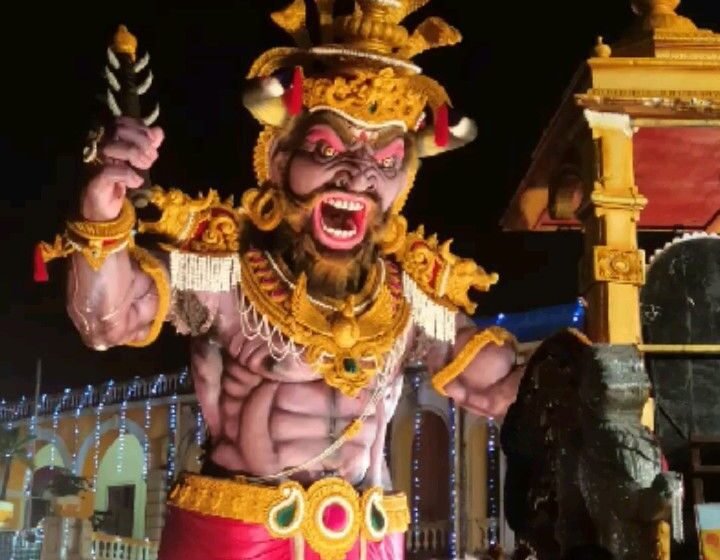
When we think of Diwali in Goa, we often imagine lamps, decorations and a joyful atmosphere. But Goa’s Diwali also has a tradition that can feel very different and surprising to someone seeing it for the first time. On the night before Diwali, large effigies of Narakasura can be seen standing in different parts of Goa. Some of these effigies are so large that they immediately attract the attention of everyone passing by.
If such an effigy suddenly appeared in front of us, we might feel frightened for a moment because the place and the tradition would be completely new to us.
After a moment, however, we realise that this is not simply a frightening figure. It is an important part of Goa’s Naraka Chaturdashi tradition. The effigies are connected with the mythological story of Narakasura. According to the story, Lord Krishna defeated Narakasura, and his defeat is associated with the victory of good over evil. In Goa, this story takes the form of a large community celebration.
Building the effigy is not something that happens in a single night. Preparations begin days in advance. Local groups, young people and members of the community come together and take part in making the effigy. Materials such as bamboo, paper, cloth and other available materials are used to create its structure. In modern times, some places have also started making much larger and more elaborate effigies.
Many people come together and work hard to create these effigies. Through this tradition, people come together and celebrate Diwali with enthusiasm. Since this festival comes only once a year, people have to wait for another year to experience this special moment again.
Looking at these effigies, another thing becomes clear: they are not only religious symbols but also examples of local craftsmanship. Giving the effigy its shape, painting it, creating its details and finally giving it a finished appearance requires considerable effort.
Making this effigy is also a form of artistic skill. Giving it the right shape, painting it, creating the small details and finally giving it a proper finish require skill and experience. Such detailed work cannot be mastered immediately; it takes practice and experience. Therefore, behind a well-made Narakasura effigy, the hard work and skill of the artists also play an important role.
This tradition has also changed over time. Older local accounts describe simpler effigies made using materials such as bamboo, grass, paper and old clothes. Over time, the size, decoration and public display of the effigies grew. Some researchers have suggested that larger public celebrations and competitions became more popular during the late 1960s and 1970s. However, there is no complete agreement about the exact origin of the tradition.
As the night progresses, the atmosphere around the effigies becomes more noticeable. People in different areas gather around the effigies that have been prepared in their communities. In many places, local groups and young people play an important role in creating them. As a result, the celebration becomes more than just the display of an effigy; it becomes a shared community experience.
For many people watching this celebration, a different kind of feeling is created— something that may be difficult to fully express in words. Seeing many people come together to celebrate the festival creates a unique sense of joy and excitement.
Then comes the most important moment of the tradition—the burning of the Narakasura effigy. On Naraka Chaturdashi, the effigies are traditionally burned before dawn in many places. A large figure that has taken days of effort to create is suddenly consumed by fire. Connected with the mythological story, this act is seen as a symbol of the victory of good over evil.
There is a striking contrast in this moment. The same effigy that people have spent days working hard to create is eventually burned. Perhaps this is also part of the meaning of the tradition. The effigy is not created to remain forever; for a short time, it brings a story, a symbol and the spirit of the festival to life before finally coming to an end.
The tradition of Narakasura in Goa reminds us that Diwali is not celebrated in exactly the same way everywhere. The culture of a region, its people, their creativity and their participation can give the same festival a completely different form. The night of Narakasura in Goa is a living glimpse of that difference.
Written By :- Parth S. Bhale