The Lost Golden Age- The rise and decline of the Gupta Empire

-Tanushree Wadodkar
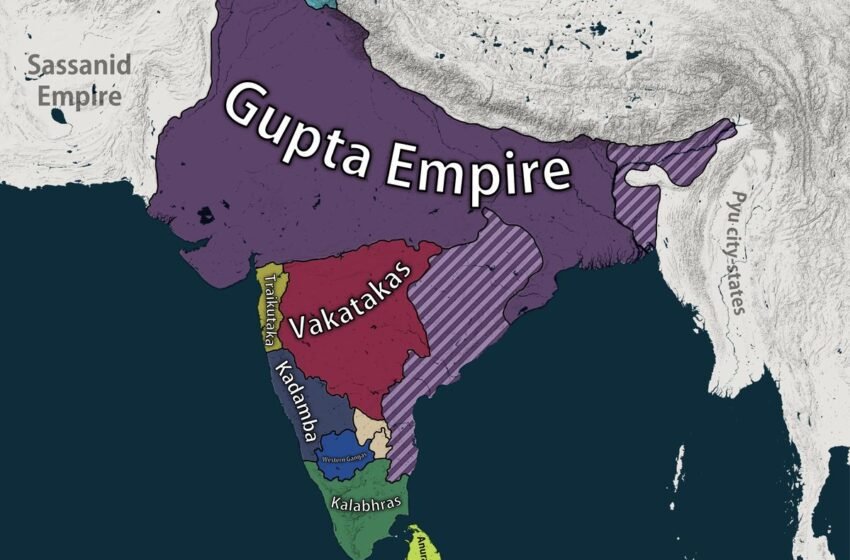
The Gupta Empire is remembered as the “golden age” because of the remarkable advancements in culture, art, and science that the period witnessed. After the decline of the Satvahanas and Kushanas, there were no powerful kingdoms in India until the emergence of the Guptas. The empire began as a small kingdom in Bihar-Uttar Pradesh and expanded into parts of central, northern, and western India. These areas were consolidated under rulers like Chandragupta I, Samudragupta, and Chandragupta II.
Start of the Gupta Empire
At the beginning of the 4th century A.D, there were no powerful kingdoms in India, and new ruling dynasties had begun to form. One of them was the Guptas.
There are various theories regarding the origins of the Guptas. However, it is widely accepted that they belonged to regions of present-day Uttar Pradesh or Bihar and rose to power from being regional rulers.
The origin of the Gupta Empire can be traced back to Sri Gupta, who ruled the Magadha region (as a regional ruler). Numismatic evidence and inscriptions have been found to support this.
Establishing the empire
The person credited with establishing the Gupta Empire is Chandragupta I. He transformed the Guptas into a powerful empire. He consolidated power in Magadha and strengthened his position through a strategic marriage to a Lichhavi Princess. The reign of Chandragupta I is credited with political stability and the beginning of centralisation.
Important rulers
After Chandragupta I, the empire was ruled by his son Samudragupta. He was one of the most remarkable rulers of the dynasty. His court poet, Harisena, wrote extensively about him in the Allahabad Pillar Inscription, also called Prayag Prasasthi. It mentions that he defeated many kingdoms in the northern part of the country and expanded his territories. His empire extended from the Ravi River (west) to the Brahmaputra River (east), and from the Himalayan foothills in the north to central India in the south-west. He also performed the first Ashwamedha Yajna after Pushpamitra Shunga.
Samudragupta is also popularly known as the “Napoleon of India” as he remained undefeated in all his conquests.
After Samudragupta, the empire was ruled by his son Chandragupta II. He was one of the most powerful rulers of India and was also known as Vikramaditya. He continued his father’s expansion policy by consolidating territories such as Gujarat, Malwa, and Saurashtra. According to Amrakardava’s Sanchi inscription, he was also known as Deva-raja.
Administration of the Gupta Empire
Administration in the Gupta Empire was a mix of centralisation and autonomy for the feudatories. This enabled effective administration over the large territories.
The main figure in the Gupta administration was the king, who held immense power. He was responsible for formulating policies, defending the empire, administering justice, appointing officials, and supporting religious communities.
There also existed a council of ministers to aid and advise the king. The Udyagiri inscriptions mention a minister of war and peace, called Virasena. The Mahanandanayaka was the chief justice and handled legal matters. Some of the most important officials in the Gupta empire were the Kumaramatyas, the officers of the crown prince.
At the provincial level, the empire was divided into divisions called bhuktis, which were further divided into districts called vishyas. The buktis were managed by a Uparika, while the vishyas came under Vishyapati. The village headman, called gramadhyaksha, became an important figure and managed village-level issues.
The Gupta Empire had a well-planned and large army. During the war, the army was headed by the king, but the day-to-day matters regarding the military were managed by a minister called Sandhi-Vigrahika. Key military officials were Asvaapati (head of horses), Narapati (head of soldiers), and Pilupati (head of elephants).
The revenue generated from land was the backbone of the Gupta economy. Officials like Akshapataladhikrita and Pushtapala maintained the revenue system. The empire collected one-sixth of the produce as a tax called Bhaga. Other taxes included Hiranya (gold tax), Shulka (commercial tax/customs), Bhoga (gifts), and Kara (irregular tax).
Literary and scientific contributions
The Gupta period witnessed the flourishing of Sanskrit and religious literature. The rulers actively supported and patronised art and literature.
The famous epics of Indian mythology, Ramayana and Mahabharata, were completed in the fourth century. It was in this era that Kalidasa wrote Shakuntala, Meghaduta, and Raghuvamsha. Various puranas (Vishnu Purana, Vayu Purana, etc.) and texts like the Smritis were written. About thirteen plays were composed by Bhasa in Sanskrit: Pratigya Yugandhara Yanam, Daridra Charudatta, and many more. Other significant authors include Shudraka, Dandin, and Bharavi.
The world-renowned mathematician and astronomer Aryabhata (who wrote the Aryabhatiya) explained the Earth’s rotation and presented calculations of planetary movements. The scholar Varahamihira made significant contributions in the field of astronomy by writing Romaka Sidhanta and Panchasiddhantaka. The period also witnessed advancements in the field of medicine and Ayurveda, as texts like Charak Samhita and Sushrut Samhita were written. Sushrut Samhita has some of the earliest mentions of the techniques of surgery.
Decline of the empire
The Gupta Empire flourished under rulers like Chandragupta, Samudragupta, and Chandragupta II. It started to decline under the rule of Kumaragupta and Skandagupta.
The central authority weakened after Skandagupta’s death, as weak successors like Purugupta, Narasimhagupta, and Budhagupta could not manage the empire. The invasions by the Hunas/Hephthalites further sped up the decline. During the reign of Budhagupta, the Hunas had managed to defeat the northwestern army, and by 500 CE, most of the northwestern part of the empire was overtaken by them.
Moreover, the economy declined due to constant invasions, and the increase in land grants had reduced the tax base. As the central authority declined, many chiefs established autonomous rule. The disruption of the Silk Road and the decline of Roman trade reduced the empire’s wealth.
By the mid-6th century, the Gupta Empire had declined due to factors like weak later rulers, invasions and wars, a declining economy, and many socio-religious regions.
The Gupta Age remains one of the most remarkable periods of Indian history. Although it is criticised for its rigid caste system, practices like child marriage and sati, and bramanical dominance, it has left behind a rich legacy in areas of art, literature, science, and medicine.