THE PANCHAKANYAS – Five women from the Hindu mythology

~Tanushree Wadodkar
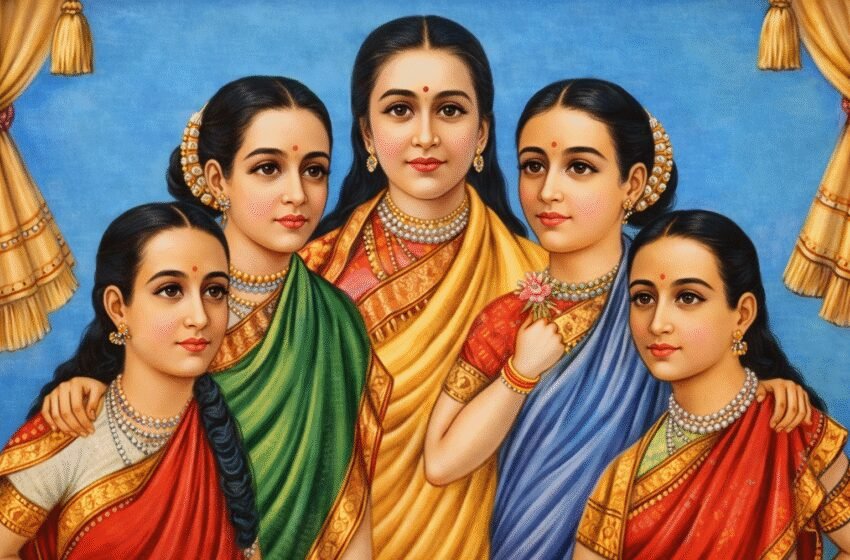
The Panchakanyas are five women from the Hindu mythology who are remembered in hymns and verses for their resilience, strength, and purity. The term “Panchakanya” literally means “five maidens”.
Ahalya Draupadi Kunti, Tara Mandodari tatha
Panchakanya smaren nityam, mahapataka nashanam
This verse literally means remembering the panchakanyas – Ahalya, Draupadi, Kunti, Tara, and Mandodari – will wash away all your sins.
The lives of these women were complex and often marked with hardships. And yet, they are worshipped today as the embodiment of purity and courage.
Ahalya
Ahalya was the daughter of Lord Brahma and the wife of sage Gautama. Ahalya was an extremely beautiful woman. Her story is one of the most debated and controversial episodes in Hindu mythology.
When Ahalya got married to sage Gautama, all the gods were envious, especially Lord Indra, who had been infatuated with Ahalya. After the wedding, sage Gautama began a very hard penance, possibly to take over heaven, after being insulted by Lord Indra.
Indra had become well aware of sage Gautama’s daily routine. So, one day, when the sage had gone out, Indra disguised himself as sage Gautama and approached Ahalyla.
What happens next varies across several versions. Some say that Ahalya is actually deceived and accepts him, while others say she recognised Indra but remains silent.
When Gautama senses that something is wrong and returns, he realises what has happened. In his fit of rage, he curses Indra and turns Ahalya into stone. She remains in that state for years until she is finally set free from the divine touch of Sri Rama.
Draupadi
Draupadi is perhaps one of the most well-known women of indian mythology. Born out of a holy fire to King Draupad, she was married to the five Pandavas (Yudhisthir, Bheem, Arjuna, Nakul, Sahadev). She was known for her beauty, intelligence, and strong will.
One of the major turning points in the life of Draupadi is when her own husband, Yudhisthir, pawns and loses her in a game of dice against the Kauravas. She was dragged to the court by Dushasana and humiliated in front of everyone. AS Dushasana attempted to disrobe Draupadi, she prayed to Krishna to help save her honour. Krishna heard his sakhi’s plight and stretched the sari indefinitely. This left Dushasana exhausted and unable to disrobe her.
This one episode of the Mahabharata is seen as a collapse of dharma and led to the Kauravas’ downfall. Filled with rage and hurt, Draupadi curses the Kauravas and vows to tie her hair only after washing it with Dushasana’s blood. This laid the foundation for the great war at Kurukshetra.
Draupadi’s life was filled with challenges and difficulties. And yet, she is remembered not for her life’s tragedies, but for her strength and defiance. She was not merely a victim, but also the very force that shaped the destiny of the Kurus.
Kunti
Kunti was the daughter of a Yadava ruler, Shaurasena, who gave Kunti to his childless cousin, Kuntibhoja. As a young girl, she was given a boon by Sage Durvasa that she could pray to any God to beget a child from them.
She once got curious and prayed to the Sun God. As a result, she gave birth to Karna. Due to the fear of dishonour and societal stigma, she gave up Karna, who was then found and raised by a charioteer and his wife.
After marrying Pandu, who could not have children due to his curse, she used her boon to summon the Gods of Dharma, Vayu, and Indra to give birth to Yudhisthir, Bheem, and Arjuna (respectively). She also shared the boon with Pandu’s second wife, Madri, who gave birth to Nakul and Sahadev.
After Pandu and Madri’s deaths, Kunti raised all five sons in Hastinapur. She lives as the queen-mother at Indraprashta after the Pandavas establish their kingdom.
Before the Kurukshetra War, Kunti goes to Karna and tells him the truth about his birth. She requests him to join the Pandavas, but he refuses to betray Duryodhan.
Kunti’s story is one of mistakes, silence, and motherhood. She raised five of her sons with love, but left her eldest son in the hands of fate.
Tara
In Ramayana, Tara was the daughter of Sushena and the wife of Vali (King of Kishkindha). She is also the mother of Angad, who played a major role in the battle against Ravana.
She is remembered for her wisdom and intelligence. She had warned Vali against abducting Sugriva’s wife Ruma, but Vali had ignored her. When Sugriva challenged Vali to a fight, Tara tried to persuade Vali not to go. She was certain that Sugriva wouldn’t do such a thing if he didn’t have someone powerful behind him. After Lord Rama strikes Vali with his arrow, Tara rushes to his side. Even in her grief, she understands Lord Rama’s reasoning and accepts that her husband had strayed to the path of adharma.
After Vali’s death, she continued to stay in Kishkindha and had authority over the palace. When Sugriva starts to forget about his promise to Lord Rama, Tara reminds him of his duty towards helping him find Devi Sita.
Tara was intelligent, diplomatic, and knew statecraft. She was more than just a wife or mother, but a woman of wisdom.
Mandodari
Mandodari was Ravana’s wife and the mother of Meghnad, Atikaya, and Akshyakumara.
When Ravana abducts Sita and keeps her captive in Ashok Vatika, Mandodari pleads with him to return her to Rama. She tries to make him see that keeping Sita in Lanka will result in his downfall. However, Ravana does not pay attention to her requests. She also recognises that Rama is, in fact, Lord Vishnu himself.
Mandodari is also said to be extremely beautiful. When Lord Hanuman goes to find Sita, he sees Mandodari and, for a second, thinks she is Devi Sita.
Mandodari is remembered for her wisdom, intelligence, and morality. Even when surrounded by adharma, she fights for righteousness and justice.
These women were more than just wives or mothers. They were examples of strength, resilience, and righteousness. They are not remembered because they were flawless. They are remembered because they overcame everything life threw at them.
What makes these Panchakanyas even more remarkable is that their mistakes and imperfections are not criticised, but rather understood. It was their ability to rise above it all that is still worshipped today.