The Trojan War: Between Legend, Memory and History

-Prachurya Ghosh
A Story That Has Been Passed Down for Thousands of Years
There are not stories from a long time ago that are still remembered today with such power and influence as the story of the Trojan War. For a long time people have been telling the story of a big fight between the Greeks and the city of Troy. A war that is said to have lasted for ten long years and ended with the destruction of a very powerful city. This story is full of moments: a queen who was taken away brave warriors, sad friendships and clever plans that changed the way the war was fought.
The famous version of this war is told in a long poem called The Iliad, which is said to have been written by the Greek poet Homer.. This poem does not tell the whole story of the war. It only talks a few weeks during the last year of the fighting. Over time other stories, poems and tales were added to the narrative and new characters and events were introduced. As a result the story of the Trojan War became one of the detailed and emotionally complex stories of the ancient world.
At the center of this story are people like Achilles, the greatest warrior of the Greek army Hector, the noble defender of Troy, Odysseus, the clever strategist and Helen whose beauty started the war.
What makes the Trojan War so fascinating is that it is a mix of myth and history. While the story has gods, prophecies and legendary heroes things that have been found by archaeologists suggest that it may also be based on fights that took place in the ancient Mediterranean world. Because of this mix of legend and possible historical truth the Trojan War continues to be of interest to historians, writers and readers today.
The Mythical Beginning of the Fight
According to Greek stories the Trojan War started with an argument among the gods, not a disagreement between kingdoms.
The story begins at a wedding party that many of the Greek gods attended.. One goddess, Eris was not invited on purpose. She was known for causing trouble so she decided to get revenge for the insult. During the party she threw an apple into the crowd. The apple had the words “to the fairest” written on it.
Immediately three powerful goddesses said the apple was for them: Hera, Athena and Aphrodite. Each one thought she was the beautiful. But the gods could not agree on who was the fairest so they decided to let a human judge the contest.
The job of judging fell to Paris, a prince of the city of Troy. Each goddess tried to convince him by offering him a reward. Hera promised him power and control over kingdoms. Athena offered him wisdom and victory in battle. Aphrodite promised him something she said she would give him the love of the most beautiful woman in the world.
Paris chose Aphrodite.
That decision would eventually bring destruction to his city.
The Start of Hostility
The woman Aphrodite had promised to Paris was Helen, who was widely considered the beautiful woman in the Greek world.. Helen was already married to Menelaus, the ruler of Sparta.
When Paris visited Sparta as a guest he left the city with Helen. Took her back to Troy. Some ancient writers said she was taken away by force while others believed she went with him willingly. No matter what happened the event was seen as an insult to Menelaus.
In the culture of Greek aristocratic society, personal honor and reputation were very important. Menelaus called upon his brother Agamemnon one of the powerful kings in Greece. Together they started gathering a group of rulers and warriors who promised to help get Helen back and punish the Trojans.
Soon a big army was formed. Among the warriors who joined the expedition were some of the famous heroes of Greek legend including Achilles, Odysseus and Ajax the Great.
With their fleet ready the Greeks sailed across the sea to Troy.
Troy and Its Defenders
The city of Troy was not a target. It was located near trade routes that connected the Aegean Sea and the Black Sea so it had become wealthy and strategically important. Its strong walls and experienced defenders made it hard to conquer.
Troy was ruled by Priam, a respected king. Among his children the most admired was Hector, who served as the citys greatest warrior and protector.
Hectors character stands out in the story because he represents duty and responsibility not glory. Unlike heroes in Greek stories he fought mainly to defend his family, his city and his people. In ways he is portrayed as the moral center of the Trojan side of the conflict.
For ten years the Greek army stayed outside the city walls fighting many battles but failing to capture Troy.
The Anger of Achilles
One of the main themes of the Trojan War story is the strong pride and emotional struggles of the heroes involved. This is especially clear in the character of Achilles.
Achilles was the most feared warrior among the Greeks.. He was also very proud. When Agamemnon took a captured woman named Briseis away from him Achilles felt humiliated.
In response he refused to keep fighting.
Without Achilles the Greek army lost its powerful champion. The Trojans, led by Hector started pushing the forces back toward their ships. For a time it seemed possible that the Greeks might even lose the war.
The Death of Patroclus
The situation changed when Patroclus, the friend of Achilles decided to enter the battle wearing Achilles armor.
Patroclus hoped that the sight of Achilles armor would inspire the soldiers and scare the Trojans. At first his plan. The Trojans started to retreat.
During the fighting Patroclus met Hector. Believing he had finally faced Achilles himself Hector fought hard. Eventually killed Patroclus.
The death of Patroclus became a turning point in the war.
The Duel Between Achilles and Hector
When Achilles learned about his friends death his sadness quickly turned into anger. Determined to avenge Patroclus he returned to the battlefield.
The Trojans retreated toward the safety of their city walls. Hector stayed outside. He knew that someone had to face Achilles if Troy was to survive.
The duel between Achilles and Hector became one of the famous confrontations in ancient stories. Although Hector fought bravely Achilles eventually defeated him.
In a moment of anger and sadness Achilles dragged Hectors body behind his chariot. Later however King Priam secretly visited the camp and begged Achilles to return his sons body. The meeting between the grieving father and the warrior who had killed his son is one of the moving scenes in the story. Achilles finally agreed, allowing Hector to have a funeral.
The Strategy of the Trojan Horse
after Hectors death the city of Troy remained standing. After years of fighting the Greeks finally turned to cleverness rather than strength.
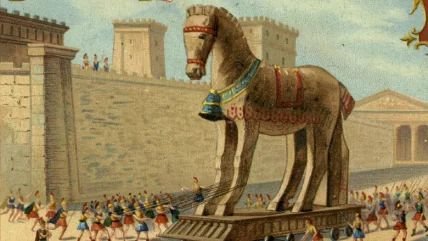
The clever warrior Odysseus proposed building a wooden horse and hiding soldiers inside it. The rest of the army pretended to leave the battlefield.
Believing they had won the war the Trojans brought the horse inside their city as a trophy. During the night the hidden soldiers came out opened the gates and let the returning Greek army enter.
This famous trick became known as the Trojan Horse, one of the enduring symbols of strategy and trickery in history.
Archaeology and the Search for Troy
For centuries the Trojan War was considered a pure myth.. In the nineteenth century the German archaeologist Heinrich Schliemann excavated the site of Hisarlik, where he found the remains of several ancient cities built on top of each other.
One of these layers dates back to a time that’s roughly the same as when the Trojan War is believed to have happened. Although archaeology cannot prove every detail of the legend it suggests that the myth may have been inspired by fights between ancient civilizations in the region.
The story of the Trojan War has been passed down for thousands of years because it talks about things that’re common to all people. It is a story about pride, ambition, loyalty and loss. It shows how personal decisions and emotions can lead to consequences that’re much bigger than anyone intended.
Through characters, like Achilles, Hector and Odysseus the legend explores both the glory and tragedy of war. It reminds us that behind every conflict there are deeply stories of courage, sadness and sacrifice.
Whether we see the Trojan War as a myth an event or a mix of both it continues to live on in literature, art and popular imagination. Its themes are still relevant today reminding us that even the oldest stories can still speak to us now.