From Saga to Settlement: The Norse Journey to Vinland

-Oishee Bose
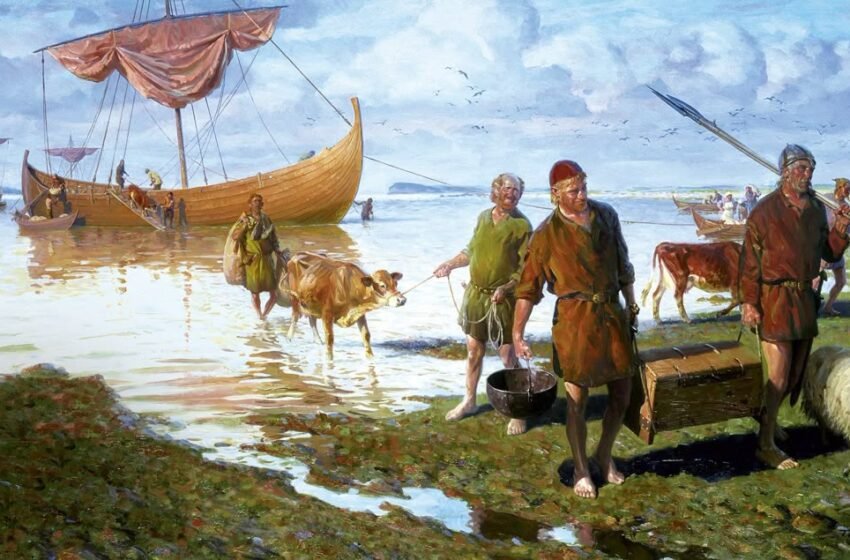
The dominant narrative of the story of America begins with a familiar statement: Christopher Columbus “discovered” the continent in 1492. It is a clear and convenient starting point, which is probably why it appears so often in textbooks. But the past is rarely that simple. Long before Columbus crossed the Atlantic, sailors from the far North Atlantic had already travelled west and reached parts of North America. These sailors were the seafaring Norse from regions such as Norway who had gradually settled in Iceland and later in Greenland. From these distant settlements they pushed even farther into the Atlantic, exploring coastlines that were completely unfamiliar to them.
Their voyages did not reshape the world in the dramatic way Columbus’s journey eventually did. They did not lead to large-scale colonisation or create immediate global connections. Yet they remain remarkable for what they reveal about the curiosity and determination of these early travellers. In relatively small wooden ships, guided by experience, weather patterns, and careful observation, the Norse managed to cross great distances of the open seas.
Two kinds of evidence carry this story. One is the medieval Icelandic Vinland Sagas: particularly The Saga of Erik the Red and The Saga of the Greenlanders, which preserve names of places and travels in vivid detail. The other is archaeological investigation and scientific dating. The archaeological sites at L’Anse aux Meadows in Newfoundland, as well as the material Norse-style architecture and tools were revealed in the Ingstads’ excavations in the 1960s, which are important sources to trace their presence. Later scientific investigation even connected the area to a single year, AD 1021.
That interplay of stone and stories, saga and tree-ring transforms our retelling of the past. Instead of one, spectacular “discovery,” the Norse presence seems as a series of travels, trials, seasonal camps, trade, conflict, and retreat. The decisions that were made seemed careful, practical, and sometimes improvisational.
Heading West: Material Motive, Greenland, Iceland
Understanding Vinland requires us to follow the Norse step by step. Many Norwegians moved for Iceland in the ninth century. The Book of Settlements, the Landnámabók, chronicles how leaders and families seized land. Political upheaval under King Harald Fairhair and regional disputes encouraged mobility westwards; Iceland provided agricultural land and fresh chances.
Later Erik the Red travelled from Iceland and started colonies in Greenland about 985 CE. Though it had restrictions, Greenland provided Norse societies with a western foothold. Wood was vital for tools, homes, and boats; however it was rare. That scarcity turned trips looking for timber, pasture, and other goods into a pragmatic need rather than a daring extravagance. The idea that Vinland offered better wood and pasture is therefore not romantic invention; it answered an everyday problem for settlers on the edge of the North Atlantic.
A Small Moment, a Big Question: Bjarni Herjólfsson
The chain of events begins with a small, incident. A merchant named Bjarni Herjólfsson sailed from Iceland to Greenland around 986 CE and was blown off course. He glimpsed unfamiliar shores but did not land; he had family waiting in Greenland and practical obligations. News of his sighting spread through island communities where sailors paid attention to any new coastline.
The sagas organize that news into three place-names: Helluland, Markland, and Vinland. Modern scholars usually associate Helluland with Baffin Island, Markland with Labrador, and Vinland with parts of Newfoundland and the Gulf of St. Lawrence. The pattern suggests a sensible coastal corridor rather than an isolated accident.
Leif Erikson: From Report to Reconnaissance
Leif Erikson is the figure most widely linked to a deliberate voyage west. The sagas tell how he bought Bjarni’s ship, assembled a crew, and sailed from Greenland around the year 1000 CE to follow up on what Bjarni had seen.
The sagas lay out a three-part route. First is Helluland, described as flat, stony ground. Most historians link that to Baffin Island. Next is Markland, “forest land”, memorable for timber and usually placed on the Labrador coast. Last is Vinland, the greener shore with rivers, fish, and, according to the tales, wild grapes. For people used to Greenland’s sparse woodlands, a landscape with pasture and vines must have seemed valuable and strange. Leif and his companions reputedly built a small camp called Leifsbúðir, overwintered, and returned to Greenland with timber and other stores. That outline reads like a reconnaissance mission: see, take, report.
Attempts to Stay: Thorvald, Thorfinn Karlsefni, and Freydis
People did not stop at one voyage. The sagas record repeat attempts, sometimes with more elaborate plans. Thorvald Eriksson, Leif’s brother, explored and according to the narratives, was killed amid conflict with local people. Thorfinn Karlsefni later organized a larger expedition with ships, livestock, and families who hoped to settle permanently. The sagas describe house-building, hunting, and continued trade and also episodes of violence and mistrust. Freydis Eiríksdóttir appears in multiple tellings as a forceful, controversial figure whose conduct sometimes provokes internal strife. These episodes show how quickly practical plans could meet difficult realities: environment, supply, and local resistance.
L’Anse aux Meadows: When Sagas Meet Dirt
For a long time historians debated whether the saga narratives were history or myth. Excavations by Helge and Anne Stine Ingstad in the 1960s altered that debate. At L’Anse aux Meadows, they uncovered eight turf-walled buildings laid out in a Norse pattern, together with iron nails, smithing debris, spindle whorls, and other artifacts associated with Viking-Age craft. More than 800 Norse-related objects and fragments have been recorded at the site. The architecture and material culture point strongly to a Norse presence and to everyday activities: boat repair, iron working, textile tasks, storage, and shelter. Parks Canada now manages the place and UNESCO recognizes its global significance.
A clear image emerges: this was a working base, not a single heroic home. People made things, fixed things, ate, slept, and set off again. The material evidence ties the sagas back to a lived place.
Pinning a Year: Dendrochronology and AD 1021
Archaeology gave us buildings; science gave us a year. A major 2021 study published in Nature used tree-ring patterns and a known cosmic-radiation spike (AD 993) to date wood at L’Anse aux Meadows to AD 1021. That finding anchor the Norse presence to a precise calendar year and shift the debate from “did this happen?” to “what happened and how often?” The AD 1021 hinge ties saga memory to an empirical moment.
Environmental studies refine the picture further. Palynology and surveys indicate a short growing season and limited woodland around the site. Those conditions make sustained agriculture unlikely. Instead the place looks like a staging post: a seasonal camp for gathering timber, hunting, drying fish, or preparing for voyages south or back to Greenland.
Meetings and Misunderstandings: Norse–Indigenous Encounters
The sagas use the term skrælings for the people the Norse met. The accounts show trade and violence in quick succession. Metal objects moved one way; furs and food moved the other. Small misunderstandings sometimes turned deadly.
It is to be noted that the Indigenous communities along these coasts were not passive. They had their own politics, trade networks, and strategic choices. Archaeology suggests encounters were episodic. That does not make them trivial. Even brief contacts change people’s perceptions, objects, and memories. Historians now try to read both sides: to imagine not only the Norse in their boats, but also the coastal people watching, testing, and responding to strangers.
Why the Norse Did Not Stay: Practical Limits
Several practical and structural reasons explain why the Norse presence did not become a permanent European colony.
First, population limits. Iceland and Greenland had relatively small communities; there were not enough settlers to mount sustained colonial projects far from home. Second, logistics. Maintaining supply lines across the North Atlantic was expensive and risky, especially when cargo and labour were scarce. Third, environment. The short growing season and limited timber in target areas made permanent agriculture and building difficult. Fourth, political cost. Repeated conflicts or the risk of conflict with local communities raised the human and economic cost of holding a remote outpost.
Put together, these constraints made seasonal use the sensible choice: collect timber and other resources; trade when possible; retreat before winter; try again later if conditions suggested advantage.
What Vinland Means: A Smaller, Messier History
Vinland complicates the usual narrative that places a single discovery in 1492. The sagas, the remains at L’Anse aux Meadows, and the AD 1021 date together show that Norse sailors reached North America centuries earlier. Their voyages were practical, cautious, and experimental. They tested resources, set up temporary bases, traded, and sometimes fought.
This history asks us to think differently about “discovery.” It is not a simple stamp on a map. It is a series of encounters and decisions shaped by weather, timber, food, technology, and human relations. It is about people who judged risk and reward at sea and on shore.
Open Questions and Next Steps
A few questions remain pressing. Did Norse contact leave subtle traces in Indigenous material culture or oral histories that we have not yet recognized? Are there other Norse sites further south along the Atlantic coast, lost to time or hidden under later landscapes? How did memory of these voyages travel within Norse communities and beyond them into broader European awareness?
Answering these questions calls for interdisciplinary work: archaeology, dendrochronology, palaeoecology, genetic studies, and, crucially, collaborative work with descendant Indigenous communities. Respectful partnership is essential. The story of Vinland is not just Norse. It is shared history shaped by multiple peoples.
Final Thought
Vinland sits between story and material fact. It is both a set of sagas and a place with timbers and nails. That two-sided reality makes the history richer. It reminds us that exploration often looks like patient testing, not grand proclamations. The Norse did not plant flags and claim continents; they sailed, they stayed a season or two, they traded and sometimes fought, and then they pulled back. For historians that is the interesting part: small human choices, made in ordinary weather, add up to surprising consequences.