Queen Himiko – The Power of the Unseen

-Prachurya Ghosh
The Power of the Unseen
History usually rewards those who speak loudly. Kings who conquer, generals who expand borders, emperors who leave inscriptions bragging about victories—these are the figures who survive clearly, their voices carried forward through stone, metal, and carefully preserved texts. Queen Himiko does none of this. She leaves behind no speeches, no monuments bearing her name, no military campaigns that echo through legend. And yet she stands at the very beginning of recorded Japanese history, unavoidable and unsettling. Himiko survives not because she explained herself, but because something fundamental changed around her. She emerged at a moment when society was fracturing, and somehow held it together not through force, but through belief. Order followed her presence, and disorder followed her absence, and that fact alone tells us that she mattered.
A Japan Before Japan
To imagine Himiko’s world, modern Japan must be set aside entirely. There are no emperors yet, no Kyoto or Tokyo, no unified state. The islands are a mosaic of communities, coastal and inland, connected by fragile trade routes and even more fragile alliances. This is the late Yayoi period, an era reshaped by wet-rice agriculture but still searching for political stability. Rice brought surplus, surplus produced inequality, and inequality bred conflict. Chinese observers described the land of Wa as torn apart by constant warfare, where villages fought villages and leadership remained unstable and contested. This was not a world calmly awaiting a ruler; it was a world desperate for coherence. It is within this tension that Himiko appears.
Choosing a Woman to End Chaos
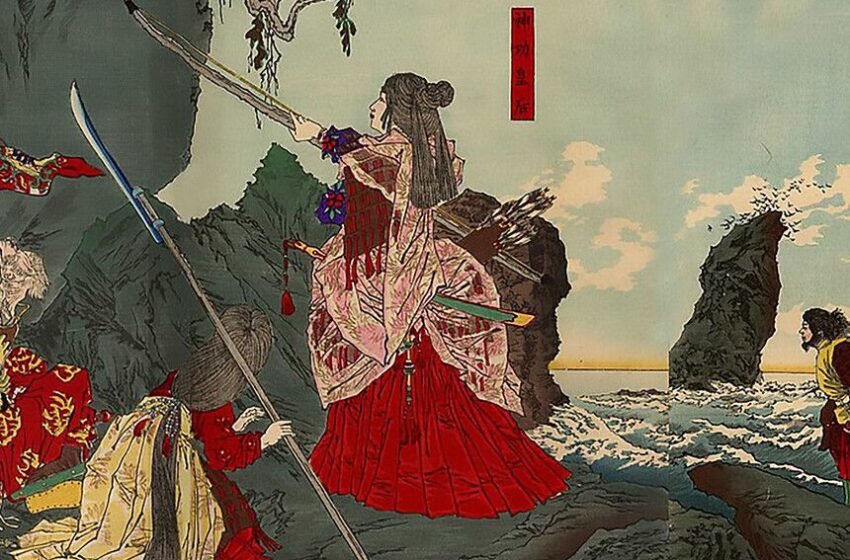
The Chinese records describe something striking: when the fighting became unbearable, the people chose a woman to rule them. Not because she commanded armies or embodied physical strength, but because she was believed to communicate with spirits. Himiko is portrayed as a shaman-queen, deriving authority from ritual, divination, and mediation between the human and the unseen. Modern categories that separate religion from politics do not apply here. In early societies, legitimacy did not arise from written law or institutional bureaucracy, but from alignment with ancestral and cosmic forces. Himiko’s authority lay in her role as mediator, translating uncertainty into meaning. In a time of chaos, such authority was not weak or passive; it was profoundly stabilizing.
Distance as Authority
Equally revealing is how distant Himiko remained from ordinary visibility. The Chinese accounts emphasize that she rarely appeared in public, lived within a fortified residence, and was attended by hundreds of women, while men guarded her surroundings. Only one man served as her intermediary, relaying her words to the outside world. To modern readers, this arrangement can feel suspicious, even manipulative, but within ritual societies, distance itself generates power. The sacred is not familiar; it is set apart. By withdrawing from daily interaction, Himiko transformed herself into a symbolic figure rather than a conventional ruler. This separation was not accidental. It was a deliberate political strategy that reinforced her authority.
Diplomacy Without Conquest
Himiko did not rule in isolation. She extended her influence beyond the islands through diplomacy, sending envoys across the sea to the Wei dynasty in China. The Records of Wei describe her tribute missions and the emperor’s response, which included an official title and valuable gifts, most notably bronze mirrors. These mirrors carried deep symbolic weight across East Asia, associated with truth, cosmic order, and divine legitimacy. By receiving them, Himiko was recognized as a legitimate ruler within a broader regional hierarchy. This exchange reveals that her realm was not a loose collection of settlements, but an organized confederation capable of presenting itself as a unified political entity. Himiko did not seize legitimacy through conquest; she negotiated it.
Yamatai and the Problem of Place
Yet even the physical location of her kingdom, Yamatai, remains unresolved. Chinese descriptions provide distances and directions, but they are inconsistent and ambiguous. Some scholars locate Yamatai in northern Kyushu, while others argue for the Yamato region of central Honshu, later associated with the imperial state. The debate matters because the implications are immense. If Yamatai was located in Yamato, Himiko becomes a foundational figure whose absence from later chronicles demands explanation. If not, she represents an alternative political tradition that did not survive. Archaeological evidence offers tantalizing clues—elite settlements, burial practices, ritual mirrors—but no definitive identification. Himiko resists fixation, remaining elusive even in geography.
The Queen Who Left No Grave
One of the most striking absences in her story is her grave. The Chinese records mention her death and the unrest that followed, but they do not describe her burial in detail. Japanese archaeology has yet to identify a tomb that can be conclusively linked to her, an absence that stands out in a culture that would later monumentalize its rulers through massive burial mounds. This may suggest that Himiko’s authority was never meant to be preserved in stone. Her power existed in ritual performance and personal presence. Once she was gone, the structure she sustained collapsed. The records note that chaos returned after her death and that another shaman-queen, a young girl, had to be installed to restore order. Institutions did not replace Himiko; embodiment did. Her power was personal and irreplaceable.
Silence in the Official Histories
Equally telling is her near absence from later Japanese chronicles such as the Kojiki and Nihon Shoki. These texts construct a divine imperial lineage rooted in male rulers and the sun goddess Amaterasu, leaving little space for a female ruler whose authority derived from shamanic mediation. Some scholars argue that Himiko was mythologized, others that she was deliberately erased, and still others that her lineage simply lost political dominance. Erasure is never neutral. Figures disappear from official memory because they challenge the narrative being built. A woman ruling through spiritual authority does not fit easily into the ideological foundations of a centralized, patriarchal state. Himiko’s silence in these texts may be one of the loudest clues history provides.
Gender Before Power Hardened
Her existence also reminds us that gender roles were not always fixed. In early Japan, women could hold spiritual and political authority, lead rituals, and embody legitimacy. Power had not yet hardened into exclusively masculine forms. This would change as warfare intensified and centralized rule emerged, privileging military leadership and patrilineal succession. Spiritual mediation receded, and women’s political power narrowed. Himiko stands at the threshold before those boundaries solidified. She is not an anomaly, but evidence of a different social possibility.
Ruling Without Performing Strength
Himiko does not perform strength in the conventional sense. She does not boast, threaten, or dominate through spectacle. Instead, she withdraws, listens, interprets, and speaks selectively. This is a form of authority modern politics often struggles to recognize. She ruled not by making herself unavoidable, but by making herself necessary.
Why Himiko Still Haunts History
Queen Himiko endures because she refuses to resolve into certainty. She exists between history and myth, governance and ritual, presence and absence. She challenges assumptions about how societies stabilize themselves and complicates the belief that power must always be loud or visible. Himiko reminds us that history is not shaped only by those who shout. Sometimes it is shaped by those who listen, interpret, and hold fragile worlds together when everything threatens to collapse. She ruled without leaving her own words behind, and yet, nearly two thousand years later, we are still trying to hear her.