TAWAIFS AND TEHZEEB – The courtesans of medieval India

~Tanushree Wadodkar
We have all seen and loved ‘Heeramandi- The Diamond Bazaar’ by Sanjay Leela Bhansali. We have admired the actors’ beauty, the costumes, and the grand sets. But let’s talk about the actual core of the series- the tawaifs. Who were they? How did they come to be? And what happened to them? Several movies have been made about the life and beauty of courtesans like Umrao Jaan and Pakheeza. Let us go beyond the cinematics and actually understand the tawaifs.
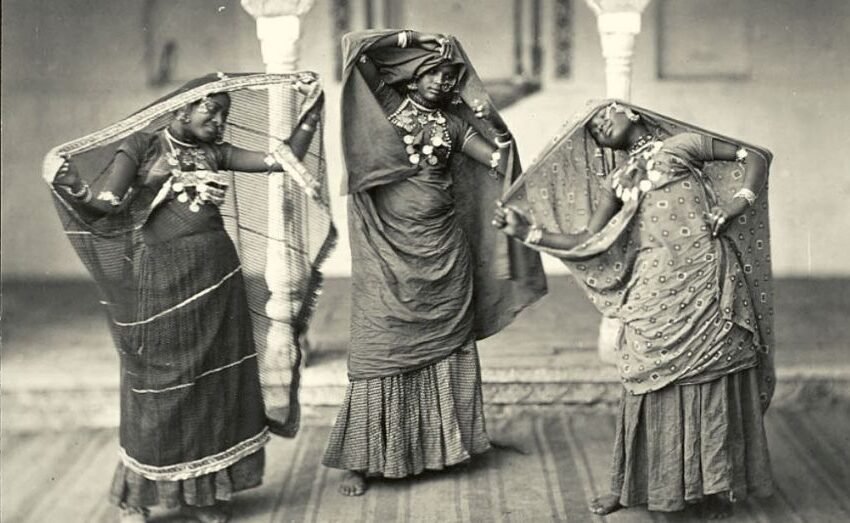
Tawaifs were highly skilled dancers, singers, and poets. They were not only entertainers, but also custodians of culture. They were known for their expertise in classical music and literature. The word tawaif comes from the Urdu word tawaf, meaning ‘to circle’. Since Kathak involved a lot of spinning, they came to be known as tawaifs.
Tawaifs were highly popular during the Mughal period. The nobles patronised them, and they were some of the very few women who owned property and paid taxes.
Origin of Tawaifs
The origin of tawaifs can be dated back to the royal courts of the Mughal empire. As art, music, and literature developed under royal patronage, tawaifs gained popularity as respected performers who played an essential role in preserving art forms like Kathak, Urdu poetry, and Hindustani classical music. In the Mughal period, tawaifs were not looked at with the negativity which later came to define them.
Tawaifs often went through rigorous training from an early age. They were also taught the skills of etiquette, conversation, and intellectual refinement. In fact, many young men, especially nobles, were sent to their kothas to learn manners and social interaction.
In cities like Lucknow and Delhi, tawaifs became an important part of the court culture. Their kothas turned into vibrant places where art and culture thrived.
The decline of Tawaifs
As the social, cultural, and political spheres changed, the position of tawaifs in society declined. As the Mughal power weakened, the tawaifs lost the royal patronage and their primary support system. Cities like Lucknow that were once bustling with culture slowly lost their prominence.
Under British rule, the colonial ideas of morality were imposed on the Indian society. They viewed tawaifs not as artists, but as immoral figures and labelled them as ‘prostitutes’. Their profession was stigmatised, and many laws and social reforms further marginalised them. Under laws like the Contagious Disease Act of 1864, the tawaifs were forced to undergo invasive medical examination.
As newer forms of entertainment like theatre and, later, cinema emerged, audiences moved away from the traditional performances. The anti-nautch movement in the 18th and 19th centuries forced the tawaifs to fight for survival, and many of them also faced poverty as they lost their profession and prestige.
The tawaifs, who were once the embodiment of art and culture, were reduced to the position of prostitutes and degraded by the British.
Role in the revolt of 1857
The revolt of 1857 mentions figures like Mangal Pandey, Nana Sahib, Rani Lakshmibai, and Begum Hazrat Mahal. However, the contributions of the tawaifs are hardly ever talked about.
They actively helped the revolutionaries by using their resources, influence, and network. In places like Lucknow, their kothas became meeting points for political discussions and planning. They often gave shelter to the people participating in the revolt, passed on information, and even helped fund the revolution. They used their access to the influential people of society to further support the cause.
Women like Azeezun Bai played a crucial role in the revolt. Since her kotha was near the British cantonment, she gathered information and passed it along to leaders like Nana Sahib. She also dressed like a man and fought alongside the other rebels. Azeezun Bai led a group of women called ‘kothewali tawaifs’ and provided medical aid to many soldiers.
What happened to them?
After the British were able to suppress the revolt, they worked to dismantle the political systems and all the spaces that supported the rebellion. And since many tawaifs aided the revolt, their kothas came under suspicion. The colonial authorities began imposing stricter rules and started associating tawaifs with immorality and rebellion. Their performances were reduced to mere entertainment rather than a celebration of art. This led to their complete exclusion from the elite high society and loss of all the respect they had once earned.
Due to the social reform movements influenced by Victorian ideas, people began distancing themselves from the tawaifs. As a result of this, many courtesans were forced to give up their art and move on to newer roles.
Many were able to adapt to the changes and transitioned early into theatre and cinema. Some others were not as fortunate and were forced into prostitution to be able to survive.
After independence
The tawaifs underwent another major transformation after India gained independence in 1947. As a newly independent nation striving to create its own identity, India focused on the ideas of reform, respect, and modern ideas. This meant that there was no space for professions like courtesans, who had already been marginalised and disregarded during British rule.
The cultural contributions of the tawaifs in terms of dance and music slowly found their way into mainstream institutions. Hindustani classical music and kathak began to be taught in academies and through cultural programmes. While the art not only survived but thrived, the artists who had kept it alive for all these years were pushed to the sidelines.
Many former tawaifs tried to teach the younger generations the classical art forms, but without any support or social acceptance, it became very difficult. Some moved on to the film industry and contributed greatly to dance and music in early cinema, although they were never given any credit for it.
The story of the tawaifs is more complex than what Bollywood shows us. From being the flagbearers of art and culture to being degraded to prostitutes, the tawaifs have had a long history that deserves to be told. They kept a whole piece of culture alive for decades and also participated actively in the independence movements. To truly understand them, we need to look beyond the romanticised portrayals of movies and know that they were the women who once held respect, owned property, paid taxes, and were still questioned through the lens of colonial morality.