Ivan IV: Man Who Found Pleasure in Torturing

-Prachurya Ghosh
Childhood Trauma and the Formation of Autocracy
Ivan was born in 1530 to Grand Prince Vasili III, inheriting not only a throne but a fragile political world. When his father died in 1533, Ivan was just three years old—too young to understand power, yet old enough to become its symbol. A child who should have grown up sheltered instead became the prize over which ambitious nobles competed.
His mother, Elena Glinskaya, ruled as regent until her sudden death—likely by poisoning—in 1538. For Ivan, this loss was deeply personal. She had been his protector in a hostile court. With her gone, stability vanished. What remained was uncertainty, fear, and political manipulation.
The years that followed were dominated by boyar (aristocratic) infighting. Contemporary chronicles portray a lonely young prince neglected and humiliated while rival noble families struggled for influence. Ivan watched powerful men control his household, argue over authority, and treat the future ruler of Russia as insignificant. Growing up amid conspiracy and distrust, he learned early that power determined survival.
Stories about Ivan’s childhood cruelty—torturing animals, throwing them from towers, gouging out eyes—appear mainly in later memoirs, especially those written by Prince Andrei Kurbsky, once his ally and later his critic. Historians remain cautious about these accounts because political enemies often exaggerated faults. Yet the persistence of such stories reflects how observers understood Ivan’s psychological development. A child raised in violence and humiliation may come to associate control with cruelty.
There is little doubt that Ivan matured in an atmosphere of fear, instability, and resentment toward the boyar elite. These experiences shaped his lifelong belief that disorder emerged whenever authority weakened. To Ivan, only absolute and divinely sanctioned autocracy could prevent chaos.
In 1547, at sixteen, Ivan crowned himself “Tsar of All Russia.” The title carried enormous meaning. He was no longer merely a grand prince among nobles but an emperor-like ruler claiming continuity with the Byzantine tradition. The coronation represented more than ambition—it marked a transformation of Muscovy itself. The state was redefining itself as a centralized autocracy governed by sacred monarchy rather than aristocratic consensus.
Reforming Ruler to Suspicious Despot
Ivan’s early reign challenges the image of an uncontrollable tyrant. During the 1550s, he governed alongside a reformist advisory group known as the Chosen Council. This period witnessed administrative energy and constructive reform.
Legal modernization came through the Sudebnik of 1550. The Zemsky Sobor, a national assembly, was convened to involve broader social groups in governance. Military restructuring strengthened the state’s capacity for expansion. Campaigns against the Khanates of Kazan in 1552 and Astrakhan in 1556 dramatically enlarged Muscovite territory and secured control over vital trade routes.
At this stage, Ivan appeared disciplined and purposeful—a ruler attempting to build institutions and consolidate authority rather than rule through terror. Many contemporaries saw promise in his leadership.
The transformation began in the 1560s. The death of his beloved wife, Anastasia Romanovna, in 1560 profoundly destabilized him emotionally. Ivan became convinced that boyars had poisoned her. Whether justified or not, grief intensified existing suspicions formed during childhood.
Simultaneously, military difficulties during the Livonian War undermined confidence in the regime. The defection of trusted nobles such as Kurbsky felt not merely political but deeply personal. Betrayal confirmed Ivan’s fear that elites were inherently disloyal.
Gradually, anxiety hardened into paranoia. Trust disappeared from governance.
In this climate, Ivan introduced one of the most controversial institutions in Russian history—the Oprichnina in 1565.
The Oprichnina and the Oprichniki
The Oprichnina divided Russia into two administrative spheres: one directly controlled by Ivan and another governed through traditional structures. Officially it was a reform; in practice it became an instrument of domination.
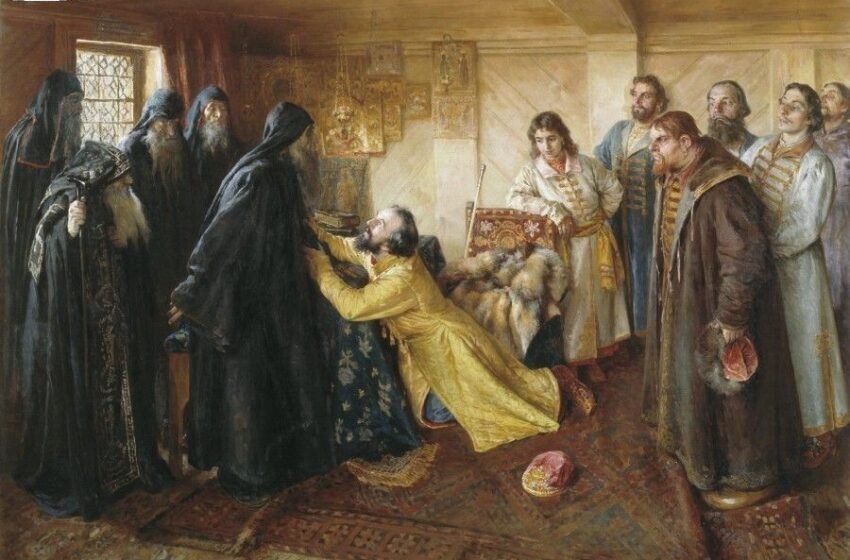
To enforce his authority, Ivan created the Oprichniki, a corps personally loyal to him rather than to the state or aristocracy. Many came from lower social backgrounds and owed their advancement entirely to the tsar. They wore black garments and rode black horses, cultivating an almost monastic yet ominous image. Contemporary descriptions claim they carried symbols such as a dog’s head and broom—signifying their mission to sniff out treason and sweep it away.
Functionally, the Oprichniki operated as a political police force. They confiscated aristocratic estates, punished suspected conspirators, and spread fear across regions associated with opposition. Violence became highly visible and ritualized. Torture extracted confessions; executions served as public demonstrations of authority.
Chronicles describe brutal punishments—boiling, impalement, mutilation, and burning—though historians caution that foreign observers often exaggerated details to portray Muscovy as uniquely barbaric. One frequently repeated story claims Ivan boiled his treasurer alive in a cauldron. While firm documentary proof is lacking, such narratives illustrate the atmosphere of terror surrounding his court.
Regardless of exaggeration, the essential reality remains: fear was consciously deployed as a governing strategy.
The Massacre of Novgorod
The most infamous manifestation of this policy occurred in 1570. Ivan suspected the prosperous city of Novgorod of plotting alliance with Lithuania. Whether the conspiracy existed remains uncertain, but suspicion alone was enough.
Ivan marched on the city with the Oprichniki. For weeks, executions, torture, and widespread plunder unfolded. Victims were reportedly tied to sleds and dragged into the freezing waters of the Volkhov River. Monasteries were looted, clergy humiliated, and communities devastated.
Chroniclers estimated thousands of deaths, while later traditions raised figures to 20,000 or more. Modern historians suggest lower numbers but still recognize the event as catastrophic.
Beyond punishment, the massacre carried symbolic meaning. Novgorod had historically represented a semi-autonomous political tradition within Russia. Its destruction signaled the end of alternative centers of authority. Under Ivan, centralized autocracy would tolerate no competing political culture.
Domestic Violence and Familial Tragedy
Ivan’s private life reflected instability similar to his political rule. He married at least seven times, though not all unions were sanctioned by the Church. Rumors surrounded several marriages and deaths. One wife, Maria Dolgorukaya, was allegedly executed after accusations concerning her purity, though historians debate the reliability of this account.
The most tragic incident occurred in 1581. According to tradition, Ivan violently reprimanded his pregnant daughter-in-law for wearing clothing he judged immodest, causing her miscarriage. When his son, Tsarevich Ivan Ivanovich, confronted him, the tsar struck him with his staff during the argument. The injury proved fatal.
This devastating moment was later immortalized by Ilya Repin in Ivan the Terrible and His Son Ivan, a painting capturing horror, remorse, and the unbearable realization of irreversible action. A ruler obsessed with obedience had destroyed his own successor.
Following the death of his capable heir, power eventually passed to the weaker Feodor I, contributing to political instability known as the Time of Troubles after Ivan’s death in 1584.
Violence, Myth, and Historical Debate
Many extreme stories associated with Ivan—daily executions of beggars, systematic feeding of victims to bears, or enormous death tolls—require careful scrutiny. The administrative capacity of sixteenth-century Muscovy limited the scale of organized killing.
Foreign envoys such as Heinrich von Staden and Jerome Horsey produced vivid accounts of brutality that shaped European perceptions for centuries. Russian chronicles themselves present conflicting images, alternately portraying Ivan as God’s chosen ruler and as a destructive tyrant.
Modern historiography places Ivan within broader European processes of state formation. The sixteenth century was marked by violence across the continent. Centralizing monarchies frequently relied on repression to weaken rival elites. Although Ivan’s methods were extreme even by contemporary standards, they were not entirely detached from the political realities of the age.
The Psychological Dimension
Debate continues over Ivan’s mental state. Some scholars interpret his behavior through psychological frameworks, suggesting paranoia or mood disorders. Others note the discovery of mercury in his remains, though mercury was widely used in medical treatments at the time.
Another interpretation views Ivan’s cruelty as deliberate political theatre. Public punishment reinforced the sacred authority of the tsar and discouraged rebellion. In Muscovite ideology, the ruler answered only to God. Demonstrations of harsh justice affirmed this divine legitimacy.
From this perspective, violence was not chaotic—it communicated power.
Legacy
When Ivan died in 1584, Russia was territorially larger but socially wounded. The Oprichnina disrupted agriculture, displaced populations, and strained economic life during prolonged warfare. These pressures contributed to famine and instability in the decades that followed.
Yet Ivan also strengthened the foundations of centralized rule. Later dynasties, including the Romanovs, inherited both his territorial expansion and his model of autocratic governance.
In Russian historical memory, Ivan remains deeply ambiguous—both state-builder and tyrant.
His life raises enduring questions about power and personality. Was he uniquely monstrous, or shaped by trauma, political insecurity, and the violent norms of his era? The answer lies between legend and historical evidence.
Ivan IV represented the harsh transformation of a medieval polity into an early modern empire. Religious absolutism, personal suffering, and calculated political strategy merged under his rule until terror itself became an instrument of governance.
Stories of mutilation, boiling cauldrons, devastated cities, and a slain heir endure because they illustrate the dangers of unchecked authority. Whether every detail is perfectly accurate matters less than the broader historical reality: under Ivan IV, fear became policy.
In the end, “Terrible” was not simply a nickname. It became history’s judgment—capturing both awe and horror in the memory of a ruler who reshaped Russia while leaving it deeply scarred.