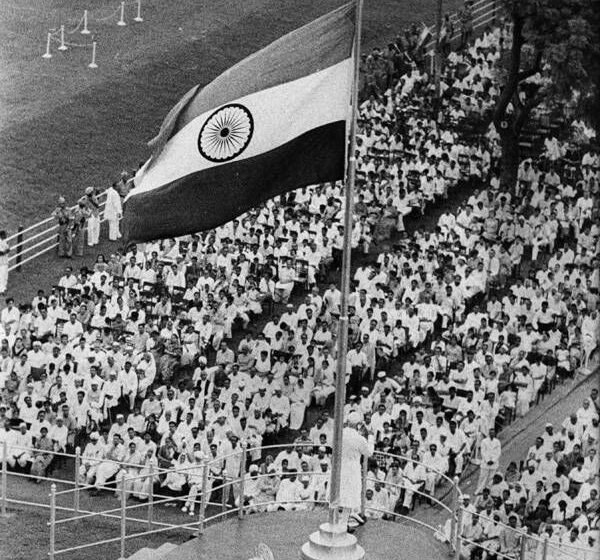
THE PRICE OF FREEDOM – The partition of India following independence

-Tanushree Wadodkar
‘In a land now called our enemy, once stood a house I only ever knew as home. I grew up there. Played in those streets. Sat on the school bench and learned. Spent my evenings playing in the verandah. But then, one day, I had to leave. Leave the only home I had ever known and cross the border with thousands of other people, who were also leaving behind their whole lives. Not all of us made it out of that nightmare alive. But those who did lived on to tell the tales.’
This is the story of hundreds and thousands of people who migrated from Pakistan to India (and vice versa) in 1947. Millions of people had to leave behind their ancestral homes and move to the newly formed nation. And unfortunately, many died before they could reach their destination.
Background of the partition
The British ruled India for over 200 years. To maintain control over the Indian population, the colonial authorities used a policy widely known as ‘Divide-and-rule’.
India was a land of different religions, communities, and cultures. The British encouraged divisions between communities to maintain their power.
By the early 20th century, when the Indian National Congress began demanding independence, the communal differences between Hindus and Muslims had already intensified. The All-India Muslim League was formed in 1906 to protect the political rights of Muslims. Furthermore, the Indian Councils Act of 1909 introduced separate electorates for Muslims, laying the early foundation for the Partition of India.
Under Muhammad Ali Jinnah, the Muslim League began demanding a separate Muslim state (Pakistan) as they feared marginalisation in the Hindu-majority India.
Several attempts were made to keep the country united, but failed as the differences between the Congress and the Muslim League increased. Violent riots broke out in many regions of the country, particularly in Bengal and Punjab.
After World War 2, the British decided to grant independence to India. The Mountbatten Plan suggested dividing the country into India and Pakistan.
And thus, the partition began.
Role of the British
As mentioned, the British actively encouraged the communal differences and conflicts. When tensions intensified in the 1940s, they failed to control the violence. After the Second World War, the British rushed the process of independence, rather than a gradual transformation. The Radcliffe Line (the border) was drawn by Cyril Radcliffe, who had very little knowledge of India’s geographical and political scenario, in just a few weeks. Neither the British nor the government prepared any plan for the large-scale migration or protection of the citizens.
Moreover, the exact division was announced after independence, which meant that people had no idea which country they were citizens of. The inadequate security arrangements allowed the violence to escalate and spread rapidly.
When the British left India, they also left behind a lot of mess for both countries to clean up.
Violence and Riots
When the partition was announced, communal violence erupted. Violent riots break out, especially in Bengal and Punjab. Some reports say that as many as 3 million people were killed as a result of partitional violence. People were attacked solely based on their religion, and entire villages were wiped out.
Violence against women was the worst. Thousands of women were abducted, abused, and assaulted. Trains carrying refugees were often attacked, and many trains reached stations filled with nothing but dead bodies.
(Read Train to Pakistan by Khushwant Singh)
The widespread violence forced millions of people to flee overnight, often with nothing apart from what they could carry. Rumours and anger spread rapidly, further escalating the violence. The sudden eruption of riots after partition also meant that there was no law and order. Authorities failed to control the situation.
The violence during the partition revealed just how fragile peace can be when faced with fear and communal politics.
Refugee crisis
This was one of the largest migrations in history. More than 15 million people were displaced and forced to migrate. Muslims migrated to Pakistan, and Hindus and Sikhs came to India.
Temporary refugee camps were set up in both countries, but they were overcrowded and lacked proper food, water, and sanitation. People had to start their lives from scratch. Families were often separated during the journey, and some were never reunited. Many refugees struggled to find jobs or any means of livelihood. The government also struggled with the rehabilitation of such a large number of people. Both India and Pakistan tried to provide relief by providing housing, rations, and employment, but the resources were very limited.
The refugee crisis was not just about leaving your home. It was also about the loss of identity and not knowing where you belonged.
The partition of India in 1947 remains one of the most tragic and devastating events in our country’s history. Although it marked the end of colonial rule and the birth of two independent nations (India and Pakistan), it also caused a lot of suffering to millions of people. It was meant to be a solution for the growing communal tensions. But it turned into a humanitarian crisis whose impact echoed for generations.
Partition was not just about drawing the boundaries. It was also about the people who lost their homes, their families, and in a way, also their identities. Thousands of people were forced to leave the home that had seen generations of their families. The migration, the violence, and all the deaths that followed are a clear example of how fear and political agendas can shape actions. Neighbours who had been living in harmony for decades suddenly turned on each other on a religious basis.
Moreover, the role of the British in this cannot be ignored. The ‘Divide-and-rule’ policies, the hurried withdrawal, and the haphazard drawing of borders all added to the situation. The partition of India was not an isolated incident, but a result of decades of political decisions.
And yet, amidst all the chaos, there were also stories of humanity. There were people who protected their neighbours, helped others hide, and chose humanity over hatred.
The legacy of the partitions does not only live in politics, but also in memories, media, and family histories.