DEMOCRACY UNDER ATTACK – The Emergency (1975-77)

~Tanushree Wadodkar
One of the darkest periods in Indian democracy was the Emergency period of 1975-77, imposed by the then Prime Minister Indira Gandhi under Article 352. What followed was public backlash, the arrest of opposition leaders, press censorship, and suspension of Articles 19 (Right to speech), 14 (equality before law), 21 (right to life and liberty), and 22 (protection against detention). The reason cited for the emergency was ‘internal disturbances’.
This was the first emergency declared in India during peacetime. The earlier ones were declared during wars with China (1962) and Pakistan (1971).
The Background
What preceded the Emergency was a period of intense political unrest. There was widespread opposition to Indira Gandhi being the Prime Minister and the allegations of corruption.
In 1969, she was removed from Congress by Moraji Desai and other veteran leaders. This led to the Congress Party’s division-
- Congress (O): Led by Moraji Desai and the other veteran politicians
- Congress (R): Led by Indira Gandhi
In the 1970s, leaders like Jayaprakash Narayan organised strikes and protests against Indira Gandhi and her government. The JP movement in Gujarat and Bihar criticised the poor governance and accused Gandhi of corruption. Jayaprakash Narayan, in his rallies and protests, used the slogan, ‘ Sinhasan khali karo, ke janata aa rahi hai’.
In June of 1975, the High Court of Allahabad ruled against Indira Gandhi in a case of electoral fraud (filed by Raj Narain). The court required her to stay out of politics for a period of six years. The appeal to the Supreme Court allowed Gandhi to remain PM, but she lost the privilege of being a Member of Parliament. After this, people started demanding that she resign.
Emergency is declared
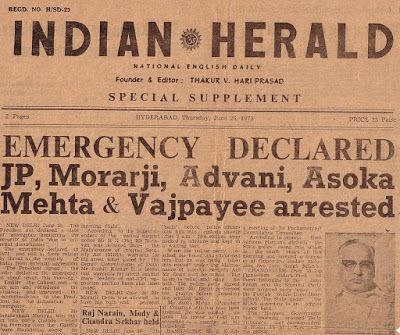
On 25 June 1975, President Fakhruddin Ali Ahmed declared a state of emergency throughout the country on the advice of Indira Gandhi.
In many neighbourhoods of Delhi, mainly where media houses were located, electricity was shut off. The news of the emergency was conveyed through All India Radio, as no newspapers could be printed.
Thus began the 21 months of censorship, arrests, and a complete murder of democracy.
Censorship during emergency
The emergency period witnessed strict censorship of the press and all other forms of media. All newspapers were required to submit their content to the government authorities before publication. The government had direct control over what could be published, and topics like arrests, protests, or criticism against the government were strictly prohibited. The freedom of the press was suspended, and journalists could not freely express their opinions. Any article, editorial, cartoon, or opinion piece against Indira Gandhi was not allowed to be published. Some newspapers and magazines were shut down or penalised for non-compliance. A few newspapers protested against this censorship by printing blank editorials, as a way to tell the public that the content or message had been censored by the government. Several editors, journalists, and writers were also arrested.
To deliver the truth to the public, a few editors came together to form an underground press. This basically meant secret, unofficial publications that functioned outside of government control. The main aim of this was to publish unfiltered truth at a time when the mainstream media was silenced. Pamphlets, newsletters, and small newspapers were printed in hidden locations, and printing presses were often moved frequently to avoid detection. These pamphlets and newsletters were distributed through trusted networks.
Movies like Andhi, Kissa Kursi Ka, and Nasbandhi were banned by the government. Sanjay Gandhi was even accused of destroying the prints of Kissa Kursi Ka. It was reshot and released after the emergency ended.
Limitation of rights
In June 1975, when the emergency was declared, Articles 358 and 359 were imposed.
Article 358 suspended all provisions under Article 19, i.e, freedom of speech and expression, assembly, and movement.
Article 359 allowed the state to suspend fundamental rights under articles 14, 21, and 22 (equality before law, right to life and liberty, and protection against detention).
Opposition leaders like Jayaprakash Narayan, Moraji Desai, Atal Bihari Vajpayee, and many others were arrested under the Maintenance of Internal Security Act (MISA).
According to the Shah Commission, about 35,000 people were arrested under preventive detention. Moreover, people could not even approach the courts for redress.
Forced sterilisation
One of the most controversial steps taken during the emergency period was the forced sterilisation campaign. It began in 1975 as a measure to control the population. More than 26 lakh sterilisations were done in 1975 alone, and this number rose to about 81 lakh in the following year.
Poor people were forced to go through the sterilisation procedure as many states reduced access to essential services. If a person had more than 2 or 3 kids and refused to undergo sterilisation, they were denied rations, housing, jobs, etc.
The Aftermath
The emergency was lifted on 21 March 1977, and general elections to the Lok Sabha were held. The Congress Party lost to the Janta Party, which formed the first non-Congress government with Moraji Desai as the Prime Minister.
The 44th Amendment Act of 1978 reversed a lot of changes made during the emergency. It replaced “internal disturbances” with “armed rebellion” as grounds for Emergency. Furthermore, it also restored judicial review. Press censorship was removed, and all detainees were released.
On the 50th anniversary of the 1975 Emergency, PM Narendra Modi marked the occasion by declaring it as ‘Samvidhan Hatya Diwas’.
The Emergency remains one of the darkest chapters in Indian history. It saw large-scale political repression, suspension of rights, press censorship, forced sterilisation, and human rights violations. The widespread anger and hate towards Indira Gandhi led to her defeat, allowing the Janata Party to form the first non-Congress government at the centre.
The Emergency may be one of the darkest phases in our country, but it also strengthened the importance of judicial review, freedom of the press, and the fact that fundamental rights under Articles 20 and 21 cannot be suspended.