Hedy Lamarr: Beauty, Scandal, and the Invention that Changed the Modern World

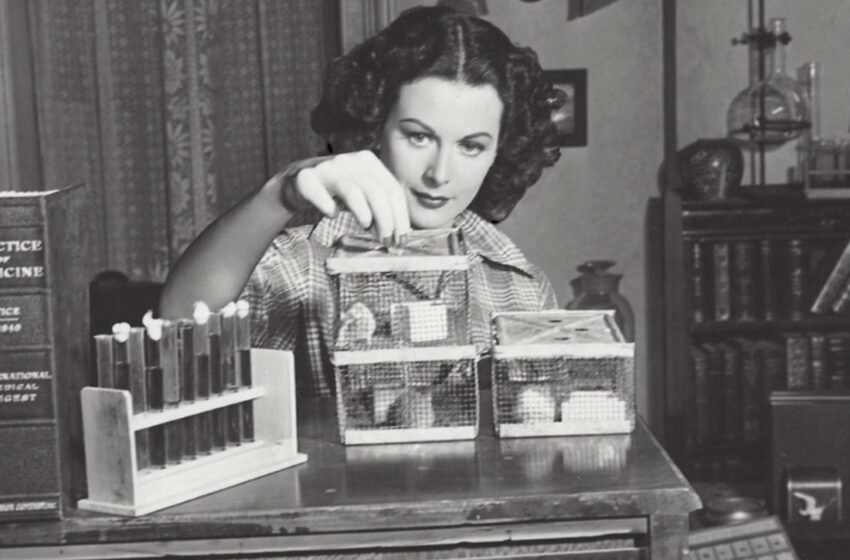
-Prachurya Ghosh
In 1933, the world was introduced to a young Austrian woman whose face and body would become symbols of both artistic daring and public controversy. At a time when cinema was still governed by strict moral codes, this woman appeared fully nude in a European film, running through forests and swimming in a lake. The film, Ecstasy, was immediately banned in several countries, yet its reputation only grew. The woman at the center of this scandal was Hedwig Kiesler, later known to the world as Hedy Lamarr.
For decades, Lamarr was remembered primarily as one of Hollywood’s most beautiful actresses. However, this popular memory hides a far more complex and extraordinary story—one that connects cinema, fascism, war technology, and the foundations of modern wireless communication.
Early Life and the Shock of Ecstasy
Hedwig Kiesler was born in Vienna in 1914 to a Jewish family that valued education and culture. From an early age, she showed talent not only in acting but also in technical curiosity. Her father encouraged her to understand how machines worked, often explaining engines and devices to her during long walks. This early exposure planted the seeds for her later interest in engineering and invention.
Her breakthrough came with Ecstasy, directed by Gustav Machatý. Unlike Hollywood films of the period, Ecstasy portrayed female sexuality openly, including a scene of female orgasm—an unprecedented moment in mainstream cinema. Although the film was artistically ambitious, its reception was dominated by moral outrage. Religious authorities condemned it, governments banned it, and newspapers sensationalized it. Ironically, this scandal made Kiesler internationally famous almost overnight.
What is often overlooked is that Kiesler herself had little control over how the film was framed. She later claimed that she had been misled about the explicit nature of the scenes and that the director used camera tricks to exaggerate what she thought were innocent moments. Regardless of intent, the damage—and the fame—were irreversible.
Marriage to Power: Friedrich Mandl and the Fascist World
Shortly after Ecstasy, Kiesler married Friedrich Mandl, one of Austria’s richest men and a major arms manufacturer. Mandl was deeply connected to European fascist networks and did business with regimes aligned with Adolf Hitler and Benito Mussolini.
Mandl was obsessively jealous and treated his wife as a prized possession. He attempted to buy and destroy all copies of Ecstasy to erase her scandalous past. At the same time, he paraded her at elite political dinners, where generals, industrialists, and dictators discussed military strategy and weapons technology. These conversations often focused on radio-controlled missiles, torpedoes, and communication systems.
Ironically, while Mandl intended to keep his wife ignorant and confined, he was unknowingly educating her. Kiesler listened carefully, absorbing discussions about signal transmission, frequency interference, and guidance systems. Over time, she developed a strong technical understanding of how military communications worked.
Yet her personal life was a prison. Mandl reportedly locked her inside his castle, Schloss Schwarzenau, under constant surveillance. As a Jewish woman married to a man supplying weapons to fascist regimes, Kiesler found herself trapped in a world she despised.
Escape from Austria and Reinvention in Hollywood
In 1937, Kiesler executed a dramatic escape. She drugged her maid, disguised herself in the maid’s uniform, and fled with only a suitcase and her jewelry. She sold these valuables to finance a journey to London. The timing was critical: in 1938, Nazi Germany annexed Austria, seized Mandl’s factories, and forced him to flee. He later became an adviser to Juan Perón in Argentina.
In London, fate intervened when Kiesler met Louis B. Mayer, head of Metro-Goldwyn-Mayer (MGM). Mayer offered her a contract, but only after renaming her Hedy Lamarr—a name chosen to sound glamorous and distinctly American.
In Hollywood, Lamarr became an instant star. She appeared alongside icons like Clark Gable, Judy Garland, and Bob Hope. Her screen presence embodied the ideal of exotic beauty: mysterious, elegant, and unattainable. Each of her first seven films was a box-office success.
Yet Lamarr herself felt intellectually frustrated. Studios cared only about her appearance, rarely offering serious roles. She was praised for being beautiful but dismissed as intellectually shallow—a stereotype she publicly mocked when she joked that the secret of her beauty was “to stand there and look stupid.”
War, Science, and the Birth of Frequency Hopping
Despite her glamorous career, Lamarr remained deeply concerned about the rise of Nazism and the war in Europe. Unlike many Hollywood celebrities who contributed by selling war bonds or entertaining troops, Lamarr pursued a far more radical form of resistance: technological innovation.
In 1942, she collaborated with composer George Antheil to design a communication system that could prevent enemy forces from jamming radio-controlled weapons. Their idea was based on a technique called frequency hopping—rapidly switching between radio frequencies in a synchronized pattern, making interception nearly impossible.
This invention was revolutionary. At the time, radio-controlled torpedoes were vulnerable because enemies could easily interfere with a single transmission frequency. Lamarr’s system allowed signals to “jump” across multiple frequencies, maintaining secure communication.
They patented the invention and donated it to the U.S. Navy, hoping it would be used against the Nazis. Ironically, the military initially dismissed it, partly because it came from a movie actress and a musician rather than professional engineers. The technology was shelved until decades later.
From Forgotten Patent to Modern Wireless World
Although Lamarr never profited from her invention during her lifetime, frequency hopping became the foundation of modern wireless technologies. Today, variations of her system are used in Wi-Fi, Bluetooth, GPS, and secure military communications.
This makes Lamarr’s story unique in the history of cinema: she is one of the very few Hollywood stars whose scientific work had a direct and lasting impact on global technological infrastructure. Yet for most of the twentieth century, this achievement remained largely unknown.
It was only in the 1990s that Lamarr began receiving recognition from scientific institutions. She was awarded the Electronic Frontier Foundation’s Pioneer Award and was inducted into the National Inventors Hall of Fame. By then, she was living in relative obscurity, having withdrawn from public life after years of being judged solely by her appearance.
Beauty as a Trap and a Weapon
Lamarr’s life reveals a deeper paradox: her beauty both enabled and limited her. It opened doors to Hollywood stardom but prevented others from taking her intelligence seriously. Scientists dismissed her, studios exploited her, and the public reduced her to an image.
At the same time, her beauty became a strategic asset. It allowed her access to powerful men, elite social spaces, and conversations about military technology. What was meant to objectify her ultimately gave her the knowledge required to challenge fascism through invention.
This contradiction makes Lamarr an important figure in feminist history. She defies the false binary between physical beauty and intellectual capability. Her life demonstrates that stereotypes are not merely inaccurate—they can actively conceal extraordinary contributions.
Legacy: Beyond the Silver Screen
Today, Hedy Lamarr is no longer remembered only as “the most beautiful woman in the world.” She is increasingly recognized as a symbol of hidden genius and historical injustice. Her story forces us to reconsider how society evaluates intelligence, particularly in women.
Lamarr did not fit neatly into any category: she was a Jewish refugee, a Hollywood icon, a self-taught engineer, and a wartime inventor. Her life intersected with some of the most powerful forces of the twentieth century—fascism, mass media, and technological revolution.
Perhaps the greatest irony is that while Lamarr once joked about “looking stupid,” the world spent decades doing exactly that—seeing only her face and missing her mind. Today, every time a smartphone connects to a wireless network, it quietly echoes the legacy of a woman who refused to be defined by appearances alone.
In this sense, Hedy Lamarr’s true fame does not belong to the past of cinema but to the present of digital civilization. She is no longer merely a star of old films; she is one of the invisible architects of the modern world.