Queen Nefertiti: The Woman Who Ruled Beside a Pharaoh

-Prachurya Ghosh
Queen Nefertiti stands as one of the most fascinating and mysterious women of the ancient world. More than three thousand years after her lifetime, her face is known across the globe, yet the details of her life remain partly hidden behind time, politics, and deliberate erasure. Unlike many queens who lived quietly behind palace walls, Nefertiti stood at the very center of power during one of Egypt’s most radical and dangerous periods. She was not simply a wife to a pharaoh. She was a political partner, a religious leader, and possibly even a ruler in her own right.
Nefertiti lived during the Eighteenth Dynasty of Egypt, around 1350 BCE. This was the height of Egyptian civilization. The empire stretched far beyond the Nile Valley into modern-day Sudan, Israel, Lebanon, and Syria. Egypt was wealthy from trade, tribute, and military victories. Its temples were filled with gold, and its gods were believed to control every aspect of life, from harvests to childbirth. To be born into this world was to live in a society deeply rooted in tradition, ritual, and divine order.
Nefertiti’s origins are still debated. Most historians believe she was born into an important noble family rather than royal blood. Her father is widely thought to have been Ay, a powerful court official who later became pharaoh himself. This means Nefertiti grew up surrounded by politics, religious rituals, and the inner workings of royal life. From a young age, she would have been trained in reading, writing, diplomacy, and temple traditions, preparing her for a role far beyond that of an ordinary noblewoman.
When Nefertiti married the young pharaoh Amenhotep IV, she entered the most powerful household in the world. At first, their marriage followed the normal pattern of Egyptian royalty. They appeared together in ceremonies, made offerings to the gods, and presented themselves as symbols of divine order. But everything changed when Amenhotep IV made a decision that would shake the foundations of Egyptian civilization.
Amenhotep IV rejected Egypt’s traditional religion, which had existed for thousands of years and was based on the worship of many gods. Instead, he elevated a single god, Aten, represented by the sun disk. He declared Aten to be the one true god, the source of all life, and the only being worthy of worship. He changed his own name to Akhenaten, meaning “He who is useful to Aten.”
This was not just a religious reform. It was a political revolution. The powerful priesthood of Amun, which controlled huge amounts of wealth and land, lost its influence. Temples were closed. Ancient rituals were banned. The old gods were abandoned. Akhenaten even built a new capital city, Akhetaten, in the desert, away from the old religious centers, to serve as the heart of Aten worship.
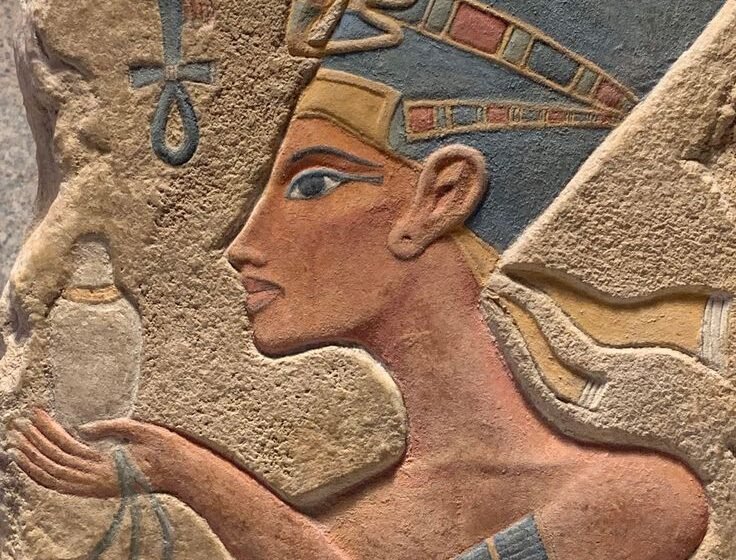
Nefertiti was not a passive observer in this revolution. She became its most visible and devoted supporter. Art from this period shows her standing beside Akhenaten in nearly every important religious scene. She is shown worshipping Aten, making offerings, and blessing the people. In some images, she even strikes down enemies, a role traditionally reserved only for pharaohs.
This was unprecedented. Egyptian queens had always held influence, but Nefertiti was being portrayed as a ruler in her own right. She wore the tall blue crown, usually worn by kings. She appeared in reliefs as a spiritual leader and political authority. Foreign dignitaries would have seen her as one of the main representatives of Egypt’s power.
Nefertiti also played an important role in diplomacy. Egypt maintained complex relationships with other major powers, including Babylon, Assyria, Mitanni, and the Hittite Empire. These alliances were maintained through letters, gifts, and royal marriages. Many scholars believe Nefertiti was deeply involved in these exchanges, helping manage Egypt’s international position during a time of religious and political instability.
Despite their radical beliefs, Akhenaten and Nefertiti still had to rule an empire. While they focused on worshipping Aten, Egypt’s borders became less secure. Foreign powers began to test Egyptian strength. Letters from this period, known as the Amarna Letters, show vassal kings begging Egypt for military help that never arrived. Akhenaten seemed more interested in his god than in governing.
This may have increased Nefertiti’s importance. While Akhenaten devoted himself to spiritual matters, she likely handled much of the practical business of ruling. Her intelligence, presence, and authority helped hold the kingdom together during a time of growing unrest.
Around the twelfth year of Akhenaten’s reign, something strange happened. Nefertiti vanished from official records. Her name stopped appearing in inscriptions. Her images were no longer carved. In a civilization that carefully recorded every royal event, this disappearance was highly unusual.
Some historians once believed she died. But there is no tomb, no burial, no funeral inscription. Instead, evidence suggests she may have changed her identity. A mysterious ruler appears at this time under the name Neferneferuaten, who seems to have ruled alongside Akhenaten or shortly after his death. Many Egyptologists now believe this ruler was Nefertiti herself.
If this is true, Nefertiti would have become one of the few women to rule Egypt as a pharaoh. This would explain why her earlier identity disappeared. She would have taken a new royal name, just as male kings did. It would also explain why later generations tried so hard to erase her memory.
After Akhenaten died, Egypt entered a period of chaos. The Aten religion collapsed. The old gods were restored. The capital was abandoned. The young Tutankhamun, who became king, rejected Akhenaten’s beliefs and returned Egypt to its traditional ways.
Akhenaten was declared a heretic. His monuments were destroyed. His name was erased from stone. Anyone closely associated with him became politically dangerous to remember. Nefertiti, as the public face of the Aten revolution, would have been one of the first to be targeted.
This explains why her tomb has never been found. Unlike most Egyptian royals, whose burial sites were carefully protected, Nefertiti’s final resting place was either hidden or destroyed. Her mummy remains unidentified, possibly buried under another name or removed entirely during the backlash against Akhenaten’s reign.
For thousands of years, Nefertiti was lost to history. Ancient Egyptian records barely mentioned her. She was known only as a name in fragments of broken stone.
Then, in 1912, everything changed. A German archaeological team discovered a limestone bust in the ruins of Akhetaten. The sculpture showed a woman of extraordinary elegance, with high cheekbones, graceful features, and a regal expression. It was Nefertiti.
The bust became one of the most famous artworks in the world. It revealed not only her beauty but her strength, dignity, and intelligence. Suddenly, the forgotten queen became a global icon.
But the bust did more than make her famous. It forced historians to rethink her importance. This was not a minor royal wife. This was a woman who had stood at the center of one of the greatest transformations in Egyptian history.
Today, Nefertiti is remembered as far more than a beautiful face. She was a political strategist, a religious leader, and possibly a king. She lived in a time when challenging tradition meant risking everything, yet she stood beside Akhenaten and helped shape a new vision of the world.
Her story is also a warning about power and memory. Those who lose political battles often lose their place in history. Nefertiti’s enemies tried to erase her completely. They failed.
Three thousand years later, her face still looks out at us, calm and eternal, reminding the world that even when history tries to forget someone, greatness has a way of surviving.