KALA PANI – THE WATERS OF DEATH

-Tanushree Wadodkar
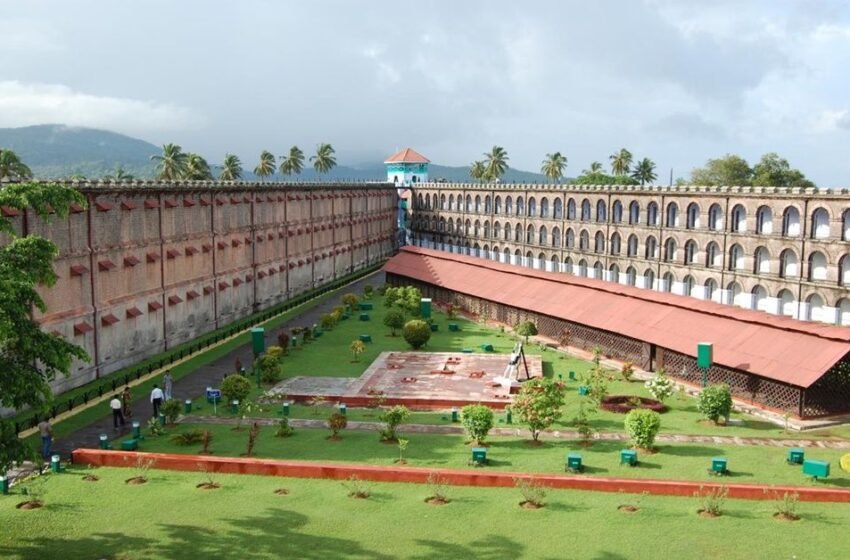
When I first stepped into the Cellular Jail in Port Blair, Andaman, I just stopped. I have tried to describe that moment several times, but I honestly don’t know how. The small cells, the hanging cellar, and the darkness, both literal and metaphorical, were overwhelming to say the least. It did not feel like I was exploring a historic place, but rather like I was stepping into a museum of pain and suffering. The heaviness in the air can not be described. This was not just any other prison- it was the place meant to break the spirit and the very will to live. This was Kala Paani.
The Construction
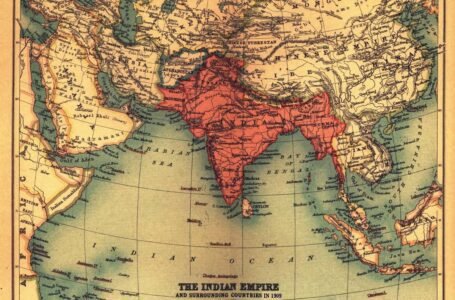
The foundation of the Cellular Jail, also known as Kala Paani, was laid in 1896, as an indirect result of the revolt of 1857. The colonial rulers saw Andaman as an ideal location to hold political prisoners, as it was far from the mainland. Another plus point for the British was that it was surrounded by water, with no way for the prisoners to escape. It was said that those who went to Kala Paani never returned.
Originally, the prison had seven wings, and in the centre stood a tower (imagine the structure of a wheel). Each wing had three floors and a total of 693 cells. Each cell was barely 14 by 7 feet and had a single small window located high on the walls. This made the cells dark and suffocating, and kept the prisoners isolated. The guards kept an eye on all prisoners from the central tower. The wings were constructed in such a manner that the front of one wing faced the back of another. This was done to ensure that the prisoners could not communicate with one another.
The brutality that the prisoners endured inside the Cellular Jail was beyond anyone’s imagination. Inmates endured a lot of physical and mental torture. They were forced to extract oil from coconuts, manually grind wheat for hours, and were made to do repetitive tasks aimed at humiliating them. If they refused to comply, they were beaten, deprived of food, and put in even worse conditions. The food that was provided was sparse and often inedible.
The torture
Inside their cells, the prisoners were only provided with one wooden cot, an aluminium plate, and two pots- one for water and one to excrete in. However, the pot was sometimes not enough and the prisoners were forced to lie in their own filth. At times, the prisoners were also being force-fed so much that it resulted in their death. Freedom fighters like Mahavir Singh and Mohan Kishore died due to drowning in milk (as a result of force feeding when the milk seeped into their lungs). Another victim of such atrocities was Ullaskar Dutt. He was tortured so much that he lost his sanity and went mad. He was transferred to a lunatic facility at Haddoo, and his screams could be heard as he was dragged away. The reason that they gave for his insanity was “malarial infection”, and not what they did to him.
Indu Bhusan Roy, another prisoner, hung himself in his cell from the small window using a piece of torn kurta.
Another story is that of Sushil Dasgupta. He was made to work in the scorching heat, pounding coconuts for hours on end. He was exhausted, thirsty, and his hands were covered in his own blood. When he asked for just one cup of water, he was whipped over and over.
A lot of times, the prisoners collapsed from severe dehydration and exhaustion. No matter how tired they were, they were not allowed to rest for even a minute. The bodies of the prisoners who died were thrown with stones, weighing them down.
The Savarkar brothers
Vinayak Damodar Savarkar was given two life sentences in 1911 and sent to the Cellular Jail in Andaman. His older brother, Baburao Savarkar, was already serving a life sentence there. Despite being in the same jail, they did not know about each other. In his writings, Vinayak Savarkar says that he had no idea that his brother was in the same prison for the first couple of years.
Even though he was mostly confined to his cell, he did not let his spirit of rebellion die. He wrote poems on the walls using nails, thorns, and charcoal. He wrote about his motherland, sacrifice, patriotism, and hope among despair. Despite the strict isolation, Savarkat tries to inspire fellow prisoners, encourage unity, and even teach others to read.
Written below is one of the poems composed by Veer Savarkar
ने मजसी ने परत मातृभूमीला,
सागरा प्राण तळमळला।
भूमातेच्या चरणतळी तूज धरुनी,
लोटांगण घालीन मी ॥
तिजविण नको राज्य मज प्रिय साचा,
वनवास तिचा जरी असो ॥
ने मजसी ने परत मातृभूमीला,
सागरा प्राण तळमळला॥
“O Sea, take me back to my motherland,
My soul aches deeply for her.
Let me fall at her feet,
Let me bow before her soil.
Without her, I desire no kingdom,
Even her wilderness is dearer to me.
O Sea, carry me back-
My very life longs for her.”
This poem reflects the internal longing and emotional pain of Vinayak Savarkar. At Kala Paani, he was completely cut off from India, surrounded by the vast sea, and living under harsh imprisonment.
The significance of ‘Kala Paani’
The Cellular Jail was popularly known as Kala Paani among Indians.
The term Kala Paani literally translates to ‘Black Water’ in Hindi, signifying the fear associated with the Andaman and Nicobar Islands during British rule. The name also came from the dark appearance of the ocean surrounding the island.
Despite the darkness surrounding it, Kala Paani stands as an example of sacrifice, resilience, and patriotism. There may have been torture and cruelty and brutality, but there was also strength and the courage to put your motherland before your own life.
At present, only 3 of the 7 wings remain, and the jail has been converted into a museum. Every night, they host a light and sound show which showcases what life at Kala Paani was like.