In the Shadows of Discovery: The Life and the Remarkable Contribution of Bibha Chowdhuri

-Oishee Bose
There is something almost cinematic about a scientist who climbs into the Himalayas to hang photographic plates on a rickety frame and waits, sometimes for months, for invisible rain from the cosmos to etch its secret on silver halide. That image fits one chapter of the life of Bibha Chowdhuri: a young Bengali woman whose curiosity drew her into the then-frontier of particle physics, into laboratories in Calcutta and Manchester, and eventually into the subterranean mines of Kolar Gold Fields. Yet her name does not appear in the same breath as the Nobel winners and headline-making discoveries of mid-20th century physics. This is an attempt to map that life, the human contours behind the papers and the plates, and to reflect on what it means for a scientific life to be remembered or forgotten.
Roots and the making of a scientist
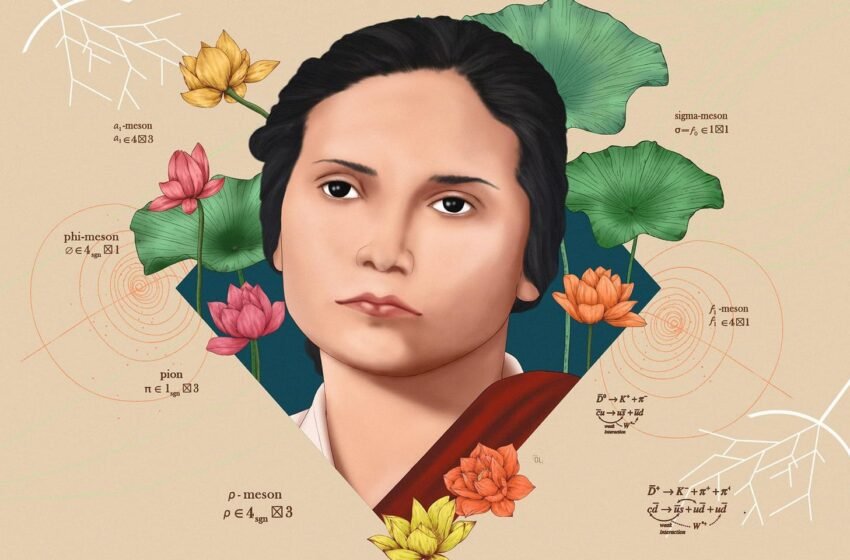
Bibha Chowdhuri was born on 3 July 1913 in Calcutta into a family that valued modern education and reformist ideas. Her upbringing, in a household influenced by the Brahmo Samaj and relatives connected to established figures in Indian science, gave her the unusual freedom for the era, which allowed her to pursue higher studies. She read physics at Rajabazar Science College, University of Calcutta, and in a class of dozens, she was often the only woman. That fact, the social texture of being both an insider to education and an outsider in a male profession shaped her voice and career in ways that later biographers and historians would highlight.
After completion of M.Sc. in the mid-1930s, Bibha joined the Bose Institute in Calcutta and began to work closely with Debendra Mohan Bose. The laboratory at that time was part of a global web of small, hands-on experimental teams working on cosmic rays or the high-energy particles from outer space that offered physicists a natural accelerator long before big machines existed. Bibha’s task was painstaking: exposing photographic and emulsion plates at high altitudes (Darjeeling and Sandakphu), developing them, and reading the faint, curved tracks left by charged particles. The lab’s observations and Bibha’s methodical reading of tracks would later be described as early measurements of mesotron (meson) events.
In the shadow and light of discovery
The 1930s and 1940s were an odd period of particle physics. Theories (like Yukawa’s prediction of a meson mediating the nuclear force) raced ahead of clean experimental proof, and the tools available in any one lab often determined who would be able to make a convincing claim. Bibha and D. M. Bose published several notes in Nature around 1940–42 documenting “stars” and curved tracks in their emulsions that suggested particles lighter than protons and exhibiting decay with altitude, a phenomena consistent with meson behavior. Their photographic technique for estimating mass from such imprints was elegant and ahead of many contemporaneous efforts. But the emulsion technology available to them, that is, the Ilford half-tone plates and early emulsions lacked the sensitivity that later European groups would have. When later teams using improved emulsions and refined chemical processing produced clearer, incontrovertible images, recognition followed them. Thus a narrative of “near-discovery” attached itself to Bibha’s work: she and her colleagues were very close, perhaps the first to see meson-like tracks, but lacked the decisive apparatus to convert observation into widely accepted discovery.
This is not merely technical trivia. It is also a story about resources, networks, and the geography of science. Labs in Europe and North America had better supply lines, faster access to new photographic emulsions, and a media ecosystem that translated experimental claims swiftly into scholarly consensus. A scientist in Calcutta in 1939, working under colonial constraints and wartime shortages, faced very different obstacles. That gap shaped the arc of Bibha’s early career.
Manchester: a laboratory and a classroom in the world
After the wartime years, Bibha travelled to England and worked in the cosmic-ray laboratory of Sir Patrick Blackett at the University of Manchester, where she completed a PhD (thesis: Extensive air showers associated with penetrating particles, 1949). Her work in Manchester focused on cloud-chamber studies and extensive air showers, in which cascades of secondary particles are produced when a highly energetic primary particle strikes the atmosphere, particularly examining the penetrating component of these showers. In technical terms, she demonstrated relationships between penetrating particle density and total shower particle density, helping to clarify where penetrating particles in showers were produced and how to interpret their tracks. Those results fed into the broader postwar effort to understand cosmic rays as a window to new particles and interactions.
Manchester was where techniques, instruments, and interpretive communities converged. It was also where Bibha experienced, in the phrase used in contemporary press, both novelty and isolation: novelty in being a South Asian woman scientist in a leading European lab, and isolation because scientific networks were still tightly gendered and nationally stratified. Yet her Manchester period matured her as an experimentalist; she learned to work with cloud chambers and geiger counters, to think statistically about showers, and to publish in international forums.
A career that threaded India and the world
On returning to India, Bibha joined the newly formed Tata Institute of Fundamental Research (TIFR) in Mumbai, the laboratory where India was trying to build a homegrown high-energy physics program. She became one of the earliest women scientists on its staff. Over the following decades she worked in many other places: TIFR, the Physical Research Laboratory, the Saha Institute of Nuclear Physics, and research visits abroad (including France and the University of Michigan). Her work continued to focus on cosmic rays, penetrating muons, and later the study of K-mesons using cloud chambers and underground experiments. At Kolar Gold Fields, for instance, the geometry of the mines, miles of rock shielding the detectors from the deluge of surface particles, made possible a different class of measurements; Bibha contributed to those subterranean efforts that would make India one of the early sites of underground particle physics.
If one traces Bibha’s papers and notes, a pattern emerges: meticulous, careful reporting; an experimentalist’s patience; a willingness to move between labs and countries to follow technique and apparatus. She published in international journals and collaborated with a variety of scientists. Yet decades later, popular retellings emphasize “missed Nobel” and “forgotten pioneer.” Those are part true, part simplification, which is important because they speak about how public memory elevates certain narratives while eliding the reality of many productive scientific careers.
Recognition, invisibility, and the politics of memory
Why was Bibha not a popular name, even in Indian scientific circles? There are several overlapping reasons.
First, the sociology of instrumentation matters. Nobel-level recognition has often followed definitive experimental images and reproducible claims; groups with access to superior emulsions and better laboratory networks could press the case more forcefully. Second, institutional visibility plays a role: European labs had easier routes into print, convening committees, and review processes that amplified their achievements. Third, gender bias, explicit and implicit, constrained the careers and reputations of many female scientists of that generation, from access to leadership positions to the ease of being cited and remembered. Finally, historiography itself — who chooses subjects for biographies, textbooks, and commemorations, has historically favoured certain geographies and personalities. Bibha’s steady, collaborative, laboratory-centred work did not fit the solitary genius myth favored by many popular histories.
In recent years a corrective has begun: books, essays, and science media in India and abroad have taken up Bibha Chowdhuri as an emblematic figure for scholarship that asks, whose histories get told? Her life has inspired biographies such as ‘A Jewel Unearthed: Bibha Chowdhuri’, journal pieces, and features in popular science outlets that seek to restore her visibility. In 2019 a star was even given the name “Bibha” in a public naming exercise, a symbolic nod that says as much about memory as it does about honor.
The work itself: what did she actually show?
It helps to be concrete. The experiments at Darjeeling and Sandakphu involved exposing photographic emulsions to cosmic rays at different altitudes and then comparing track length, curvature, and frequency. Bibha and Bose observed that certain tracks became shorter or fewer at lower altitudes, a behaviour one would expect of an unstable particle that decays during its transit. They proposed photographic methods to estimate particle mass from emulsion “stars.” Later, while at Manchester, Bibha’s thesis and papers clarified the role of penetrating particles in extensive air showers, and her cloud-chamber studies helped isolate energetic components that were essential to interpreting cosmic-ray data. These were not casual observations; they were careful, replicable analyses that advanced techniques in a period of rapid discovery.
On being “forgotten”: myth, memory, and justice
Labeling Bibha a “forgotten genius” risks a flattening, it elevates the narrative to one of singular victimhood (missed Nobel) while overlooking the more typical and instructive story of a serious scientist whose work is influential in steady, incremental ways. The better corrective is not merely to mourn the absence of a prize but to read Bibha’s career as evidence of how science is distributed: who gets resources, who builds labs, who circulates results. Her story invites structural questions about science and empire, about gender and career structures, and about how national science policies in early independent India shaped research trajectories.
Personal traces: the quiet courage of a life at work
Biographical fragments — the anecdote of the young woman being the only female in her M.Sc. cohort, the image of Himalayan emulsion work, the foreign press calling her “India’s new woman scientist” — give texture to what otherwise could be an arid list of publications. Contemporary interviews and memorial essays report that Bibha combined a rigorous work ethic with a modesty that made her an unassuming presence in labs. She taught, supervised, and collaborated; she travelled to labs in Europe and North America at a time when such journeys were uncommon for women from her social background. Those personal traces are important: they show the human side of scientific labour, the long afternoons of plate-reading, the slow back-and-forth of correspondence, the domestic negotiations required for travel and work.
What her life asks of us
Bibha Chowdhuri died in 1991, and public attention begun to gathered around her contributions only in her last decade. This belated attention is welcome, but it should be the beginning of questions, not the end of them. If we care about scientific justice, we should ask: how many other lab scientists — women, colonial subjects, regional amateurs with deep expertise were edged out of the canonical narratives because their apparatus, their geography, or their gender made them less legible? What kinds of archives and oral histories do we need to collect to make laboratory lives visible? How should institutions, be it the national academies, universities, funding agencies, repair patterns of neglect that are not only personal but structural?
Bibha’s story is not an unalloyed tragedy. It is also a story of patient craftsmanship in the service of understanding the universe: a woman who learned to coax information from fragile emulsions, who sat with cloud-chamber photographs until faint lines told a story, and who moved across continents in pursuit of technique. Remembering her, with all her complexities and limits, enriches our picture of how science actually happens, as a social, material, and deeply human practice.
So next time you hear the headline about a dramatic discovery, remember the plates in Darjeeling, the mines of Kolar, and the patient scientist who read those tracks for what they were. Then ask whether history is telling the full story, and if it is not, whether you can help make the gaps or under-discussed parts visible.