The Diverse Tapestry of Holi Celebrations across India

-Saptadeepa Mahapatra
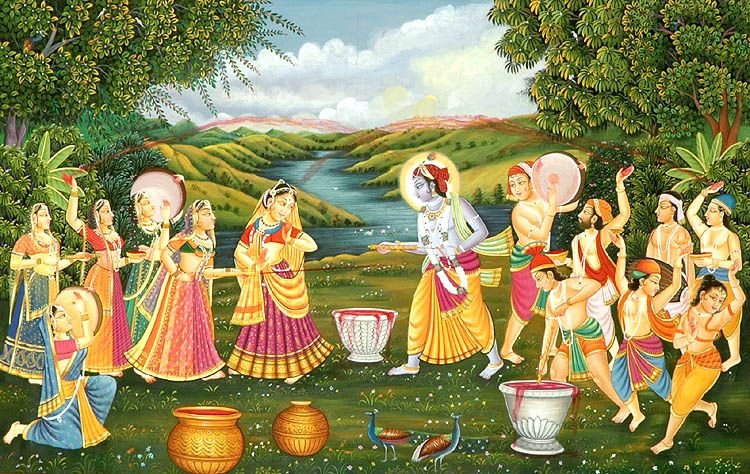
The pink blossoms, the bright colors, the vibrant beats, the calm breeze in the evening- all indicates the arrival of spring and specially the festival of Holi, marking the triumph of good over evil and of eternal love.
Since the ancient age, the festival of colors has painted India’s cultural canvas, with renewal, love and much more. Traced back to the Vedic traditions and entangled through ribbons of folklore, the vibrant rituals are performed in a varied manner, within communities all over the Indian subcontinent. From tribal bonfires to royal pageants, the spring festival is intertwined among all.
Rooted in the Vedic period around 1000 BCE, various mythological facts, like Kamadeva with bonfires and wild herbs like Bhang are mentioned in the Rig Veda. By the 4th century CE, epics like Bhagavata Purana immortalized the divine tale of Holika and Prahlad and how little Prahlad, survived the flames of his demon father Hiranyakashipu and aunt Holika. This give birth to the Holika Dahan pyre ritual, that is followed almost all over India. During the medieval period, when Bhakti saints emerged, saints like Surdas, Mirabai are deeply connected to the festival of colors. The preach of elite Krishna cults to the mass audience through Rashleela, marks up an important ritual in the festival. Mughal empires like Jahangir embraced it, blending a touch of Persian aesthetics, in his court.
With evolution of time period, human life and way of living, the festival evolved too, but keeping on with the traditional essence. India does not celebrate Holi in a monotonous way. It unfolds its different forms, very dramatically, depending on the culture, the communities and the history they possess.
Mark Twain once said, “Varanasi is older than history, older than tradition, older even than legend and looks twice as old as all of them put together”. The statement holds very true even with Masaan ki Holi or Bhasma Holi, which is a very unique and mystical celebration that takes place on the cremation grounds of Banaras. Instead of pretty colors, ashes from burning pyres are used to mark this celebration, symbolizing the cycle of life and death. In Banaras, the festival is observed the day following Rangbhari ekadashi at cremation grounds, especially at Manikarnika and Harishchandra Ghats. It is celebrated by ascetics, Aghori sadhus and the Shiva devotees, who embrace the ashes as a form of purification and conection to the divine. It is not a normal festival and especially for the faint hearted or for entertainment. It is a sacred practice that goes beyond the worldly pleasures, emphasizing a touch of spiritual essence of existence. As per old sayings, it is believed that after bringing Goddess Parvati to Kashi on Rangbhari Ekadashi, Shiva returned to the cremation ground to play Holi with his ghosts, spirits and attendants, who were not allowed to take part in the main celebrations. This tradition also reflects Varanasi’s ancit Shaiva culture, where death is not viewed as an end but as a gateway to liberation. The ritual embodies a profound philosophical truth that life and death coexist and celebration can emerge even from impermanence.
Another unique celebration from Uttar Pradesh’s twin towns, Barsana and Nandgaon, the Lathmar Holi, is an iconic one. As the name literally means “Holi of sticks”, the festival is celebrated with spirited mock battles between men and women. Its origins are traced to the divine love story of Krishna and Radha. According to local legend, Krishna from Nandgaon would visit Barsana, to tease her and her friends. In response, the women playfully chased him away with sticks. This episode became ritualized over centuries into today’s lathmar holi. Historically the tradition gained prominence under the patronage of local temples in the Braj region of Uttar Pradesh, where Krishna devotion flourished during the Bhakti movement, during the medieval period. The celebration begins days before the main day of holi, with men from Nandgaon visiting Barsana. Women greet them with sticks, while the men shield themselves with padded shields. The celebration occurs amid songs and showers of colors and flowers, preserving Braj’s cultural memory through joy, devotion and spirited play.
Holi celebrations among the adivasi communities infuse primal earthly worship. The tribal areas in the southern parts of Chhattisgarh, especially in the Dantewada district, resides the indigenous people. They observe a very distinctive festival known as Phagun Madai. It is a glorious and vibrant festival that goes on for 10 consecutive days, leading upto Holi. Notably celebrated by the Gond, Baiga and Halba tribe, it features a royal celebration, worshipping Maa Danteshwari. In the last 10 days of the month of Phagun, this tribal festival of culture, folk dance is observed by the tribes of the entire Bastar division and from neighboring villages of Odisha, with devotion and reverence in the temple premises of Dantewada. The festival begins with the inauguration of the idols’ of local deities, with Maa Danteshwari’s palanquin leading the procession. Started by the erstwhile king of Bastar, Purushottom Dev, the tradition is one of the oldest traditions of India, celebrated during spring. Daily for nine days, the palanquin is taken from the main temple to Narayan temple where tribal culture, folk dances are presented after worship rituals. The 10th day marks the end of the festival, and happens on the day of Holi, which the tribe calls as Rambh-Bhang festival, which means Gulal-Abir. In order to keep the tribal folk culture, traditions and beliefs alive, this festival or madai, as called by the tribals, is being celebrated uninterrupted, through generations.
The state of Manipur has its own way of celebrating the spring festival. The celebration stretches over six days, with spectacular dance, music and sports, blending ancient cultural traditions with modern energy. Known as Yaosang, the Manipuri style Holi has its roots for over 300 years that is getting evolved with changing times. The festival is known to have been shaped by the influence of Vaishnavism, which became of immense importance durng the reign of King Meidingu Pamheiba, of the Ningthouja dynasty. But if we delve deeper into the history, the origin of Yaosang lies in the ancient traditions of an ethnic group called Meitei, who originally celebrated it as a harvest festival. Meitei are the dominant ethnic group of Manipur, occupying central part of the state. The name itself reflects the agrarian origins. In Manipur, ‘Yao’ means sheep, and ‘Sang’ means shed, which emphasizes on the fact that the festival once marked the end of winter and arrival of spring. It is celebrated around the full moon day, which is known as Lamba, in the month of March. Thabal Chongba or dancing in the moonlight, remains one of the most fascinating customs, of this festival. Other than that, it follows all other customs related to the celebration of Holi, like Holika Dahan, at dusk.
In the misty hills of Uttarakhand’s Kumaon region, Pahadi holi unfolds not only fleeting burst of colors but also a soul-stirring, month-long symphony of music, tradition, customs and community warmth. Traced back to the 15th century courtly culture of the Chand kings in Champawat, the festival prioritizes heartfelt bonding through its three enchanting forms: Baithaki Holi (sitting), where gatherings in courtyards and cozy homes occur during Basant Panchami, with the crowd, singing soulful classical ragas and folk tunes. The second one is known as Khadi holi (standing), is a lively celebration, pulsing with group dances to the rhythmic thump of drums and hurka, as participants sway in spirited processions. The last custom remains another unique trait of the Pahadi holi celebration, the Mahila Holi, a women only affair brimming with vibrant songs and dances that echo feminine joy and solidarity. The festival ignites with Chir Bandhan, tying a colorful cloth banner to mark the season’s promise, building to the sacred Chir bonfire and Holika Dahan.
In the multi-layered zone of India’s Holi celebrations, the festival emerges not merely as a riot of colors, but as a profound testament to the nation’s ethos of unity on diversity. The unity shines the brightest in Holi’s regional kaleidoscope, where local flavors amplify the national chorus. In Rajasthan’s opulent Royal Holi, Udaipur’s Mewar royals lead elephantine processions from City Palace, their gilded mehfils blending Rajput splendor with folk fervor, a regal nod to Mughal-era syncretism. Maharashtra’s Shimga Holi unfurls over five vibrant days, from rural dhulivandan acrobatics honoring shepherd deities to Rangpanchami’s rooftop color barrages, embodying Marathi resilience and communal joy.
West Bengal offers dual delights: Kolkata’s flamboyant Rolls Royce Holi, where elites in vintage luxury cars parade Park Street with champagne flutes and imported hues, juxtaposes colonial nostalgia against urban swagger; while Shantiniketan’s Holi pulses with Tagore’s Baul rhythms, barefooted dancers in white swirling amid basanta utsav blooms, a poetic fusion of rural Bengal’s soulful simplicity. Tamil Nadu’s Kama Dahanam, meanwhile, burns effigies of the love god before Shiva’s third eye, its alattukolu stick duels and puccha games evoking Dravidian antiquity, where fire rituals eclipse colors in austere devotion.
As eco-conscious adaptations bloom amid global pilgrimages, Holi endures as democracy’s colorful heartbeat, reminding us that beneath the powder lies an unbreakable bond of shared humanity. In its multi faceted embrace, diversity is not division, but the very pigment of unity.