Other side of the coin: Mythical Folklores on Holi Celebration

–Saptadeepa Mahapatra
With the fading cool breathes of winter, every spring brings a subtle restlessness all over the Indian subcontinent, especially the Northern belt, the air begins to sway the enchanting scent of new blossoms. It’s a gentle reminder that festival of colours- Holi is just knocking on the door.
People are very familiar with the Holika Dahan and Prahlad story, but Holi carries with it a cascade of stories that are as vibrant as the gulals that are flung across the streets. Holi comprises of the myth that speak of fear and renewal, desire and abandonment, village anxieties and even mythical cosmic love. Stories like the Chase of Dhundhi, Lord Shiva and the sacrifice of Kamadeva are mythical folklores that enchant people, stretching from North to the South of the Indian peninsula.
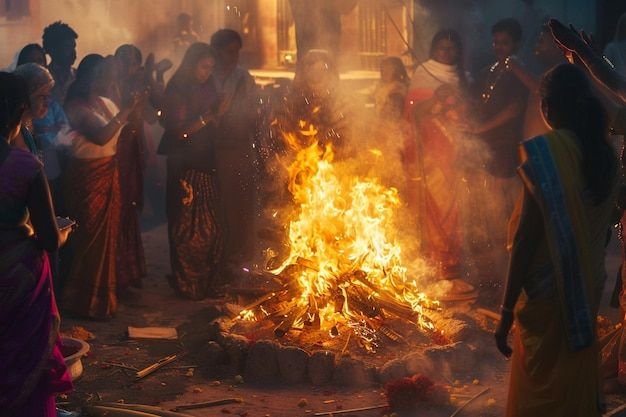
It is believed and still recounted by elders, in North India, especially in rural Uttar Pradesh, that Holi is not only a festival of laughter and colors, but also an acknowledgement that fear itself can be mocked with courage and unity. Based on early legends and tales related to Bhavishya Purana, Dhundhi, sometimes called as Dhundha was a female demon, whose presence haunted the dreams of children and whose shadow fell long and terrifying across a the kingdom of King Raghu, who was a righteous ruler of the Solar Dynasty of Ayodhya. Dhundhi had secured a peculiar boon from Lord Shiva, that made her immune to the weapons of Gods and men, invulnerable to the austerities of sages and the power of rituals. The boon was she would neither be killed by gods, men nor suffer from arms nor from heat, cold or rain. These boons made her almost invincible but she also possessed one curious weakness- she could be driven away by the noisy, irreverent pranks and mocking laughter of children. Deeply troubled by the Ogress, the King Raghu consulted his priest. Giving the solution, the priest said that on Phalguna 15, the season of cold vanishes and summer starts. Boys with bits of wood in their hands may go out of their house, collect a heap of wood and grass, set it on fire with mantras, clap their hands, go around the fire thrice, laugh, sing and by their noise, laughter and homa, the ogress would die. The only solution of the ogress’ tormenting torture was a child’s unruly chorus and not a warrior’s sword. As a solution, during the transition period between winter and spring, on the night of the full moon of Phalguna, villagers gathered wood for a bonfire, an act that has now become central to Holi’s eve known as Holika Dahan, and encouraged the children to run around the streets and lanes, banging sticks, shouting cuss words, singing ribald songs and tossing away the darkness with their defiant glee. The young boys of the village decided to rid their land of Dhundhi’s menace. They devised a plan to chase her away using loud noises, shouts, and pranks. They also threw colorful powders and water at her that she was not immune to, despite her other powers. The cacophony, raw and unrestrained behavior was believed to scorch Dhubdhi’s power and force her retreat into the wilderness, beyond the protective circle of the community’s firelight. Overwhelmed by the noise and the colors, Dhundhi fled the village, never to return.
Holi’s mythic tapestry is not woven from a single thread and along with Dhundhi’s smoky retreat stands another tale, one that shifts the scene from village lanes to the heights of cosmic drama. The story of Lord Shiva and the sacrifice of Kamadeva, the god of desire. His sacrifice binds Holi to the themes of longing and transcendence. Popular in the Southern states of India, it is believed that Lord Shiva out of anger, burned Kamadeva, the lord of love and desire, during this time and when Lord Shiva regained his peace, brought back Kamadeva to life. In South India, people worship Kamadeva for his extreme sacrifice on the day of holi. As per Hindu mythology, the narrative unfolds against the backdrop of a crisis, the demon Tarakasura, who had grown nearly invincible, could only be defeated and killed by the son, born of the union of Lord Shiva and Parvati. But Shiva was deep in meditation and sorrow after the death of his first consort Sati. He completely withdrawn from worldly engagement and was ascetically focused in meditation, unbroken by earthly concerns. Horrified and deeply troubled by Tarakashura, the gods desperately turned to Kamadeva, asking him to aim his floral arrows at Lord Shiva and awaken in him the spark of love for Parvati. Kamadeva released his arrow at the Lord and it is believed that for a fleeting instant, desires stirred in Shiva’s consciousness. But the disturbance of his penance ignited a fierce wrath and opening his third eye, Shiva unleashed a flame that incinerated Kamadeva into ashes. The god of love fell down, bodiless, henceforth known as Ananga (the one without body) and his wife Rati was left to mourn. Her grief, profoundly moved Lord Shiva into eventual compassion. It is believed that, Lord Shiva granted Kamadeva to continue living invisibly, shaping desire without physical form, while in other folklores he is believed to have been restored completely. This scene was later described in Puranic texts and celebrated in poetry. The connection of this situation to Holi lies not only in the timimg, that it occurred during the full moon of Phalguna, but it also symbolizes fire and ash, as the destruction of preceding renewal. In parts of South India, the day after Holika Dahan is sometimes linked to Kama Dahanam, commemorating the burning of Kamadeva, as bonfire’s embers are seen as reminders of transformative power.
In Tamil Nadu, Holi is known by three different names, Kamavilas, Kaman Pandigai and Kama Dahanam. During Dol Purnima, the deity is offered with mango and blossoms that he loved and sandalwood paste to cool off the pain of his fatal burns. Songs are also song in which Rati’s sorrow is depicted. When villagers circle the flames on Holi eve, offering grains and prayers, they participate, in a ritual that mirrors both the banishment of Dhundhi and the incineration of Kama, which is believed to threaten balance, whether it be disease-bearing bacterias or unbridled desires. These myths are endured not merely because of their antiquity but also their psychological resonance. Dhundhi is generally embodied with the unnamed fears that gather in transitional seasons, when illness get communicated easily, while Kamadeva’s fate depicts the tension between ascetic restraint and sensual vitality.
Holi positioned at such a period that becomes a festival that holds opposites together. Noise and silence, mockery and devotion, fire and color altogether, emerge to smear each other with pinks, greens and yellows. Historically, references to this spring festival appeared un early Sanskrit texts and by the medieval period the celebration had become widespread, depicted in temple inscriptions and miniature paintings, portraying people drenched in color.
The mythological folklores of Dhundhi and Kamadeva, suggests that Holi’s roots are entwined much earlier times, revealing a festival that is at once earthy and metaphysical.