Shivaji Maharaj: The Warrior Who Challenged an Empire

-Chirag Peshawariya
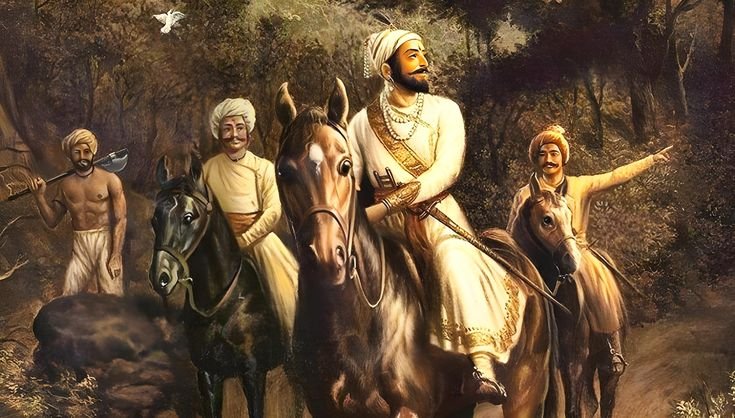
A warrior born from the heart of India that sent shocks down some of the mightiest courts and royal chambers, and the empires that opposed him (and watched him closely) made sure to never underestimate him once, let alone twice was Chhatrapati Shivaji Maharaj, the founder of a new Maratha State, and one of the great military minds of the 17th century.
Shivaji was born on the 19th of February, 1630, at Shivneri Fort, present day Maharashtra. His sole influence in his early years was his mother, Jijabai, who filled his mind with images/ideas of bravery, faith, and duty. She taught him the stories of the Ramayana and Mahabharata. On the other hand, his father was Shahaji Bhonsle – and a General under the Mughals in the Daga Region. As a result, Shivaji grew up in the center of a very political environment; however, Shivaji developed a mindset that believed in self-government rather than serving the powerful in India.
At that time period, most of India was being ruled by the Mughal Empire under the rule of Aurangzeb; the Deccan consisted of the two competing City States of Bijapur and Golconda, and the local powers were weak and unable to maintain any power. Shivaji believed that the people of the Deccan needed a government which was raised in their own homeland – so during his teenage years, Shivaji dedicated himself to building the idea of “Hindavi Swarajya,” a government led by the citizens of the Deccan region.
The First Victories
At the young age of 16, Shivaji Maratha took his first step to greatness by capturing the Torna Fort in Maharashtra. This was not an impulsive ambush; Shivaji carefully studied Torna’s approach and defenses and creatively used speed to capture the fort’s resources and gain recognition among the local populace and confidence from his followers. Following this captured fort, he fortified the Raja Fort and expanded his influence into surrounding regions.
What made Shivaji’s strategy so unique was that he did not engage in traditional large‐scale battles; rather, he used fast raids either alone or in small groups and relied on an extensive intelligence network to gain tactical advantages through quick surprise attacks (which later became known as guerrilla warfare). The combination of speed, intelligence networks, mobility, and attacking supply lines allowed his small numbers to defeat much larger enemy forces, and in doing so he captured fort after fort throughout southern Maharashtra.
Afzal Khan’s Encounter
Shivaji had now become a threat to the Sultan of Bijapur. So the Sultan sent General Afzal Khan to bring Shivaji down. The two were going to meet in 1659 beside Pratapgarh Fort. Afzal Khan believed that he would be able to deceive Shivaji and be able to kill him. Some historians say that he tried to stab Shivaji when he engaged Shivaji in embrace.
Shivaji expected the betrayal, therefore he was wearing hidden body armour and had the weapon of Wagh Nakha in his hand and hit back at Afzal Khan. The result was that Afzal Khan was killed, causing Afzal Khan’s army to go into chaos.
The victory gave Shivaji a firm place in the Deccan as no longer just a regional challenger but as a potential leader.
The Panhala siege and Pavan Khind’s sacrifice
The forces of Bijapur, commanded by Siddi Jauhar, soon surrounded the fort of Panhala. Food supplies ran low, and there appeared to be no escape route. To escape, Shivaji planned to break out at night. Some of his men had to remain behind to slow down the enemy, one of whom was Baji Prabhu Deshpande.
At Pavan Khind, a narrow pass in the mountains, Baji Prabhu and a few hundred of Shivaji’s soldiers single-handedly fought off thousands of pursuing troops. Only when a cannon was fired to show that Shivaji was safe at Vishalgad did they stop fighting. Baji Prabhu was killed during the fight; however, he paid the ultimate sacrifice to protect Shivaji and the rest of the Maratha Empire. This loyalty represented this moment in history and the history of the Marathas.
Raiding Other Cities
The Mughals Became Aware Of These Actions By The Marathas. When Aurangzeb Heard Of This He Sent His Uncle, Shaista Khan, With Thousands Of His Soldiers To Suppress The Deccan. Shaista Blockaded Pune And Even Established Himself In The Place Where Shivaji Had Lived As A Boy, The Lal Mahal.
1663 Was The Year That Would Go Down As One Of The Great Feats For Shivaji. In Considerable Boldness He Used Night Concealment To Enter Pune With Very Little Force. Once Inside He And His Small Force Entered The Mughals Palace And Attacked The Forces Of Shaista Khan. The Unbelievably Successful Attack By The Marathas Caused Shaista Khan To Lose Several Of His Toes Due To Injury He Suffered And Had An Unquantifiable Psychological Effect On The Entire Mughal Empire. Even The Mughals Confidence Was Greatly Shaken With All That Shivaji Had Accomplished. The Attack On The Mughal Presence Would Also Serve To Establish That The Marathas Were More Than Up To The Task Of Striking Deep Into Mughal Territory.
The Sack Of Surat
In 1664 Shivaji Attacked Surat Which Was The Most Wealthy Of The Mughal Port Cities. The Raid Would Hinder The Financial Strength Of The Mughal Empire As Well As Provide The Maratha Government With Funds. The Raid On Surat Did Not Cause Any Unnecessarily Harm To Civilian Or Religious Institutions, Rather It Primarily Disrupted Imperial State Treasuries And Wealth, Generally Associated With The Mughal Government.
Shivaji Wanted To Make A Statement About To The Mughals That Financial Strength And Military Power Were Equally Important.
Strategic Halt And Treaty Of Purandar
The Mughal Empire swiftly answered with force to combat Shivaji under Rajput chief Jai Singh I in 1665. Under the threat of a strong offensive Shivaji signed the Treaty Of Purandar. Shivaji signed it, yielding to Mughal control at the same time surrendering some forts as well as visiting the Mughal court at Agra.
The experience in Agra left Shivaji feeling insulted due to his treatment and resulted in his being placed under house arrest. His actual escape from Agra remains one of the most dramatic events in Indian history; while trying to get back to the Deccan, he used disguise and showed resourcefulness, upon finally reaching Deccan, worked to consolidate his power.
Crowning Of And Administration Of Shivaji
June 6, 1674, saw Shivaji formally crowned as Chhatrapati at Raigad Fort, which represented more than royal acknowledgement; it was a confirmation of his sovereignty as well.
Shivaji organised His administration in accordance with what became known as the Ashta Pradhan council (the Council of 8), that delegated 8 ministers in regard to finance, foreign diplomacy, military affairs and justice to manage the realm. Under his administration, he implemented an efficient revenue system that allowed the farming community to be sheltered from marauding attacks.
Shivaji’s naval policies strengthened coastal defences from foreign nations such as the Portuguese and the Siddis.
Shivaji was known for tolerance in a multitude of different ways; he afforded protections to Mosques, extended services to all Academics and publically encouraged working towards stability and social order, rather than persecuting people.
Campaigns in the South and Final Years
After being crowned as king, Shivaji conducted campaigns into the southern territories, expanding his influence into Karnataka and fortifying the network of forts under his control, which stretched from the east to the west along the southern region of India. Shivaji’s focus was on the design and construction of defense infrastructures as he knew that a network of strong forts would help to secure long-term viability.
Shivaji died in 1680 at the age of 50 years in Raigad Fort. His death represented the conclusion of a significant period of activity, but was not the end of the Maratha movement. The impact he had created laid the groundwork for the Marathas to continue to contest the Mughals’ supremacy for decades to come.
Legacy
The life of Shivaji is characterised by discipline, planning, and courage. He established an entire state from a disjointed collection of forts and loyal warriors. He succeeded in confronting the most powerful empire in the world during that time without reckless ambitions, through strategic planning and sound judgement.
He is a symbol of the pride of Maharashtra and is held in high esteem throughout India. His memory has been preserved by statues, forts and in folk songs. The model of decentralised defence and strong local governance he put into place has been continued in many future movements.
History tends to honour conquerors who inherit armies, Shivaji’s army was created by him through his vision which attracted support one village at a time and founded a kingdom founded on the basis of self-rule. His story is not only of battle, but about the ability to provide leadership under pressure, to be patient when surrounded and to persist when facing overwhelming difficulties.
Centuries on, his name remains relevant. This is not just due to myth; but because of the structures he created and the discipline which governed his action. His journey from a hill fort in Maharashtra to his throne at Raigad is one of the most compelling stories of India.