Umaid Bhavan Palace: A History of Royal outlook and Eternal splendor

-Aritra Biswas
Introduction: A Palace Made of Purpose
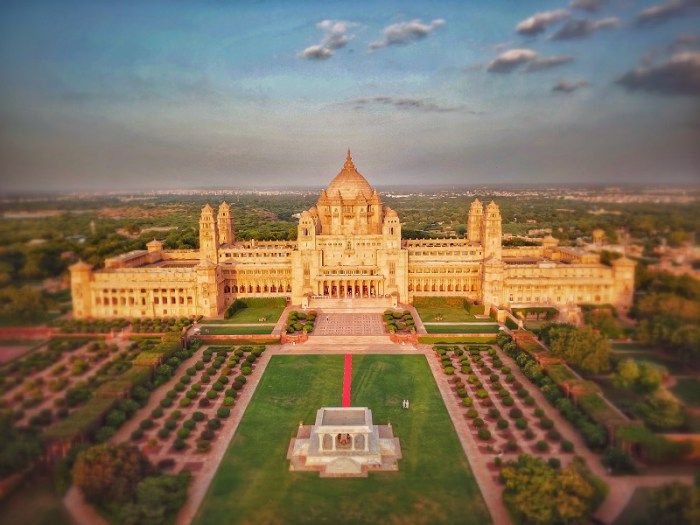
Umaid Bhavan Palace on high of Chittar Hill in Jodhpur, is one of the last grand royal palaces in India. This palace developed unlike most of the historic forts and palaces, which were constructed in defense or lavish display, and had a different motive which was to offer jobs at a time of a devastating famine. The palace was commissioned by Maharaja Umaid Singh in the early 20 th century not only to stimulate the local economy but also herald a new age of architecture in the state of Rajasthan. It is now an intriguing combination of the past, opulence, and history.
The Vision of Maharaja Umaid Singh
The palace can be traced back to the 1920s when Jodhpur was hit by a terrible drought and famine. Villagers turned to Maharaya Umaid Singh to be relieved, so he came up with a spectacular idea of creating a great project that would offer jobs and give the region long-term prosperity. This vision gave rise to the construction of Umaid Bhavan Palace, a project that took almost 15 years and it involved thousands of local workers.
Maharaja Umaid Singh demonstrated a leadership, which was compassionate and foresighted by initiating such a grand project. Not only was the palace a royal home, it was a message of strength to the people of Jodhpur and that all would be well.
Architectural Wonder: Indo-Deco Style Blend
Umaid Bhavan Palace is renowned with its distinctive architural style. The palace is an extraordinary masterpiece designed by the British architect Henry Vaughan Lanchester and it is a blend of both the classical Indian style and Western Art Deco.
Material and Construction
The palace is built majorly using golden-yellow sandstone color that makes it look warm and radiant depending on the sun color. One of the unique aspects was that the construction was also done using interlocking stones rather than mortar and that made the structure environmentally robust and aesthetically smooth.
Internally, Makrana marble floors, Burmese teakwood gives it a lot of beauty and sophistication. All rooms, corridors, and domes represent a compromise between classicism and modernism.
Iconic Dome and Layout
The most recognizable characteristic of it is the huge central dome that is about 105 feet in height; it is Renaissance style and reminds us of the buildings of the British Parliament. Surrounded by lengthy corridors, huge courtyards and highly decorated rooms, this central dome brings harmony to the architecture which even to date continues to charm both professionals and visitors.
Palace Divided: Museum, Hotel and Royal Residence
The Umaid Bhavan Palace now incorporates three types of functioning parts into it where each one presents its own experience:
1.The Taj Hotel Wing
A part of the palace is a luxury hotel, which is run by Taj Hotels. The hotel is famous in its royal hospitality and makes the guests feel like being in a royal splendor through huge suites, well-kept gardens, displaying old vintage cars, and traditional Rajasthani food. Celebrities, royalties and dignitaries across the world have been hosted in the hotel promoting the international image of the palace.
2. The Museum Wing
The other section of the palace is accessible to the people as a museum. The museum maintains the white heritage of the royal family of Jodhpur and exhibits:
.Vintage clocks
.Stunning royal crockery and glass
.Paintings and murals Historical photographs
.Weapons and regal attire
The museum provides the visitors with an insight into the lavishness and the lifestyle of the royalty of Jodhpur, which is why it is viewed as one of the most popular tourist destinations in Rajasthan.
3. The Royal Residence
The third wing is still a personal residence of the current Maharaja of Jodhpur, Gaj Singh II and his family. This renders Umaid Bhavan as one of the last royal palaces in the world where the heirs of the original rulers dwell.
The life in the palace is a combination of tradition and new-age comfort. Despite the traditionalism, the palace includes the current amenities and design features that are ahead of their time.
All these factors contributed to the architectural and technological wonder in the 1930s of the palace. Even nowadays, the interiors are characterized by a blinding mixture of a 20 th century modernity and the Rajput splendor.
Umaid Bhavan -Before and After Independence
The palace came to be built in 1943, shortly before India became an independent state. The political situation in the country was evolving at an extremely high rate, and the state of the princes was shifting to the democracy system of the newly independent India.
Thus it happens that Umaid Bhavan is located at a junction of two worlds the fall of the old royal power and the emergence of a new India. It was later used as a royal palace and still has the legacy of the royal families of Rajasthan maintaining it as a royal heritage building.
Tourism and Cultural Significance
Umaid Bhavan Palace is presently not only a tourist spot, but also a cultural heritage. It has a museum that attracts art, history, and architecture enthusiasts all over the world. The lawns of the palaces are used to hold big events like weddings, film shoots and cultural festivals which are also a part of the showcasing royal heritage of Rajasthan.
Specifically, the palace was brought into the spotlight of the entire world in 2018 when a Bollywood star Priyanka Chopra and an American singer Nick Jonas organized their wedding here, which only enforced the notion that the venue is one of the most luxurious wedding venues globally.
The Palace as a Sign of the Identity of Jodhpur
Umaid Bhavan Palace remains to have strong emotional and cultural values to the people of Jodhpur. Its invention assisted the people of this city to overcome a period of extreme struggle. It has been over the decades a symbol of pride, a representation of the resilience of the city, its royal tradition, and architectural masterpiece.
The golden figure of the palace in the sky of the desert always reminds about the timeless beauty of Rajasthan when the tourists come to Jodhpur.
In conclusion: An Eternal Landmark of Hope and Grandeur
Umaid Bhavan Palace is much more not only a marvelous architectural miracle but a tale of kindness, creativity and culture. Having been created as a way to motivate the population of Jodhpur in the times of crisis, it sprouted into one of the most recognizable palaces in the global scope. Nowadays, it is a living monument part museum, part hotel, part home keeping the memory of the royal heritage of Rajasthan and inviting the contemporary world to open its door.