INS V Kaundinya: The Modern Warship with ancient Indian Sea Spirit

-Aritra Biswas
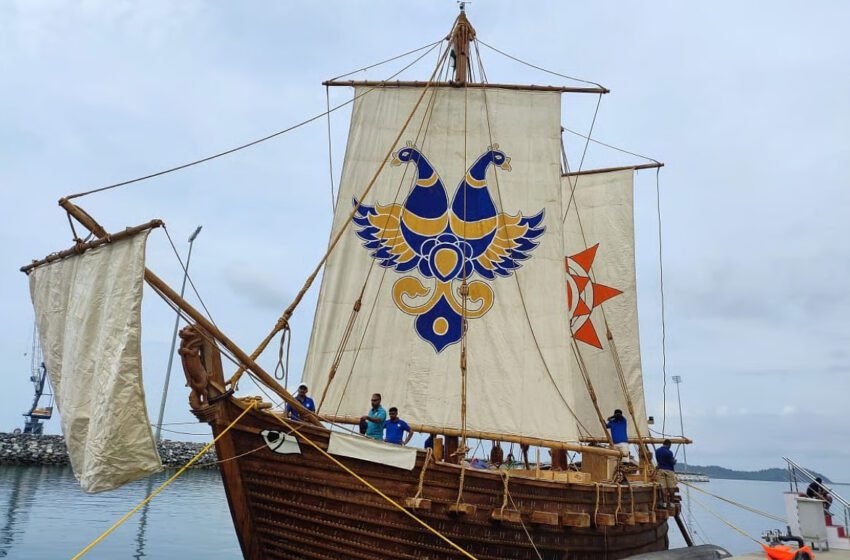
The post of INS V Kaundinya holds a unique position in the Indian Navy not only as it fulfills the role of its work but also as the name itself has a strong historical connotation. The vessel is a symbol of a rare intersection between the Indian traditional nautical culture and its modern naval aspirations. Being a Landing Ship Tank (LST), INS V Kaundinya enhances the amphibious and logistical power of India, and symbolically reminds the people of a time when Indian sailors used to sail long distances through the oceans to trade, carry out diplomatic missions and hold to the cultural exchange. The paper will discuss the origin of the name of the ship Kaundinya, the design of the ship, its functioning, and its strategic and cultural importance in the contemporary times.
The Legacy of Kaundinya
Kaundinya is thought to have been a pre-historic Indian sailor, Brahmin, who, in the early centuries of the Common Era, crossed the Indian subcontinent to the Southeast Asian region. Historical traditions and inscriptions relate him to the establishment of the ancient Funan Kingdom, which exists in modern Cambodia. His travel emphasizes years of water relations between India and Southeast Asia, with the basis on trade, cultural interchange, and non-confrontation interaction.
The Indian Navy honors this maritime heritage by naming one of its modern naval ships after Kaundinya. The name is a reminder that the connections of India with the seas are older than the modern nation-state and the military theories.
Initial and Reason of INS V Kaundinya
INS V Kaundinya was an initiative that was established by India in an attempt to improve its amphibious warfare and logistics support capacity. The purpose of the Landing Ship tanks is to deliver soldiers, armored combatants and supplies to the shore even when there is no well-developed port. These vessels play an important role in the military missions as well as in humanitarian missions.
The INS V Kaundinya induction is also indicative of India in general moving towards self-sufficiency in defense production. Building of naval platforms by the natives guarantees strategic independence, enhanced local industry and lessened reliance on external suppliers. Meanwhile, the symbolic naming of the ship emphasizes a conscious attempt to relate the new military equipment to the Indian civilization history.
Design and Building Characteristics
INS V Kaundinya is to be versatile and durable. It has a hull shape that allows stability on long sea journeys and also when beaching. The ship has a bow ramp, on which the tanks, trucks, and troops may disembark on the shore directly, which is an ideal in amphibious landings.
The ship has the use of contemporary navigation systems, communications and safety measures which allow the ship to be used in both peaceful and warlike periods. The ship has large decks and cargo capacities that enable it to transport a diverse assortment of military equipment, vehicles and humanitarian cargo. The design focuses on flexibility in operations with the ship being able to undertake several roles without significant alteration.
Amphibious Warfare Capability
Ambibious warfare is one of the main functions of INS V Kaundinya. Armored vehicles, engineering supplies and a large number of troops may be shipped in the ship and this allows fast deployment in military operations. Amphibious is particularly essential to a nation such as India that has extensive coastline with islands of strategic locations.
This capability to deploy troops at the bottom of a beach is a strategic edge to the Indian Navy and Army. It enables for surprise, versatility and quick reaction, especially in those situations where traditional access to ports might be refused or non-existent.
Position in Humanitarian Assistance and Disaster Relief
INS V Kaundinya does not restrict itself to fighting roles. Its high carrying capacity and the fact that it does not require port infrastructure also make it very useful in the humanitarian aid and disaster relief efforts. The ship can take food, medical supplies, vehicles, and rescue teams to the impacted coastal areas in case of cyclones, floods, earthquakes or tsunamis.
These missions would improve the image of India as a responsible maritime power that creates conditions of stability in the region and the humanitarian welfare. The appearance of the ship in the course of the disaster relief proves the way of how the naval power may be deployed to positive and life-saving purposes.
Logistics and Strategic Mobility
Another important operation of INS V Kaundinya is logistics support. The ship will be able to transport troops and equipment between mainland bases and island territories maintaining operational readiness. This attribute is especially applicable to the island areas in India, whereby it is necessary to ensure that the supply lines are maintained on the defense and development front.
INS V Kaundinya increases the strategic mobility and operational range of the forces and materials located in the region of the Indian Ocean by facilitating their speedy movement.
Strategic Significance of the Indo-Pacific
Indo-Pacific has become an important player in the world geopolitics characterized by critical sea lines, economic activities and escalating strategic tussles. The central location of India in the Indian ocean gives it a big responsibility of ensuring that it protects maritime security, and freedom of navigation
INS V Kaundinya is one of the contributions to this mission by enhancing the amphibious and logistical skills of India. It promotes the collective and multinational exercises, joint activities and collaborative interactions with friendly navies. Such deployments assist in projecting the determination of the ship to emit a stable, secure, and rules-based maritime order by India.
Cultural and Symbolic Value
In addition to its functional aspects, INS V Kaundinya has a very strong cultural connotation. The name of the ship brings to mind the recollections of the ancient Indian sailors who traversed the ocean well before the invention of modern technology of navigation. These sailors exported Indian culture, religion, and ideas in Asia, and civilizations were formed in the peaceful exchange.
Conclusion
INS V Kaundinya is one of the many symbols of continuity between the past and the present of India. It functions as a new-generation Landing Ship Tank, and it improves the capacity of the Indian Navy to undertake amphibious operations, offer humanitarian aid, and a logistical operation. Concurrently, it is named after a legendary traveler who sailed to India during historic times and whose expeditions portrayed the historical relationship of India with the oceans.
Combining a high level of arsenal with intense cultural commentary, INS V Kaundinya takes on the larger Indian maritime strategy to date, one that has its origins in history, expanded by self-sufficiency, and has its aims in the promotion of peace and stability on the seas. The ship is not only loaded with soldiers and supplies, but the seafaring civilization of India, as it sails across the waters of the Indian Ocean and further.