Remembering Lachit Borphukan: A Warrior at the Margins of History

-Oishee Bose
Sources, memory and the problem of visibility
In many conventional accounts of Indian history, Lachit Borphukan’s narrative lies on the margins not because of his lack of merit and accomplishment but due to how Indian historiography developed. Lying apart from the Indo-Gangetic political centre that dominated Mughal records and subsequent colonial historical writing, the history of the Ahom kingdom of Assam was overlooked. As a result, the Ahom Buranjis, the written legacy documenting Lachit’s life, stayed regionally restricted for centuries. This marginalisation resulted in Lachit mostly missing from all-India historical accounts until the twentieth century, despite being well remembered in Assamese historical consciousness. Hence, recovering his life calls not just on events but also on how history is preserved, conveyed, and selectively remembered.
Indigenous court records and historical data recorded by the Buranjis
The Buranjis, the Ahom court chronicles whose name roughly translates as “a store that teaches the ignorant,” are the most significant primary sources for Lachit Borphukan. Compiled by official scribes, these records included diplomatic contacts, governmental decrees, military campaigns, treaties, and appointments. Works such as the Deodhai Buranji and the Kamrupar Buranji offer thorough records of Mughal-Ahom connections, Lachit’s ascent through administrative levels, the reconquest of Guwahati, and the Battle of Saraighat. Significantly, the Buranjis chronicle failures, disease, abandonment, and internal strife, as well as moments that show stress within the Ahom war effort; hence, they are not always celebratory. Although they were sponsored by the court and had to be read critically, their historical density and administrative detail make them absolutely necessary for reconstructing Assam in the seventeenth century.
Surya Kumar Bhuyan and the switch to contemporary historiography
Lachit Borphukan’s transfer from regional memory into national historical dialogue is inextricably linked with the efforts of Surya Kumar Bhuyan. Early in the twentieth century, Bhuyan made the Buranji corpus available to researchers outside Assam by editing, translating, and distributing sizable parts of it. His work, especially Lachit Borphukan and His Times, presented Lachit as a prominent character in pre-colonial India’s opposition to imperial growth. Bhuyan focused on the anti-imperial aspects of Lachit’s career while writing during the nationalist era, framing the Ahom–Mughal conflict inside a bigger story of resistance. Bhuyan’s work was absolutely critical in creating Lachit as a historically significant personality nationally, even if later historians would warn against projecting contemporary nationalism into seventeenth-century politics.
Early years, family context, and bureaucratic development
Born at Charaideo in Assam, Lachit Borphukan was the youngest son of Momai Tamuli Borbarua (also known as Sukuti), one of the most powerful leaders of the Ahom kingdom. He was born on 24 November 1622. Momai Tamuli’s adjustments to the Paik system, the rotational labour and military service framework, moulded the administrative culture Lachit grew up in. Following aristocratic Ahom customs, Lachit’s education included instruction in statecraft, mathematics, religious traditions, and military skills. His early appointments, offices like head of palace guards (Dolakasharia Barua), superintendent of royal horses (Ghora Barua), and scarf-bearer, served as a slow apprenticeship in governance, logistics, and command. This development clarifies the organisational discipline and administrative skills clearly present in his later army command.
State power and discipline
The Buranjis continue to uncover the portrayals of the operation of Ahom administration under Lachit. The most frequently cited scenario is Lachit’s maternal uncle’s assignment to build a defensive rampart close to Amingaon, which was delayed. Lachit ordered his uncle’s execution, reportedly stating that allegiance to the kingdom outweighed personal relationships, considering the threat to state security during wartime. Whether it was a captured verbatim or was shaped by later memory, this occurrence shows the Ahom focus on discipline, accountability, and the primacy of state interest. Such incidents, along with records of forced labour mobilisation, inspections, and redistribution of confiscated Mughal arms, demonstrate how administrative discipline underpinned military efficacy.
Military organisation and warfare on rivers
Under Lachit, the Ahom military strategy was ideally suited to the topography of Assam. While local boatmen brought unmatched expertise in navigating the river Brahmaputra’s currents and channels, the Paik system provided manpower for war, fort-building, and ship construction. Smaller and more agile than Mughal ships, Ahom warboats enabled quick movement, ambushes, and retreats. Lachit worked with senior ministers like Atan Burhagohain, managing intelligence, supplies, and defences; hence, command was collaborative. This institutional structure guaranteed that military success depended not only on personal valour but also on consistent mobilisation and a coordinated command system.
Historical background: Conflict between Mughal and Ahom in the seventeenth century
Lachit’s career grew during an especially aggressive Mughal advance toward the eastern edge. Under Aurangzeb, Mughal interest in Assam grew and culminated in Mir Jumla’s attack in 1662. The Ahom kingdom was subjected to humiliating terms under the ensuing Ghilajharighat Treaty, therefore limiting its sovereignty temporarily. The Ahom political approach in the decade after this was greatly shaped by these developments. The regaining of lost territory and the restoration of independence became main goals of Chakradhwaj Singha, as he ascended the throne. It was in this context of political urgency and military change that Lachit Borphukan rose as a major commander.
Pre-Saraighat campaigns and Guwahati recovery
Following the treaty with Mir Jumla, Lachit was given the assignment of retaking the strategically riverine city of Guwahati. By 1667, he had coordinated and operationalised the reconstruction of fortresses, the reorganisation of river defences, and the disruption of Mughal supply lines. Sustained pressure, rather than one spectacular final fight, allowed for the reconquest of Guwahati, using blockades, small-scale engagements, and astute use of terrain. This success generated a major Mughal reaction, which resulted in the expedition led by Raja Ram Singh I.
Saraighat’s fight: leadership, strategy, and change agents
The Battle of Saraighat, fought in March 1671, was mostly a naval battle on the Brahmaputra, near Guwahati. Seeking to overthow the Ahom defences, Mughal armies which was numerically superior and included infantry, cavalry, and a sizable fleet, advanced against Ahom positions. Lachit purposefully selected a battlefield that neutralised these advantages. Strong currents, sandbars, and narrow channels reduced Mughal mobility, while Ahom boats exploited speed and local expertise. Ahom morale faltered during the battle when Lachit was severely unwell but his decision to personally engage in the fray restored order and cohesion. His clear leadership transformed a moment of catastrophe into a turning point, culminating in the Mughal retreat.
Decisive element of Ahom success: terrain
Central to the Ahom victory at Saraighat was geography. Large, heavily armed ships found the braided, shifting character of the Brahmaputra inhospitable. To set up ambush locations and kill zones, Ahom commanders used seasonal river levels, river bends, and fortified riverbanks. Hilltop positions dominating the river restricted enemy movement and regulated landing spots. Operating far from its supply centres and unfamiliar with the dynamics of the river, the Mughal army found its numerical superiority neutralised. In this manner, the land served as an appendage of the Ahom plan.
Saraighat’s long-term importance and effects
The Mughal setback at Saraighat essentially put their ambitions in Assam to rest. Their withdrawal to the Manas River guaranteed the political independence of the monarchy for decades and brought Ahom power over the Brahmaputra valley back under control. Beyond its immediate military repercussions, the war showed the limits of Mughal imperial expansion and confirmed the ability of local governments to resist centralising empires through institutional strength and environmental adaption. Later Ahom achievements reinforced this boundary, therefore impacting the political map of North-eastern India further till the eighteenth century.
Memorialisation, inscriptions and modern remembrance
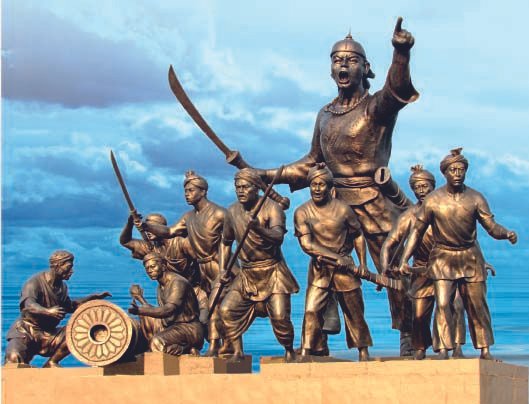
Inscriptional records, especially the victory pillar honoring the Namjani Borphukan’s knowledge, bravery, and leadership, also record archeological evidence of Lachit’s accomplishments. Local traditions over time kept this memory alive, and later contemporary celebrations such Lachit Divas, public sculptures, and the Lachit Borphukan Gold Medal granted at the National Defence Academy helped to magnify it. These levels of recollection show how historical figures are constantly reevaluated and written into public perception.
Conclusion: individual leadership inside institutional power
Lachit Borphukan’s significance lies not only in his personal heroism but also in his ability to use and control the institutional assets of the Ahom kingdom. Modern historiography shows how nationalistic revivals of regional pasts formed his memory, yet the Buranjis portray a commander working within a disciplined administrative structure. Seen from micro-histories, topography, and logistics, the Battle of Saraighat becomes a perfect example of how native knowledge and organisation could surpass imperial authority. Re-establishing Lachit in Indian historiography therefore allows for a more accurate interpretation of early contemporary India as a multi-centered political environment instead of as a narrative of unilinear imperial dominance.