Nilamādhaba, or the God Who Refused Convenience

-Prachurya Ghosh
There is something deeply inconvenient about Nilamādhaba.
He does not arrive where power expects him.
He does not stay where authority wants him.
He does not behave like a god who can be scheduled, processed, or fully understood.
And perhaps that is why the Jagannath tradition never erased him. It absorbed him, carefully, almost nervously—like something too powerful to discard, yet too wild to keep unchanged.
Nilamādhaba is not merely a pre-Jagannath form. He is the tension that Jagannath never resolves.
The Forest Was Not Outside Civilization
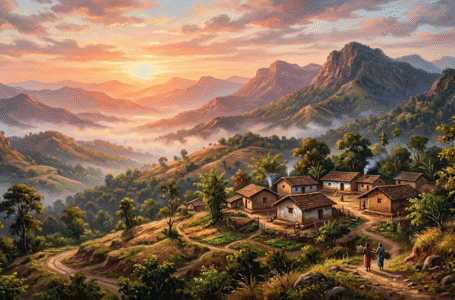
Modern retellings often place Nilamādhaba in a “remote” forest, as though the forest existed outside culture. This is a misunderstanding born from later hierarchies.
For the Sabaras, the forest was not marginal. It was central.
Paths were known. Seasons were tracked. Memory moved through stories, not scrolls. The cave that housed Nilamādhaba was not hidden because it was unknown; it was hidden because it was known too well.
Sacredness, in this context, was not public property.
This distinction matters. Because when Vidyāpati entered the forest, he did not enter emptiness. He entered a complete world—one that did not need royal validation.
Nilamādhaba belonged to that world.
Visvavasu: The First Priest Was Not Chosen—He Remained
Visvavasu is often reduced to a “tribal chief” in retellings. But leadership here did not mean command. It meant continuity.
He did not “discover” Nilamādhaba. He inherited responsibility.
He knew when offerings should be made, when silence was required, when the cave must not be approached at all. He knew the god not through scripture but through rhythm—through what changed and what did not.
Visvavasu did not seek expansion. He did not want Nilamādhaba known beyond the forest. Not because he was selfish, but because sacred things fracture when exposed too widely.
When he blindfolded Vidyāpati, he was not hiding a god. He was protecting a balance.
Lalita Is Not a Footnote
Lalita is rarely given space in this legend. She should be.
Her marriage to Vidyāpati is often framed as a tactic, a bridge between two worlds. But marriages are lived realities, not metaphors.
Through Lalita, Vidyāpati did not simply gain access—he gained accountability. He could no longer observe the Sabara world as an outsider. He became answerable to it.
Lalita’s presence complicates the story. It ensures that the transition from Nilamādhaba to Jagannath is not a theft, but a transformation negotiated through relationship.
This matters later, when the Daitapatis claim descent from both forest and priesthood.
Blood remembers what texts simplify.
Seeing Nilamādhaba Was Not the Same as Knowing Him
When Vidyāpati finally stood before Nilamādhaba, what he saw cannot be fully reconstructed.
Descriptions of Indranīla mani, lotus eyes, and Ajanubahu arms are attempts—reverent attempts—but they fail to capture the weight of the moment.
Nilamādhaba was not dazzling in ornamentation. He was overwhelming in stillness.
The legend says liberation occurred instantly upon darshan. This is not about reward. It is about annihilation of ego. To stand before Nilamādhaba was to be unmade.
Such a god could not belong to crowds.
Why the God Had to Withdraw
The story of Yama’s anxiety is not mythic exaggeration. It is theological reasoning.
A god who removes consequence removes learning. A god who shortcuts existence disrupts meaning.
Nilamādhaba’s withdrawal was not punishment. It was restraint.
In that restraint lies one of the most profound ethical ideas in Indic thought: that compassion without limitation can be destructive.
So Nilamādhaba chose distance.
Indradyumna’s Failure Was Necessary
King Indradyumna is often portrayed sympathetically, but his failure is crucial.
He approached the divine with reverence, yes—but also with intent to institutionalize. He wanted to bring the god. To establish him. To make him part of a kingdom.
Nilamādhaba refused that trajectory.
Only after loss—after fasting, grief, and waiting—did Indradyumna become capable of receiving Jagannath.
The Jagannath cult does not begin with triumph. It begins with humility forced by absence.
Daru Is Not Inferior to Stone
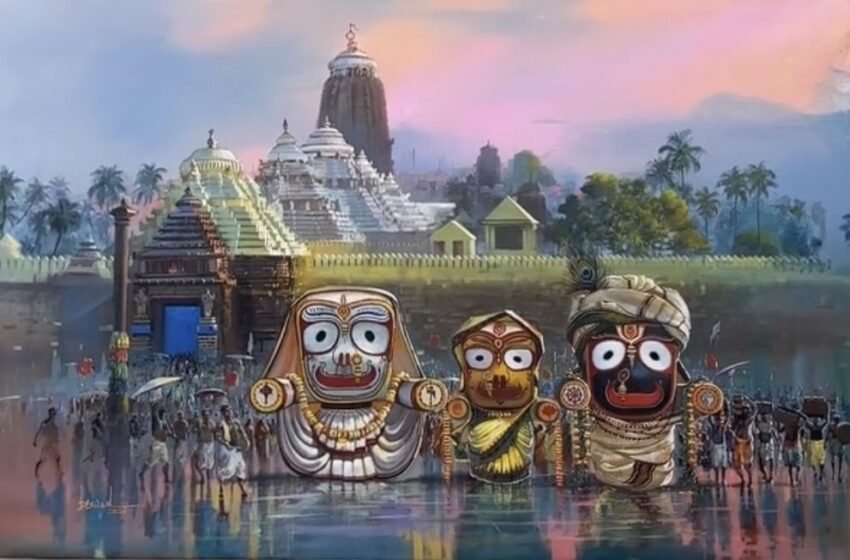
When Nilamādhaba returns as Daru-Brahma, it is not a downgrade. It is a philosophical shift.
Stone resists time. Wood cooperates with it.
By choosing wood, the god accepts mortality as a mode of worship. The deity will decay. He will be replaced. He will die publicly and be reborn ritually.
This is not symbolic. It is enacted.
Jagannath is one of the few major deities whose mortality is ritualised, not denied.
Nilamādhaba could not have survived that. Jagannath could.
The Incomplete Body Is an Invitation
The stumped arms and absence of legs are not signs of limitation. They are refusals.
Jagannath refuses anthropocentric expectations. He refuses the idea that divinity must resemble human perfection.
Nilamādhaba was too perfect. Jagannath is intentionally unfinished.
This allows proximity.
People do not fear Jagannath. They approach him. They joke about him. They pull his chariot with their hands.
A god who was once hidden in a cave now demands to be dragged through streets.
This reversal is deliberate.
Kantilo Exists So the Story Does Not Collapse
Kantilo is not a backup shrine. It is a reminder.
Here, Nilamādhaba remains complete. Four-armed. Blue. Still.
The flowing water at his feet is not miracle theater. It is continuity.
The moving Shiva linga nearby reminds visitors that sacredness is not static. Even stone shifts.
Kantilo does not challenge Puri. It stabilizes it.
Without Kantilo, Jagannath risks becoming abstract. Kantilo keeps him rooted.
The Daitapatis Are Not Symbolic Bridges
The Daitapatis do not merely represent tribal memory. They carry it.
Their authority during Nabakalebara is not ceremonial. It is ancestral.
When they handle the most secret elements of the deity, they do so not as servants, but as inheritors of a trust older than temple walls.
This is why Jagannath remains one of the few major deities whose worship cannot fully exclude non-Brahmanical lineage.
Nilamādhaba ensures that exclusion never completes itself.
Nilamādhaba Today: Not Visible, Still Active
Nilamādhaba no longer grants instant liberation. But he has not disappeared.
He exists in restraint. In ritual secrecy. In the refusal to reveal everything.
He exists every time Jagannath leaves the sanctum.
Every time wood replaces stone.
Every time decay is accepted as sacred.
Nilamādhaba teaches that disappearance can be generosity.
The Blue God Did Not Become Jagannath
This is the final misunderstanding.
Nilamādhaba did not become Jagannath.
He allowed Jagannath to happen.
He stepped back so another form could step forward—one better suited to crowds, to time, to imperfection.
Nilamādhaba remains what Jagannath remembers.
And remembering, in this tradition, is the highest form of worship.