Rethinking the Identity of the Vanara Sena: A Historical Reading of the Rāmāyaṇa

-Oishee Bose
Situating the problem
The Vanara Sena is in an especially unsteady position among the many groups inhabiting the Rāmāyaṇa heritage. In popular perception, they resemble monkeys; in devotional stories, they serve as semi-divine creatures; and in scholarly literature, they swing between being interpreted as mythical beings, forest tribes, or symbolic characters. This volatility is not coincidental. Rather, it highlights the more fundamental historical processes by means of which early Indian civilisation negotiated its interaction with forest-dwelling communities, frontier peoples, and groups outside the ceremonial and social order of developing Brahmanical orthodoxy.
Composed and rewritten over centuries, the Rāmāyaṇa is a layered literary tradition in which Brahmanical, patriarchal, and royal ideas were slowly blended. The Vanaras arise as characters within this expanding textual world through which conflicts between settled agricultural civilisation and forest civilisations were envisioned, negotiated, and symbolically reconciled. Thus, to historicise the Vanara Sena is not to seek a literal ethnic group hiding behind the epic but rather to interpret their depiction as a cultural archive of social interactions, negotiations, and unbalanced power dynamics.
The Vanaras should be seen as liminal forest societies positioned at the meeting point of tribal systems, early state growth, caste philosophy, and cultural “othering” processes. Drawing on postcolonial theory, especially Edward Said’s idea of Othering, historical anthropology, and Romila Thapar’s work on forest people and social borders, the article aims to position the Vanaras within the material and intellectual context of early Indian history.
The forest as social space: ecology and marginality
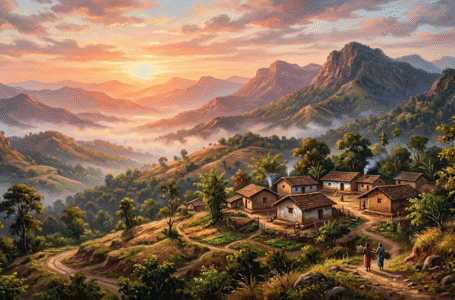
Any effort to understand the Vanaras has to start with the forest (vana), which is a historically loaded terrain. The forest is more of a social category than merely a physical surrounding in early Indian texts. Unlike the grāma (village) and kṣetra (cultivated land), which are associated with settled life, ritual order, and caste hierarchy, it stands in contrast. Forests, by contrast, are shown as sites of mobility, peril, asceticism, and otherness.
According to Romila Thapar, because they lacked Vedic ritual systems, Brahmanical marriage patterns, or agrarian means of production, forest-dwelling groups were usually placed outside the normative social order. They were therefore perceived as culturally defective or socially incomplete, not because they lacked organisation but because their organisation clashed with Brahmanical values. This conceptual distance set the ground for the symbolic transformation of forest peoples into ambiguous characters within literary works.
The Vanaras are initially introduced from these forested margins. Their connection with wilderness, movement, and physical agility shows how settled elites saw forest civilisations as strong, unpredictable, yet necessary. The woodland thus marks the first point of differentiation, generating a social boundary that presents the Vanaras as “not-quite” human within the epic setting.
Naming and identity: vana–nara and the politics of representation
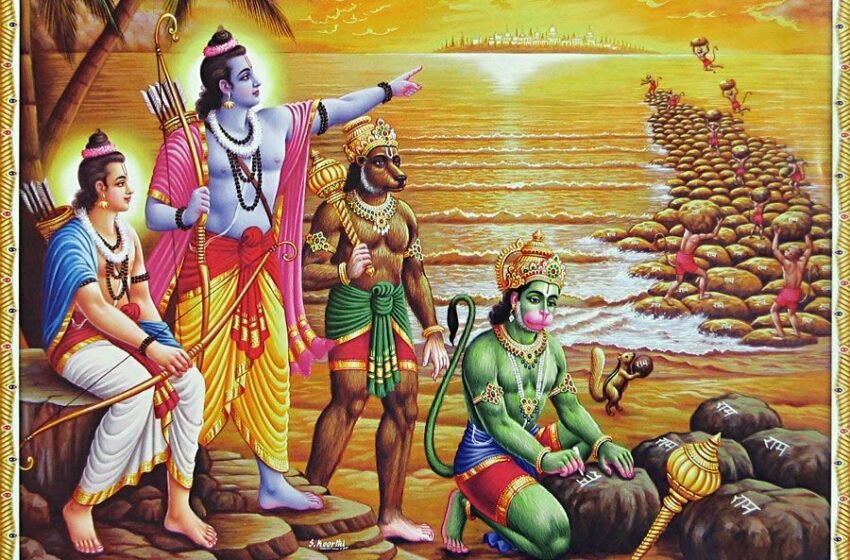
The word vānara itself exposes the politics of representation at play. The often-quoted derivation from vana (forest) and nara (man) suggests “forest-men,” a title that immediately places the group within a human context while distinguishing them as socially different. Particularly as the text gains layers and incorporates visual and devotional conventions, this linguistic ambiguity enables a gradual shift from “forest people” to “animal-like creatures.”
Here, Edward Said’s idea of Othering is illuminating. Said contends that dominating cultures often define themselves by constructing a lower, strange, or animalised “other,” whose portrayal stabilises the identity of the self. The Vanaras operate precisely in this manner within the Rāmāyaṇa tradition. By contrast, Brahmanical–royal standards embodied in Rāma, appear organised, ethical, and civilised, thanks to the Vanaras’ physical exaggeration, animalistic characteristics, and hyper-masculine energy.
Notably, this process contains the agency of the Vanaras rather than rejecting it. They are strong but need direction; loyal yet subservient; courageous yet devoid of sovereign legitimacy. Such representation reflects social hierarchy translated into legendary form rather than zoological imagination.
Social grouping: clans, tribes, and military movement
Notwithstanding their animalised portrayal, the Vanaras clearly display human social systems. They possess organised military units, councils, bonds of brotherhood, territorial divisions, and kingship. These characteristics closely match what historical anthropology identifies as tribal or chiefdom-level civilisations, typically distinguished by segmentary organisation rather than rigid caste stratification.
Early Indian forest communities were not socially unstructured. Clan affiliations, totemic identities, and fluid leadership styles that enabled rapid mobilisation for migration or war defined their organisation. This arrangement is reflected in the structure of the Vanara Sena. Their capacity for quick assembly, passage through challenging terrain, and engagement in unconventional warfare demonstrates the historical role of forest peoples as frontier allies and military auxiliaries of expanding states.
The epic therefore records how early political entities depended on forest groups for strategic advantage. Still, this dependence is deliberately framed within a hierarchy: the Vanaras fight for Rāma’s cause, not for their own independence. Their labour and sacrifice legitimise the Kṣatriya Suryavanshi hero, resonating with historical processes in which tribal people were absorbed into state systems without full political autonomy.
Caste, incorporation, and Brahmanical mediation
The narrative role of the Vanaras revolves around their position outside the varṇa system. They neither fit neatly into the fourfold caste structure nor remain completely outside it. Rather, they occupy a transitional space, reflecting the historical reality that caste was shaped by processes of inclusion and exclusion rather than functioning as a fixed framework.
B. D. Chattopadhyay’s integrative state system and Romila Thapar’s work demonstrates that Brahmanical culture expanded through both negotiation and subjugation. While some groups were relegated as impure or dangerous, others were incorporated through land grants, ritual patronage, or marriage alliances. The Vanaras’ participation in Rāma’s moral universe and their allegiance to him can be interpreted as a symbolic representation of such assimilative processes.
At the same time, their persistent difference: their bodies, habitats, and collective identity, marks the limits of integration. Their moral or ritual status is never fully equal to that of the epic’s royal protagonists. This limited inclusion reflects historical patterns in which tribal groups were absorbed as service communities, soldiers, or labouring populations while remaining socially subordinate.
Postcolonial perspective and colonial analogies
Though separated by millennia, the logic underlying the portrayal of the Vanaras bears strong similarities to colonial discourses. Colonial administrators frequently described indigenous forest peoples as “primitive,” “childlike,” or “closer to nature,” thereby justifying intervention, governance, and extraction. Edward Said’s framework clarifies how comparable discursive techniques function in premodern writings.
In both contexts, representation serves power. By portraying forest societies as physically strong but culturally deficient, dominant groups claim the authority to govern, civilise, or direct them. The Vanaras’ heightened emotional expression, unwavering loyalty, and bodily difference reflect tropes later used to characterise the colonised. While this does not imply direct equivalence, it reveals a shared epistemology of dominance in which difference is aestheticised and moralised.
Reading the Vanaras from this perspective enables the epic to be understood as a participant in longer histories of social control and cultural hierarchy rather than merely as legend.
Patriarchal consolidation and the layered text
Understanding the Rāmāyaṇa as a multi-layered text is vital. Over time, as Brahmanical patriarchy solidified, the narrative increasingly emphasised obedience, hierarchy, and moral order. The portrayal of the Vanaras mirrors this shift. While earlier layers may have retained more fluid representations of forest allies, later accretions drew sharper distinctions between the civilised centre and the natural margin.
Their exclusion from female genealogies, the masculinisation of the Vanara body, and their positioning as helpers rather than decision-makers align with patriarchal modes of social organisation. Their role shifts from autonomous actors to instrumental supporters, reinforcing a worldview in which order radiates outward from the centre.
Conclusion: from primates to memory
The Vanara Sena can neither be romanticised as pure tribal survivors nor reduced to monkeys. They are best understood as symbolic condensations of historical processes between forest and field, tribe and state, mobility and settlement, autonomy and incorporation. Their animalisation functions as a narrative technique through which difference was rendered intelligible and manageable, rather than as evidence of belief in hybrid species.
By situating the Vanaras within the historical processes of caste formation, frontier expansion, and cultural negotiation, their narrative emerges as one of unequal encounter rather than fantasy. The epic integrates forest societies into a moral universe that simultaneously recognises their power and limits their agency; it does not erase them.
Historicising the Vanaras, therefore, reveals the Rāmāyaṇa not as a timeless moral narrative but as a living archive of early Indian social history, one that records, in mythic language, the complex and often uncomfortable relationships between civilisation and its margins.