Yogi Narayana of Kaiwara: Life, Teachings, and Legacy

~ Debashri Mandal
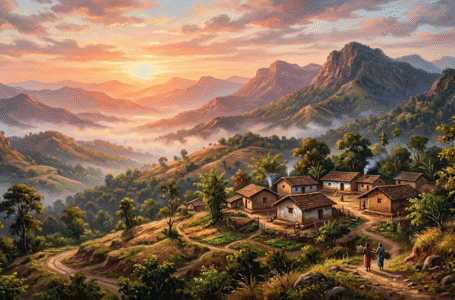
Also known as Kaiwara Thathaiah, Kaivara Narayana Tatayya, or Sri Yogi Narayana Yatindra, “Yogi Narayana of Kaiwara” was considered to be a renowned 18th– to 19th-century saint, poet, and mystic born in 1726 AD in the village of Kaiwara (then in Kolar, now Chikkaballapur district) to Kondappa and Muddamma, in Karnataka. Earlier, he was also named Narayanappa. His father was a bangle seller, and young Narayanappa attended the local elementary school and learned Kannada, Telugu, and Sanskrit. From a very early age, he was deeply inclined to spirituality and asceticism. Even during every break while selling bangles with his father, he somehow tried to find opportunities to meditate or chant divine names anytime. According to beliefs, he once fixed a woman’s bangle without looking, and to him it was a great miracle to be granted a vision of Goddess Mahalakshmi for his sincere service. He lived a very simple married life, but his ardent spiritual longing set the stage for his later renunciation.
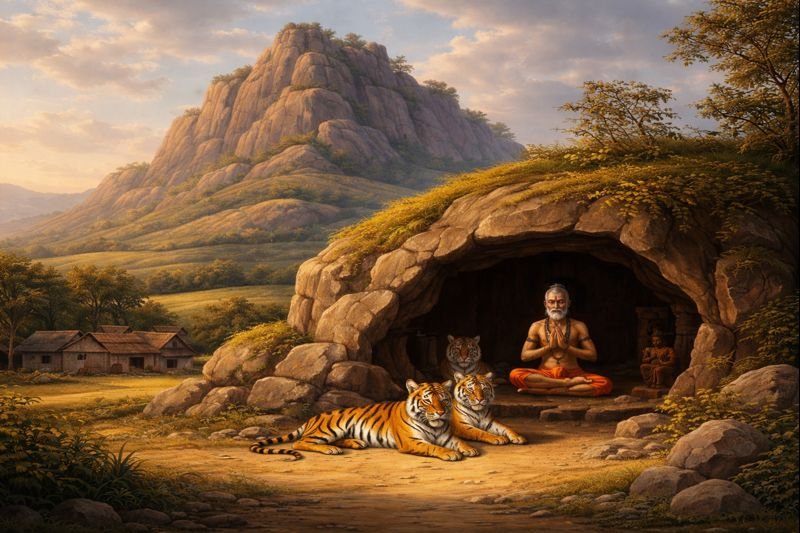
It is said that once in stormy weather, during his journey, Narayanappa prayed for their safety and suddenly came across Pradesha Swamiji, a siddha saint. Swamiji initiated him with the Ashtakshari Mantra—Shri Krishnarpanamastu—and prophesied that when the pebble in the mantra turned to sugar, he would attain full realization. After experiencing this, he became more detached from worldly life. Further, when his wife drove him out of the home, saying he was more fit to be an ascetic than a householder, he embraced her claims and became a sanyasi. He climbed to a nearby cave temple of Lakshmi Narasimha on the Kaiwara hills. The god named Amara Narayanaswamy appeared there in the guise of a cowherd boy and advised him to meditate in the cave there. Narayanappa goes into a deep meditation in that cave for over three years (circa 1776-1779), with a pebble in his mouth, chanting the mantra. In the meantime, the pebble miraculously turned into a sweet (symbolising his mastery over desires), and he attained siddhi. He emerged from this austerity as Sri Nareyana Yathindra, a “Yogi Narayana” so blessed and enlightened, and began to manifest yogic powers (such as converting twigs to sugar) and to teach by example.
His life has been divided into two different phases: Bangle seller Narayanappa, the earnest household, and Yathindra, the liberated saint. The transition between them occurred after his deep meditating years in the cave; during this, poisonous reptiles and wild beasts mounted guard to test him, and at its end, the pebble had turned into a sugar candy, signifying his divine realisation. By this point, he was popularly known as Yogi Narayana Tatayya (Grandfather Yogi Narayana), and village skeptics came to scoff and gossip, only to become his devotees later. He returned to Kaiwara with a small number of disciples and sat under a tamarind tree, preaching Viveka (discernment) and jnana (knowledge) to seekers. Over time, villagers built a modest ashram (mutt) for him in Kaiwara, and the place gradually became a centre of pilgrimage.
His teachings were ingrained with Bhakti and Advaita Wisdom. His compositions include poetry in both Kannada and Telugu, dedicated to lord Amara Narayana (a form of Lord Vishnu worshipped in Kaiwara). His known works include the Amaranarayana Shataka, Kala Jnana Sukshma Shataka, Nada Brahamananda Shataka, and Tarana Brahmananda Dvaya Shataka, among others. These hymns illustrate traditional Advaita or Bhakti themes, citing verses from the Upanishads, Ramayana, Mahabharata, and Bhagavad Gita. He explained and emphasized bhakti and constantly invoked names of Krishna and Vishnu (for example, chanting “Shri Krishnarpanamastu” as a mantra). Yogi Narayana used anecdotes from the Bhagavad Purana to emphasize his points on devotion. Moreover, he taught social equality: following the spirit of Sri Ramanujacharya, he spoke against caste prejudice and insisted that all people are equal before God. Vaishnava Agama rituals (the traditional Vishnu temple rites) were his major practice. He encouraged communal worship of the local Amara Narayana idol and helped revitalize the ritual life of the Kaiwara temple.
The location of Kaiwara already had a sacred significance and status in ancient times of the Hindu tradition. Legend says that the gods (Devatas) consecrated it in the Satya Yuga; Rama and Lakshmana paused here and worshipped Lord Amara Narayana in the Treta Yuga; and in the Dwapara Yuga Bhima slew the demon Bakasura on this hillock and installed a Bheema linga. In each age the site was hallowed by divine acts, and Yogi Narayana’s appearance in the Kali Yuga is considered the completion of this divine cycle, “re-establishing its illustrious name in Kali Yuga.” Yogi Narayana himself lived a remarkably long life (contemporary accounts say about 110 years) and remained active into old age. He consciously embraced iccha-marana (self-willed death) when he felt his mission was complete. According to beliefs on the mentioned day, he sat in meditation from evening through midnight as a halo of light formed around him; at exactly midnight, as a halo of light formed around him, he merged into Parabhraman (the supreme reality). His Maha Samadhi (live-entombment shrine) is saturated with power: there are many reports of seeing his form or hearing his voice in the temple and feeling a sacred vibration of the “Om” sound emanating from his chamber. “He who helped thousands to tread the path of jnana… continues even after death to alleviate the suffering of many,” one account says.
Later, his influence grew over time. He was celebrated as a social reformer and messenger of harmony. In recent years, educational and religious bodies have honoured him: for example, a 2022 seminar at Mysore University noted that “Yogi Nareyana Guru… lived a long life of 110 years… was a wonder saint” who taught that all people are equal. Today, Kaiwara is a well-known pilgrimage site. A chair for studies on Yogi Narayana has been proposed at Bengaluru North University, reflecting his continued cultural significance. Yogi Narayana is revered in local Vaishnava tradition, and his legacy is celebrated in numerous festivals. The annual Brahmarathotsava (Car Festival) is held on the full moon (Hunnime) of the Hindu month of Phalguna (March). On this day, the idol of Sri Amara Narayana (along with his consorts Lakshmi-Sridevi and Bhudevi) is placed in a decorated chariot and paraded through the streets of Kaiwara amid devotional singing. The next day, a Guru Rathotsava is celebrated for Yogi Narayana himself: his image is likewise taken in procession, symbolizing the guru–disciple tradition.
Through these rituals and charitable activities, Yogi Narayana continues to influence the community. Devotees visit his samadhi year-round, seeking blessings and inspiration. His philosophy of equality and devotion remains part of local religious life—as one observer notes, his preaching of social reform (destroying caste prejudice) “is very much relevant even today.” Over time, Kaiwara has become a thriving pilgrimage centre, and Sri Yogi Nareyana’s name remains inseparable from the spiritual identity of the region