VIMAN SHASTRA: A BOOK SURROUNDED BY QUESTIONS

-Aritra Biswas
“Viman Shastra” also known as “Vaimanika Shastra” is one of the few texts that are at the border of admiration and controversy. To some, it is a symbol of lost scientific genius of ancient India; to others, it is an imaginative creation of a religious fanaticism instead of an engineering work. It is not only it’s content but the strange circumstances of its creation and strong cultural feelings that envelop it that make it compelling. One has to read between the lines of the Vaimanika Shastra to realize it’s origin and the world, where it was conceived.
THE STRANGE CIRCUMSTANCES UNDER WHICH THE MANUSCRIPT WAS BORN
However, in contrast to the popular opinion that Vaimanika Shastra could be dated to the period of the Vedas or the sage, Bharadwaja, the manuscript was in fact created in the beginning of the twentieth century. It’s author Pandit Subbaraya Shartry, was a Karnataka mystic who held that he was dictating ancient knowledge in a state of spiritual or psychic revelation. He never wrote the manuscript but his disciples took notes of his words during several years, since circa 1918.
The Sanskrit text employed in the text indicates this chronology. It is closer to the modern Sanskrit writing than the linguistic richness and form of the works of the ancient times. This makes no difference to the earnestness of Shastry he actually believed that the knowledge was passed down in him. However, historically the text is a present day work with an ancient voice.
This timeline can be seen in the Sanskrit in Which the text was written. It more like modern Sanskrit writing than the linguistic richness and patterns of the truly ancient writings. This is no fault of Shastry who truly felt that knowledge was passed through him. However, historically, the writing is a contemporary production and presented in an antique voice.
WHAT THE VAIMANIKA SHASTRA ASSERTS TO BE
The writing is made to look like a far older tradition and credited to sage Maharshi Bharadwaja. It talks of the different flying vehicles or Vimanas, how they were designed and their functionality as well as the morality of the pilots .It’s style of narration tries to imitate the tones of classical treaties of science giving detailed classifications and technical-sounding descriptions as though it were a manual found in some unknown past.
The most notable thing is the assurance that the text has on the aerial technology. It talks about metals that are not known to the contemporary science, processing of materials and complex mechanical designs. It is the bottom attempt to associate epics mythological allusions such as the Ramayana attempts to fill in the divide between Godly imaginations and the early twentieth century envy regarding aviation.
WITHIN THE WORLD OF IT’S FLYING MACHINE
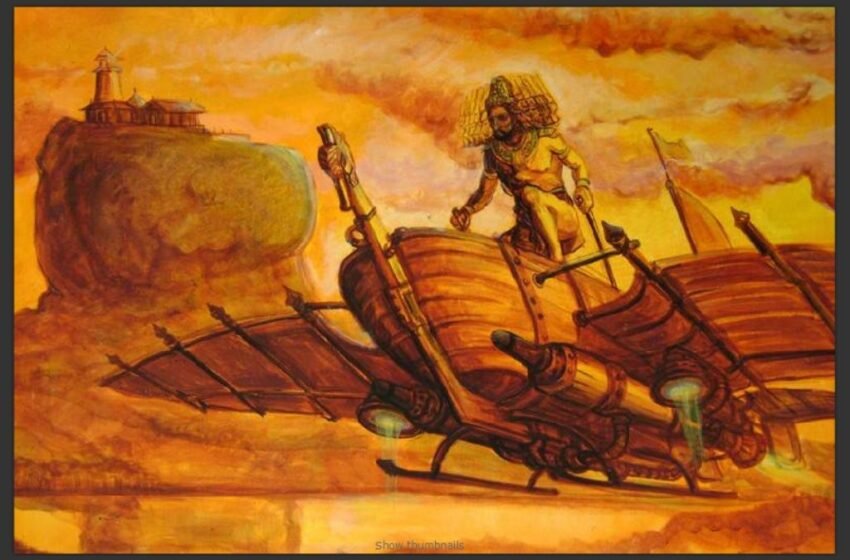
The Vimanans that are in the manuscript are imaginatively described. They have multi-storey crafts, bird shaped vehicles and more geometrically organized aerial machines. Others are depicted as lavish air carriages and others have been almost like early aircraft test vehicles. The book also contains what seem to be regulations on flying, pilot handling, aerodynamics and the description of various power or abilities of the machines.
The descriptions of these things make one feel like early science fiction and not actual engineering today. But they are composed with honesty which shows how much Shastry believes in the existence of such early knowledge.
SCIENTIFIC REVIEWS AND CONCLUSIONS
Vaimannika Shastra finally attracted some notice of scientists, although only after being more widely circulated in the 1950s and 60s. The best known assessment was in 1974, when a group of aeronautical engineers and scientists at the Indian Institute of Science took the designs and explanations apart. They reported that this manuscript had neither aerodynamic soundness of the shapes of the Vimanas was determined, the accounts of the materials were not scientifically significant and several technical terms were found to have been interpreted symbolically as opposed to being a product of physics.
This paper was not intended to criticize cultural pride, it simply evaluated the manuscript as a technological treatise and in that regard, it failed. The rest of what had survived the scientific examination was different but no less interesting than the emotional and cultural meaning of the text.
WHY THE TEXT CONTINUES TO IMAGINATIVELY MOVE
Although Vaimanika Shastra is not an example of ancient aeronautical engineering, it still causes interest. This is partly driven by some larger desire to believe that there is more knowledge that existed in ancient civilizations that no longer remains today. The thought that India could once be an advanced country was a psychological reaction to centuries of cultural rejection by a nation by a nation still evolving in the twentieth century out of the colonial rule.
The Shastra also rings since it is built on the shoulders of the rich Indian mythology. The narrations of heavenly cars and divine chariots have been influencing the imagination of the subcontinent thousands of years. When Shastry gave birth to a text that was as though to mechanize those myths, it was a passage between the spiritual past and the technological future.
THE VAIMANIKA SHASTRA AS THE HUMAN CREATION
The Vaimanika Shastra is when looked at with neither exaggeration nor denial is something very human. It is neither some old-fashioned building technique nor incoherent. It is like a peep-hole to the mind of a man of spiritual nature who wished to give life to the stories which he had imagined were true at one time. It captures the aspirations, pride and dreams of a society in transition stalled between futuristic development and the primordial cultural memory.
At least in that regard the Shastra can be considered less of a technical text, more of a cultural artifact. It is a representation of the need to re-established a luscious past and the ability to fantasize a future whereby with and technology are in harmony.
CONLUSION: A TEXT THAT TELLS ANOTHER KIND OF TRUTH
The Vaimanika Shastra is not a book of the secrets of flight but it does disclose something very vital, the human need to dream. It demonstrates that myth can be used to influence contemporary imagination, that conviction can determine imagination and how a culture may be proud of itself in the most unforeseen way. By putting the Shastra into the context of that, the Shastra is not merely a failed scientific manual but a distinct form of how India felt and continues to feel about it’s own past.
Instead of trying to demonstrate that ancient Indians made artifacts, Vaimanika Shastra demonstrates that man has always yearned to fly not to mention the fact that not a single machine has ever touched the sky all the same time.