Raulane mela – Himalayan Festival of Fairies

~ Debashri Mandal
With the welcome of long-awaited winter, several seasonal festivals are being celebrated by the people of different regions of India, and one of which is the Raulane of Kinnaur in Himachal Pradesh. Filled with pomp and show, this lies high in the remote, on the foothills of the Himalayas, settled in the middle of snow-covered peaks and beautiful valleys of the Shivalik. Those who have witnessed say that it feels more like a ritual found in stories and folktales than just a mere cultural celebration. According to locals, Raulane is believed to signify a symbolic union between the mortals and the spirits, which binds together with nature, religion, and age-old faiths and communal beliefs. It is said to have started around five thousand years ago, which is, of course, long before we can even think of any community could have existed in such extreme weather conditions then, and thus making it one of the oldest living and enduring traditions of the Himalayan towns. The recorded roots of these festivals have not been found in any formal scriptures or written chronicles; rather, somehow, they found their strength and faith within the locals, and further through their generations, they have been passed down orally, embraced in rituals, dance, and costumes of this region to continue their legacy till today.
According to the legends and folklore, for the people of Kinnaur, it is not just a festival, but a living dialogue with the mountain fairies, and the guardian spirits, more popularly known as the ‘Saunis,’ are believed to watch over the valley through the hardships of the harsh winters of their inhabitants. These Saunis are said to be gentle but powerful entities, guiding the travelers, protecting the flocks, quietly maintaining a fragile harmony in nature. When winter comes by and snow embraces the valleys, the villagers say that these spirits come down from their mountain meadows to stay close, and for the people there, Raulane serves both as a thanksgiving and a farewell to the Saunis.
Raulane is mainly celebrated in Kalpa and the villages around Kinnaur. It does not follow a fixed or rigid timing, unlike other religious festivals. But according to local tradition, it usually takes place after Holi, marking the arrival of spring when snow begins to fade. Some village elders say the exact date is fixed “with Narayan ji’s permission” (with the approval of lord Vishnu), underlining how the festival remains deeply rooted in local spiritual practice rather than being governed by modern calendars.
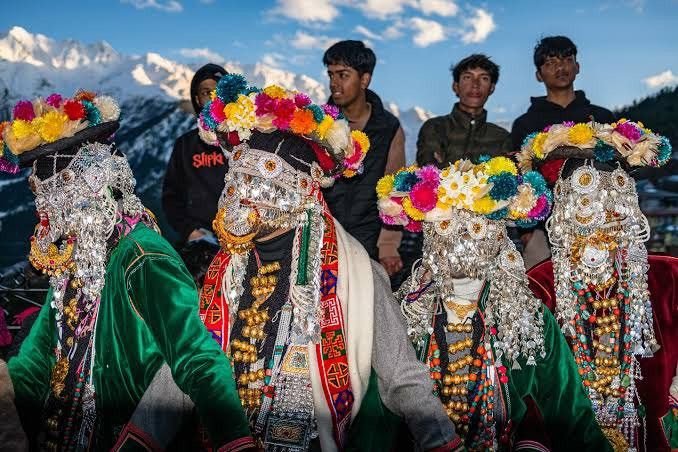
At the heart of Raulane are two men chosen from the local community to represent a symbolic couple, the groom is called “Raula” and the bride is called “Raulane”. This pairing is not about actual marriage but about representing the spirit world: the Raula and Raulane become vessels for the Saunis, acting as a bridge between humans and the guiding entities. They are chosen by the elders of the community, often selecting from different “saring” (neighbourhood clusters), giving every part of the village a chance to be represented.
On the day of the festival, the two undergo a profound transformation. Costumes worn during Raulane are rich and immersed in tradition. The Raula dresses in thick Kinnauri woollen garments, layered to protect him from the biting cold. The most important and popular scene is his face: covered with a red cloth, his head is veiled, hiding his identity so fully that he is no longer seen as an ordinary man but as a spiritual figure with no face representing an anonymous identity held by the Saunis, colour, or structure. The Raulane is also played by a man, but he dons the traditional women’s dress of Kinnaur: a doru (shawl), a choli, and a waist-shawl called a pattu or gachchi. Her headgear is particularly striking, an elaborate floral crown made of locally sacred blossoms like Chamka, Narkasang, or Bakhri Kan. She is heavily adorned in jewellery, and every inch of skin is hidden and similarly, her face is masked, and her hands are covered by gloves. This concealment of identity is not merely general; it is deeply symbolic to the existence of the Spirits. By hiding their individual selves, Raula and Raulane leave their human identity and become living embodiments of the Sauni spirits. Their anonymity and costumes allow villagers to see them not as humans, but as messengers, as a bridge to the divine realm.
One of the central moments of Raulane is the procession to the Nagin Narayan Temple, a revered temple in Kinnaur where local deities are worshipped. Raula and Raulane enter the temple’s courtyard, accompanied by drumming, chanting, and a gathering of villagers to celebrate this occasion. There, they perform a deliberately slow, meditative dance, unhurried and every movement charged with meaning and a message. This dance is not at all for entertainment; rather, it is a ritual, a channel through which humans communicate with the Saunis. The dance is often described as a “farewell,” and as the festival comes to a closing end, the Raula and Raulane’s movements signal the return of the Saunis to their mountain meadows. After the dance, the village elders lead the final prayers, invoking blessings for the year ahead: protection, good harvests, health, and harmony. The Raulane Mela is layered with meanings. On one level, it is a gratitude and a communal expression of thanks to the Saunis, who are believed to protect the villagers during winter. On another, it is farewell to the Saunis as they are not permanent residents, and as the seasons change, they would return to their high meadows; this is how Raulane helps mark this transition.
The representative marriage of Raula and Raulane shows a deeper metaphysical idea, the union of masculine and feminine, the human and the cosmic, the physical and the spiritual. Moreover, the festival suggests the close relationship between the people of the Kinnauri communities. In a land where nature can be both harsh and gentle, the Saunis represent a spiritual ecology — beings of frost and moonlight, when their presence both protects and inspires us.
In recent years, Raulane has caught widespread attention, especially on social media. Especially the photographs of masked dancers in traditional attire, dancing in the stark Himalayan light, have gone viral, sparking fascination. Media outlets have highlighted the festival, wondering at its ancient origins and deep spiritual symbolism. Despite its newfound visibility, Raulane retains its authenticity. Unlike many cultural traditions that evolve into tourist interest, the selection of Raula and Raulane, the dance, the masks — these are not performed for outsiders, but for the Saunis, and for the villagers’ spiritual continuity.
As Raulane becomes more visible, questions arise about its preservation. With tourism increasing and social media shining a spotlight, there’s always the risk that the festival could become commodified. Maintaining its sacredness will require balance: welcoming outsiders and sharing its beauty, while protecting the integrity of its religious meaning. Still, there are reasons for optimism. The renewed attention brings greater respect, more people are learning about Kinnaur’s rich cultural heritage, and local communities are gaining recognition for their culture and traditions. The festival’s existing strength over millennia, through harsh winters, changing times, and external pressures, suggests resilience and a deep-rooted commitment to identity and spirituality.
What makes Raulane so enchanting is that it is ancient yet alive; mystical yet rooted; deeply symbolic yet expressed humanly, in communal ways. Watching the Raula and Raulane perform their slow dance under heavy wool, masked and unrecognizable, one can sense the veil between this world and another gently lifting. So that on the heights Himalayas, culture is not just a performance but a prayer, a memory, and maybe a promise. In this age where many traditions are fading or being recreated for fun and convenience, Raulane stands as a testament to endurance. It is both a farewell and a welcome, an homage to the Saunis leaving, and an affirmation that their spirit, and the spirit of the mountains, lives on in the people of Kinnaur.